SFP+ Fiber Optic Connectors (SC vs LC, APC vs UPC), Single-Mode vs Multi-Mode & Switch Cable Sizing Guide
Why SC-receptacle SFP+ modules (GPON/XGS-PON ONU sticks and single-fiber BiDi optics) have taken over modern homelabs and offices—and how to match OS2 Single-Mode, OM3/OM4 Multi-Mode, passive DAC Twinax, and low-power 10GBASE-T transceivers to your switch without frying cages or crushing ceramic ferrules.
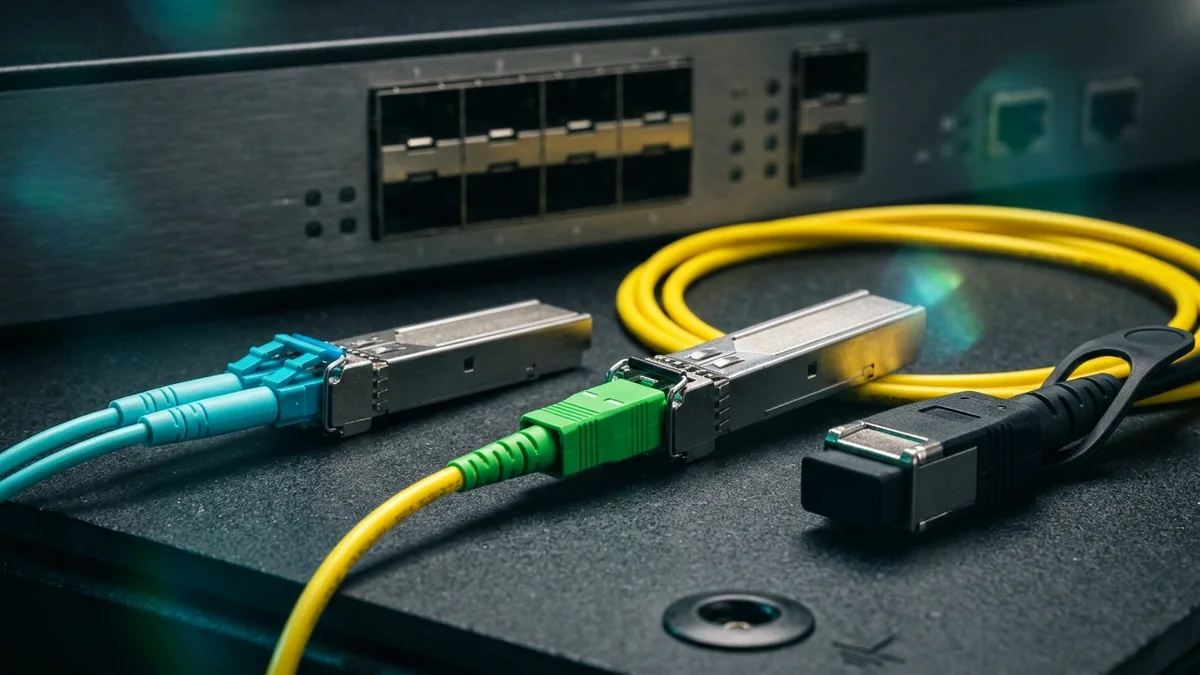
Affordable 2.5GbE switches with 10G SFP+ uplink cages have brought data-center bandwidth below £60—yet the empty rectangular metal slots on the front of the switch remain the single biggest source of costly purchasing mistakes. Every week, builders plug a yellow Single-Mode patch cord into an 850nm Multi-Mode transceiver, jam a flat blue SC/UPC connector into an angled green SC/APC GPON module, or bake a silent fanless switch to death with two legacy 10GBASE-T copper sticks.
⚡ Interactive SFP+ Transceiver & Switch Cable Matcher
Select your connection scenario and switch brand below. All optical calculations run 100% locally in browser RAM and generate an exact, zero-mismatch parts list.
1. SFP (1G) vs SFP+ (10G) vs SFP28 (25G): Same Cage, Different Physics
Mechanically, SFP (1 Gbps), SFP+ (10 Gbps), and SFP28 (25 Gbps) modules share the exact same physical footprint (13.4 mm wide) and latch mechanism. Electrically, however, their SerDes lanes are completely different:
- 10G SFP+ module in an older 1G SFP switch port: Will NOT work (except rare dual-rate
1G/10Goptics). Standard 10GBASE-SR/LR lasers cannot clock down to 1.25 Gbaud. - 1G SFP module inside a 10G SFP+ switch port: Usually works, but often requires manual speed forcing (
1000baseX Full-Duplex, auto-negotiation disabled) in your switch GUI or RouterOS CLI because many cheap 2.5G+10G switches default their SFP+ SerDes strictly to10Gbps. - 2.5G HSGMII (
2500baseX) Warning for ISP GPON Sticks: Many ISP fiber ONU sticks sync at2.5 Gbps(HSGMII) rather than1 Gbpsor10 Gbpsso you can get full1.2–2.0 Gbpsfiber broadband speeds. Verify your switch or router SFP+ cage explicitly supports2.5G Base-Xclock rates (MikroTik CRS310, Ubiquiti Cloud Gateway Fiber, and select Realtek RTL930x switches do; basic unmanaged switches often only sync at1Gor10G!).
2. Single-Mode (OS2) vs Multi-Mode (OM3 / OM4): Never Mix Yellow and Aqua
Optical fiber is divided into two incompatible physical families defined by the diameter of the microscopic glass core carrying the light pulse:
🔬 Core Diameter & Jacket Color Cheat-Sheet
- Single-Mode Fiber (
OS2— Yellow Jacket,9/125 µmCore): Uses a razor-thin 9-micron glass core driven by narrow-spectrum1310 nmor1550 nmFabry-Pérot / DFB lasers (10GBASE-LR,BiDi,GPON). Zero modal dispersion allows a single cheap10GBASE-LRmodule to span anywhere from 2 meters to 10 kilometers (no attenuator needed on modern 10km LR optics!). - Multi-Mode Fiber (
OM3Aqua /OM4Violet or Aqua Jacket,50/125 µmCore): Uses a 5.5x wider 50-micron core driven by inexpensive850 nmVCSEL light sources (10GBASE-SR). Ideal for indoor runs up to 300m (OM3) or 400m (OM4). Avoid legacy orangeOM1/OM2cables—they choke 10GbE beyond 26–33 meters. - What happens if you mix them? Plugging a yellow
9 µm OS2cable into an850 nm Multi-Mode SRtransceiver drops over 85%–95% of the optical launch power at the ferrule boundary because the wide 50-micron beam misses the tiny 9-micron core. Always matchSR (850nm) ↔ OM3/OM4andLR / BiDi (1310nm) ↔ OS2.
3. LC vs SC Connectors & The Fatal APC (Green) vs UPC (Blue) Polish Trap
Choosing the right connector comes down to two independent specifications: 1. Housing Size (LC vs SC) and 2. Ceramic Ferrule End-Face Angle (UPC vs APC).
LCConnector (Lucent Connector —1.25 mmferrule): Compact snap-latch plug. Because it is half the width of SC, two fibers (TX + RX Duplex) fit side-by-side into a single SFP+ module. Standard on10GBASE-SRand10GBASE-LR.SCConnector (Subscriber Connector —2.5 mmferrule): Larger square push-pull plug used universally by FTTH broadband providers (BT Openreach, CityFibre, Orange, Play, Netia) and single-fiber Simplex SFP/SFP+ transceivers.
⚠️ CRITICAL HARDWARE WARNING: Never Plug Blue (UPC) Into Green (APC)!
The plastic boot and housing color on Single-Mode fiber is not cosmetic—it encodes the physical grind angle of the zirconia ceramic tip:
- Blue =
UPC(Ultra Physical Contact,0°Flat/Domed Polish): Standard on enterprise switches (LC/UPCon10GBASE-LRand mostBiDimodules). Reflected light bounces straight back down the core (~ -50 dBreturn loss). - Green =
APC(Angled Physical Contact,8°Beveled Polish): Mandatory on passive optical ISP networks (GPON,XGS-PON, FTTH wall boxes). The 8-degree bevel deflects back-reflections harmlessly into the fiber cladding (< -60 dBreturn loss). - The Disaster Scenario: If you force a flat blue
SC/UPCplug into an angled greenSC/APCsocket, only the sharp outer edge of the 8-degree tip touches the flat ferrule—crushing microscopic glass/ceramic shards into the core and creating an air gap with4–8 dBsignal loss. Need to bridge an ISPSC/APCwall socket to anLC/UPCswitch transceiver? Use a factory-terminated HybridSC/APC(Green) toLC/UPC(Blue) OS2 Patch Cord!
4. Why SFP+ Modules with SC Connectors Are Exploding in Popularity
Historically, almost every switch transceiver used dual LC ports. Today, Simplex SC-receptacle SFP and SFP+ sticks are among the best-selling networking components on Amazon. Why? Because a single 2.5 mm SC barrel fits cleanly inside an SFP+ cage whenever transmit and receive share one single fiber strand via Wavelength Division Multiplexing (WDM):
10G SFP+ BiDi (Bidirectional WDM) Simplex SC & LC Transceivers
How it works: Module A transmits at 1270 nm and listens at 1330 nm, while Module B transmits at 1330 nm and listens at 1270 nm through an internal WDM prism filter. That means you get full-duplex 10 Gbps over a single simplex SC-to-SC OS2 patch cord—cutting fiber cabling bulk in half and letting you plug pre-terminated SC wall runs directly into your switch without SC-to-LC adapter pigtails. Golden Rule: Always buy BiDi modules in matched Side A + Side B pairs!
GPON & XGS-PON ONU SFP / SFP+ Sticks (SC/APC Green Receptacle)
Why enthusiasts love it: Instead of powering a separate plastic ISP ONT box on the wall, advanced users unplug the green SC/APC fiber patch lead from the ISP terminal and plug it straight into a programmable GPON (2.5G) or XGS-PON (10G) ONU SFP+ stick inside a Ubiquiti Gateway, MikroTik router, or OPNsense firewall. Engineering Warning: Unlike passive dumb transceivers, an ONU stick contains a full Linux/MIPS SoC inside the SFP shell and runs at 60°C–72°C—attach stick-on copper SFP heatsinks and verify your ISP allows PLOAM/SN authentication before ordering!
5. Choosing the Right Cable for Your Switch by Distance & Thermal Budget
Before buying optical glass, measure your cable run. Over-specifying optics wastes money and adds unnecessary failure points, whereas forcing 10GbE over copper RJ45 inside a fanless switch can trigger thermal throttling:
📊 SFP+ Transceiver & Cable Buying Matrix (Amazon UK)
| Component & Standard | Ideal Distance | Connector / Fiber | Power / Temp | Check Stock |
|---|---|---|---|---|
| 10Gtek 10G SFP+ Passive DAC Twinax Direct Switch ↔ NAS / Server link |
0.5m – 3m | Integrated SFP+ (Copper AWG30) | 0.1W (30°C) | View Amazon ↗ |
| 10GBASE-SR SFP+ 850nm Multi-Mode Indoor room-to-room homelab standard |
2m – 400m | Duplex LC/UPC (Aqua/Violet OM4) | 0.6W (42°C) | View Amazon ↗ |
| 10GBASE-LR SFP+ 1310nm Single-Mode Future-proof 10G/25G/100G OS2 glass |
2m – 10km | Duplex LC/UPC (Yellow OS2) | 0.8W (46°C) | View Amazon ↗ |
| 10G BiDi WDM SFP+ Pair (SC Simplex) 1270nm/1330nm matched A+B single-fiber pair |
2m – 10km | Simplex SC/UPC (1-Strand OS2) | 0.9W (48°C) | View Amazon ↗ |
| Armored OS2 SC/APC & Hybrid LC-SC Patch Cords Crush-resistant G.657.A2 bend-insensitive fiber |
1m – 50m | SC/APC (Green) or LC/UPC–SC/APC | Passive 0W | View Amazon ↗ |
| OM4 LC-to-LC Duplex Multi-Mode Patch Cable LSZH low-smoke jacket for 10GBASE-SR |
1m – 30m | Duplex LC/UPC (50/125µm OM4) | Passive 0W | View Amazon ↗ |
| Low-Power 80m/100m 10GBASE-T SFP+ to RJ45 Modern Broadcom/Realtek 1.8W multi-rate 1G/2.5G/5G/10G |
Up to 80m | RJ45 Female (Cat6a Shielded) | 1.8W (65°C) | View Amazon ↗ |
| One-Click Optical Ferrule Cleaner Pen (1.25mm & 2.5mm) 800+ cleans for LC (1.25mm) or SC (2.5mm) ports |
Lab Essential | 1.25mm (LC) / 2.5mm (SC) | Mechanical | View Amazon ↗ |
6. Two Hidden Traps: Vendor EEPROM Locks & Dirty Ferrules
- OEM EEPROM Coding (
Intel X520/X710&Cisco): Most 2.5GbE/10G homelab switches (MikroTik, TP-Link, QNAP, Zyxel, BrosTrend, Ubiquiti) accept universal Open MSA transceivers out of the box. However, Intel server NICs (such as theX710inside the Minisforum MS-01 orX520-DA2cards) reject non-Intel optics unless you buy an Intel-coded SFP+ module on the Amazon dropdown menu (or passixgbe.allow_unsupported_sfp=1in Linux GRUB). - Microscopic Skin Oil Destroys 10GbE Links: A single
9 µmSingle-Mode core is ten times thinner than a human hair. Never touch the white ceramic tip of a patch cord—even a brand-new sealed cable can carry static dust from its plastic cap. One click with a1.25 mm(LC) or2.5 mm(SC) dry-cloth cleaner pen prevents mysteriousCRCframe errors and link flaps.