The Engineer’s SSD Hierarchy: Top 10 Best NVMe & SATA Drives Ranked by Silicon, DRAM & Real-World TBW
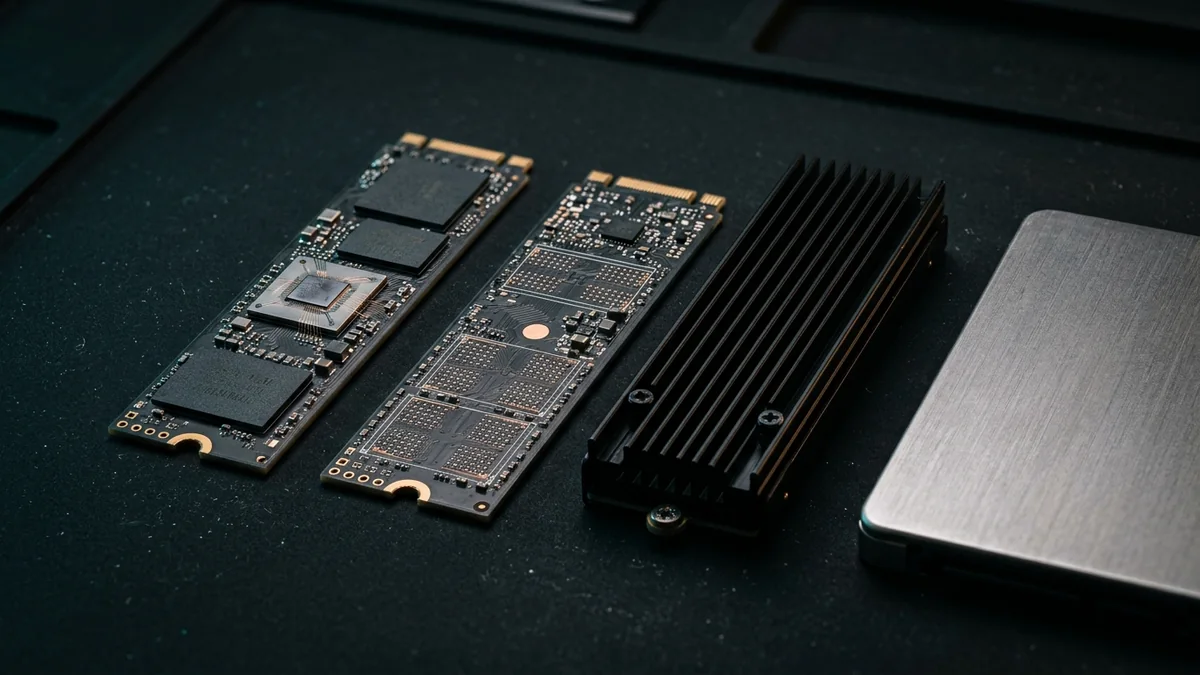
Marketing brochures love advertising theoretical 7,500 MB/s burst speeds while silently substituting cheap 4-bit QLC NAND and stripping hardware DRAM cache. In sustained enterprise workloads, 4K video rendering, and heavy gaming, poorly engineered SSDs crash to slower speeds than 15-year-old mechanical hard drives. Here is the verified 2026 hardware engineering ranking of the Top 10 SSDs that actually survive prolonged bench torture.
- Rule 1: Always demand 3-bit TLC NAND over 4-bit QLC: QLC memory suffers catastrophic write cliff drops (collapsing to ~80 MB/s once the pseudo-SLC buffer fills) and has 3x lower write endurance (TBW).
- Rule 2: Never run your OS drive without DRAM or robust HMB: A dedicated LPDDR4/DDR4 DRAM cache keeps the flash translation table (FTL) in memory, preventing system micro-stutters during random 4K writes.
- Rule 3: Beware of silent NAND revisions: Manufacturers frequently launch a drive with high-grade controllers and quietly downgrade components 6 months later. Every drive below is selected for verified architectural stability.
Why Paying an Extra £20–£40 for Tier-1 Storage Yields Maximum Optimization (The Hidden Costs of Cheap SSDs)
When configuring a PC or upgrading a laptop, buyers often cut £25 from the storage budget to spend on a flashy RGB cooler or slightly faster RAM. In real-world engineering benchmarks, this is the single most expensive mistake in modern PC building. A mediocre SSD degrades your entire system into an unresponsive bottleneck, regardless of how fast your CPU or GPU is. Here is why investing in tier-1 silicon pays for itself tenfold:
1. The 80 MB/s "Write Cliff" Trap
Cheap QLC drives advertise "5,000 MB/s" using a temporary dynamic pseudo-SLC cache. Once you transfer a 120GB game, a 4K video reel, or a large database, the cache exhausts and write speeds crash down to 60–90 MB/s (slower than a mechanical HDD!). Tier-1 TLC drives like the Samsung 990 PRO and WD_BLACK SN850X sustain 1,800 to 3,800 MB/s of continuous direct-to-die writing indefinitely.
2. Zero Micro-Stutter (Hardware DRAM)
The Flash Translation Layer (FTL) maps every block on the SSD. Drives with dedicated LPDDR4 DRAM keep this map in hardware memory with 0.05ms latency. DRAM-less budget drives must request memory over the PCIe bus; under heavy multi-tasking, compiling, or gaming, this causes 200ms–800ms I/O latency spikes that make Windows and games hitch or freeze.
3. Thermal Throttling Immunity
Budget controllers built on legacy 28nm/40nm nodes run scorching hot, hitting 80°C within 45 seconds of heavy load and cutting bandwidth by 70%. Tier-1 drives use 8nm/12nm controllers with nickel-plated heat spreaders and copper heat-dissipating labels that remain stable under prolonged workloads without throttling.
4. 10-Year Longevity Across 3 PCs
High-end TLC NAND offers 1,200 to 1,600 TBW (Terabytes Written). Even if you write 50GB of new data every single day, a 1,600 TBW drive will take 87 years to exhaust its silicon. A £140 flagship drive will migrate seamlessly across your next three laptop or PC upgrades over the next decade, costing less than £14/year for flawless speed.
| Engineering Metric | Cheap Budget SSD (£50–£75) | Tier-1 Flagship SSD (£105–£145) |
|---|---|---|
| NAND Flash Type | 4-bit QLC (Slow & Fragile) | 3-bit TLC (High Speed & Durable) |
| Sustained Write (Post-Cache) | Collapses to 60–120 MB/s | Maintains 1,800–3,800 MB/s |
| DRAM Cache | None (DRAM-less, high latency) | 1GB–4GB LPDDR4 / DDR4 Onboard |
| Write Endurance (2TB) | 400–600 TBW | 1,200–1,600 TBW (3x longer life) |
| DirectStorage & 4K IOPS | Slow queue depth latency | Sub-1-second game loads (Game Mode 2.0) |
⚡ Interactive Master SSD Comparison Engine
| Rank & Model | Interface | NAND & Controller | DRAM Buffer | Read / Write | TBW (2TB) | Deal Link |
|---|---|---|---|---|---|---|
| #1 Samsung 990 PRO | PCIe 4.0 x4 | 176L TLC • Pascal ARM | 2GB LPDDR4 | 7,450 / 6,900 MB/s | 1,200 TBW | Check Deal ↗ |
| #2 WD_BLACK SN850X | PCIe 4.0 x4 | BiCS5 TLC • SanDisk 20-82 | 2GB DDR4 | 7,300 / 6,600 MB/s | 1,200 TBW | Check Deal ↗ |
| #3 Crucial T500 | PCIe 4.0 x4 | 232L TLC • Phison E25 | 2GB LPDDR4 | 7,400 / 7,000 MB/s | 1,200 TBW | Check Deal ↗ |
| #4 Lexar NM790 | PCIe 4.0 x4 | 232L TLC • Maxio MAP1602 | DRAM-less (64MB HMB) | 7,400 / 6,500 MB/s | 1,500 TBW | Check Deal ↗ |
| #5 Kingston KC3000 | PCIe 4.0 x4 | 176L TLC • Phison E18 | 2GB DDR4 | 7,000 / 7,000 MB/s | 1,600 TBW | Check Deal ↗ |
| #6 Crucial T705 (Gen5) | PCIe 5.0 x4 | 232L TLC • Phison E26 | 2GB LPDDR4 | 14,500 / 12,700 MB/s | 1,200 TBW | Check Deal ↗ |
| #7 WD Blue SN580 | PCIe 4.0 x4 | 112L TLC • SanDisk In-House | DRAM-less (64MB HMB) | 4,150 / 4,150 MB/s | 900 TBW | Check Deal ↗ |
| #8 Kioxia Exceria G2 | PCIe 3.0 x4 | 96L TLC • Kioxia TC58 | 1GB DDR4 | 2,100 / 1,700 MB/s | 800 TBW | Check Deal ↗ |
| #9 Crucial MX500 | 2.5" SATA III | 176L TLC • SM2258 | DDR3 DRAM + PLP | 560 / 510 MB/s | 700 TBW | Check Deal ↗ |
| #10 Samsung 870 EVO | 2.5" SATA III | 128L TLC • Samsung MKX | 2GB LPDDR4 | 560 / 530 MB/s | 1,200 TBW | Check Deal ↗ |
Samsung 990 PRO NVMe M.2 SSD (1TB / 2TB / 4TB)
The unrivaled king of random 4K read/write latency. Built on in-house Samsung Pascal (S4LV008) controller with dedicated LPDDR4 cache and class-leading thermal throttle defense.
Lab Verdict: Ideal for professional video workstations, engineering simulation, and high-end desktop gaming. For desktop PCs and PS5, get the Heatsink Edition ↗.
WD_BLACK SN850X NVMe SSD (1TB / 2TB / 4TB)
Western Digital's flagship gaming storage powered by in-house SanDisk 20-82-20035-B2 controller. Delivers the lowest queue-depth latency in real-world game level loading.
Lab Verdict: The fiercest rival to the 990 PRO. Game Mode 2.0 optimizes pre-loading algorithms for DirectStorage games. Exceptional thermals that do not throttle prematurely.
Crucial T500 NVMe M.2 SSD (1TB / 2TB)
Built with Micron's cutting-edge 232-layer TLC NAND paired with a 4-channel Phison PS5025-E25 controller. Matches 8-channel drives in throughput while consuming 35% less power.
Lab Verdict: The absolute best PCIe 4.0 drive for laptops where thermal limits and battery life are paramount. Runs substantially cooler than 8-channel competitors.
Lexar NM790 NVMe M.2 SSD (1TB / 2TB / 4TB)
The undisputed king of DRAM-less Host Memory Buffer (HMB) architecture. Powered by Maxio MAP1602A controller and 232-layer YMTC 3D TLC flash. Zero heat choke, massive endurance.
Lab Verdict: Proves that a modern 4-channel controller using 64MB of host RAM via HMB can outperform hot DRAM drives in laptops while maintaining a monstrous 1,500 TBW rating.
Kingston KC3000 PCIe 4.0 NVMe SSD (1TB / 2TB / 4TB)
The 8-channel Phison PS5018-E18 tank. Features a graphene aluminum heat spreader and a punishing 1,600 TBW write endurance rating designed for high-bitrate ProRes/RAW video editing.
Lab Verdict: Unlike budget drives whose write speed craters to 150 MB/s once the SLC cache exhausts, the KC3000 maintains a blistering 3,800 MB/s sustained direct TLC write speed.
Crucial T705 PCIe 5.0 NVMe SSD (14,500 MB/s)
The fastest consumer storage drive in existence. Powered by the Phison PS5026-E26 controller pushing PCIe 5.0 x4 bandwidth to its theoretical limits.
Lab Verdict: Strictly for high-end Z790/X670E motherboards with PCIe 5.0 M.2 slots. Requires substantial airflow or dedicated motherboard heat sinks to prevent thermal throttling.
WD Blue SN580 NVMe SSD (1TB / 2TB)
Western Digital's rock-solid budget champion. Avoids dodgy third-party controllers by pairing in-house SanDisk silicon with reliable BiCS5 TLC NAND.
Lab Verdict: The safest £50–£90 upgrade for office computers, secondary game drives, and students who want genuine Western Digital reliability without paying flagship prices.
Kioxia Exceria G2 NVMe M.2 SSD (1TB / 2TB)
The only remaining sub-£50 drive on the market that includes a dedicated DDR4 DRAM cache chip alongside genuine Japanese BiCS TLC flash.
Lab Verdict: While limited to PCIe 3.0 speeds, its onboard DRAM cache makes it significantly smoother for OS booting and random multitasking than flashy Gen4 QLC drives that lack DRAM.
Crucial MX500 2.5" SATA III SSD (500GB / 1TB / 2TB / 4TB)
The golden standard for reviving older laptops, desktop towers, and home NAS servers. Includes hardware DRAM cache and Power Loss Immunity capacitors.
Lab Verdict: The single most reliable SATA drive ever engineered. If your motherboard lacks M.2 slots or your laptop is from 2012–2018, this transforms sluggish hard drives into lightning-fast machines.
Samsung 870 EVO 2.5" SATA III SSD (1TB / 2TB / 4TB)
Samsung's benchmark SATA drive powered by the MKX Metis controller and V-NAND TLC. Maximum saturation of the SATA III bus with enterprise longevity.
Lab Verdict: The definitive choice for enterprise NAS bays, CCTV servers, and mission-critical legacy workstations requiring hardware-level AES-256 BitLocker encryption.
Engineering Summary: Which Drive Should You Choose?
- Best Uncompromising Performance: Samsung 990 PRO ↗ or WD_BLACK SN850X ↗.
- Best for Laptops & Low Temperatures: Crucial T500 ↗ or Lexar NM790 ↗.
- Best for Budget Daily Upgrades: WD Blue SN580 ↗.
- Best for Reviving Older PC / Laptops: Crucial MX500 2.5" SATA ↗.