Energy Sub-Meters, Smart Meter Overbilling & Grid Harmonics Guide: MID DIN-Rail vs CT Clamp Auditing, Rogowski Coil current-spike Errors & THD Filtering
Why do thousands of homeowners, homelab operators, and commercial warehouse managers watch their electricity bills jump by 25% to 60%+ immediately after a utility company replaces their old spinning aluminum Ferraris disk meter with a digital Smart Meter? This engineering guide dissects the documented physics of Rogowski coil current-spike saturation, 3rd-order triplen harmonics (150 Hz), and capacitive reactive power (kvarh)—and shows you how to audit your distribution board with MID Class B DIN-rail sub-meters, isolate noisy branch circuits with split-core CT clamps, and clean up your waveform using 2-stage LC EMI filters and Active PFC power supplies.
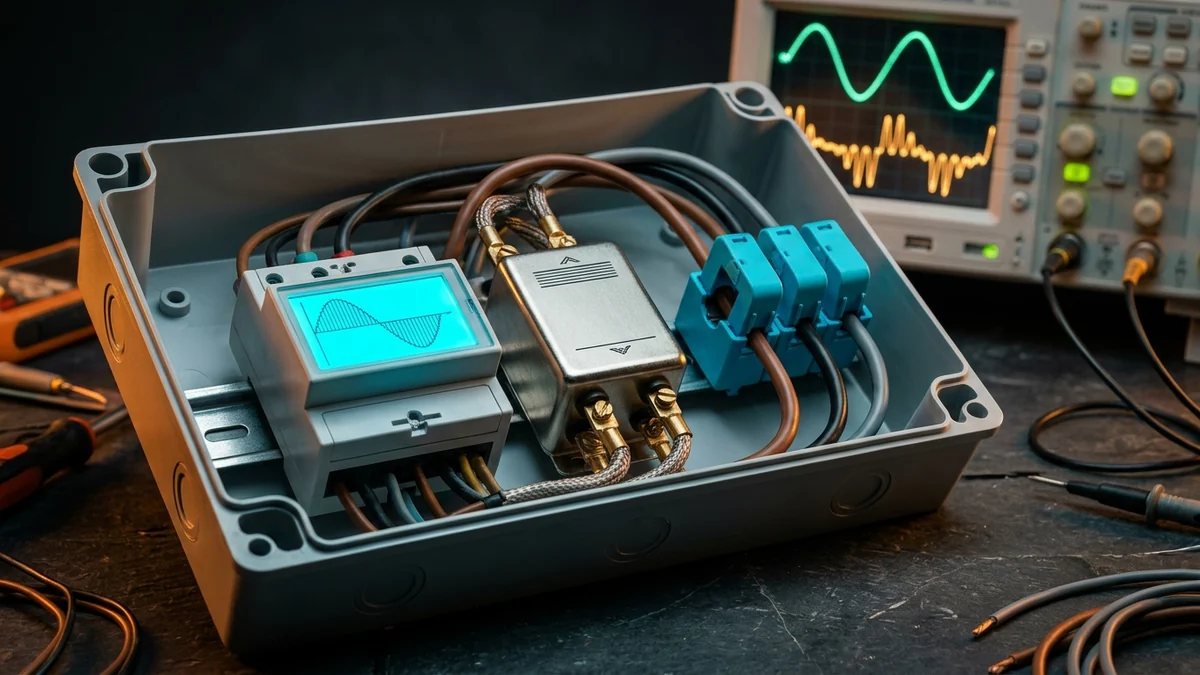
If you have recently had an old electromechanical induction meter (with the spinning aluminum Ferraris disk) swapped for a modern static electronic Smart Meter (such as a UK SMETS1 / SMETS2 meter or a Polish/EU AMI smart meter from Tauron, PGE, Enea, or Energa)—or if you manage a commercial warehouse, office, or homelab filled with switch-mode power supplies (SMPS), LED lighting, solar inverters, EV chargers, or infrared heating—you may have noticed an alarming phenomenon: your billed kilowatt-hours (kWh) suddenly jumped by 20% to 50%+, even though your actual electrical habits did not change at all.
When you phone your electricity supplier to complain, customer support reads from a script: "Your old mechanical meter was simply running slow due to age, and the new Smart Meter is 100% certified." Yet peer-reviewed electrical engineering research proves that this explanation is frequently false.
Building on our Tuya & Zigbee 3.0 Smart Home Guide, our Infrared Heating & Smart Thermostat Guide, and our ATX 3.1 Power Supply & Transient Physics Guide, this deep-dive pillar explains why static smart meters systematically over-read distorted non-linear currents, how to catch an overbilling utility meter red-handed with a MID-certified DIN-rail reference sub-meter, and how to physically clean up the harmonic pollution inside your building so you stop paying for phantom energy.
🔴 THE PROBLEM: Why Smart Meters Overbill
- Rogowski Coil current-spike Saturation: Many static smart meters measure current derivative (air-core sensor coil). Steep microsecond current spikes from cheap SMPS, LED drivers & dimmers saturate the integrator, causing +20% to +580% over-reading (Univ. of Twente IEEE study).
- Apparent (
kVA) vs Active (kW) Confusion: Low-cost ADC frontends alias high-frequency switching noise (10–150 kHz) into the50 Hzactive billing register. - 3rd-Harmonic (
150 Hz) Neutral Heating: Triplen harmonics sum in the Neutral wire , burning real resistive heat in your walls after the meter!
🔵 THE AUDIT: Two-Tier Sub-Metering
- Tier 1 — Main Board Reference (
MID Class B ±1%): Install an inlineEastron SDM120-MID(1-Ph) orSDM630-MID / Shelly Pro 3EM(3-Ph) right after your main isolator to log legal-grade ActivekWhvs Reactivekvarh&PF. - Tier 2 — Branch Circuit Forensics (
CT Clamps): ClipTuya Zigbee 80AorShelly EMsplit-core CT clamps onto individual MCB circuits in 60 seconds without disconnecting wires. - Formal Utility Dispute: Use a 30-day MID comparison log to demand an official Ofgem / OSD laboratory check-meter test.
🟢 THE CURE: 4-Stage Harmonics & EMI Fix
- 1. Passive 2-Stage
LC EMI Filters: Install aSchaffner FN2060 / FN2090low-pass filter on noisy circuits to block10 kHz–30 MHzEMI and smooth steep current-spike slopes before the utility meter. - 2. Upgrade to
Active PFC(PF > 0.98): Replace passive-rectifier LED/DC bricks (PF ~0.48) withMean Well Active PFC&80 PLUS Gold/Titaniumsupplies. - 3. Galvanic Standby Cutoff: Use Tuya DIN relays to physically disconnect idle
X2capacitors at night (0.00 kvarh).
⚡ Interactive Smart Meter Overbilling, Harmonics (THD / PF) & Filter Sizing Auditor
ROGOWSKI current-spike DRIFT • TRUE PF vs kVA • MID + SCHAFFNER BOM
Select your building's primary electrical load profile, monthly billed consumption, meter sensor type, and harmonic duty factor below to calculate estimated Rogowski-coil current-spike overbilling drift (%), phantom excess kWh & resistive cable losses, B2B reactive power (kvarh) penalty exposure, and generate a ready-to-copy Home Assistant / Modbus Sub-Meter & Anomaly Alert Blueprint:
1. Why Some Smart Meters Overbill: A Simple, Everyday Explanation (The University of Twente Study)
For over a century, homes and businesses were billed by the classic electromechanical induction meter—the old meter with the spinning aluminum disk. Because that heavy aluminum disk had physical inertia, it acted like a flywheel: it turned only in response to steady, genuine 50 Hz working electricity and completely ignored microsecond electrical noise spikes from modern electronics.
Everything changed when utilities rolled out millions of low-cost electronic Smart Meters (SMETS1 / SMETS2 in the UK, AMI in Poland and the EU). In a famous study conducted by Professor Frank Leferink's team at the University of Twente, researchers tested certified modern smart meters under everyday household loads consisting of LED bulbs, dimmer switches, and switch-mode power supplies. The findings surprised everyone:
🔬 Why Smart Meters Using Rogowski Coils Can Over-Read by +47% to Several Times Higher
Inside electronic smart meters, manufacturers use different types of current sensors. The most reliable meters use a solid metal resistor called a Manganin shunt. However, many smart meters use a cheaper air-core sensor coil called a Rogowski Coil. In the University of Twente tests, smart meters built with a Rogowski coil consistently over-billed by +47% to several times actual consumption when powering clusters of LED lamps, dimmers, and chargers! Here is why that happens in plain English:
- A Kettle Draws Smooth Current, While Cheap LED Drivers "Gulp" Current in Sharp Spikes: When you boil a kettle or run a heater, electricity flows smoothly through the wire. By contrast, a cheap switch-mode power supply without Power Factor Correction (PFC)—found inside budget LED bulbs, floodlights, LED strip adapters, and phone chargers—does not draw electricity smoothly. Instead, it "gulps" electricity in razor-sharp, millisecond bursts 100 times every second.
- How Those Spikes Fool the Meter's Sensor: A Rogowski coil does not measure steady current directly—it reacts to how suddenly current jumps. When dozens of cheap LED drivers and chargers in a house or warehouse gulp current in sharp spikes, the meter's internal electronics get overwhelmed and mistakenly count that high-frequency electrical noise as real kilowatt-hours (
kWh) on your bill!
2. Active Power (W) vs Apparent Power (VA) & Harmonics — The "Mug of Beer with Foam" Analogy
You don't need complex math to understand the difference between real power and electrical distortion. The easiest way to picture it is a mug of beer:
Total Mug (Apparent Power VA) = Liquid Beer (Active Power W — Real Work) + Foam on Top (Reactive Power & Harmonics)
- Active Power (
W/ billed inkWh— "the liquid beer"): The only electricity that actually does useful work: lighting your room, heating water, or running your computer and heat pump. On a residential tariff, this is the only part you should ever pay for. - Reactive Power (
var / kvarh) & Harmonics (THD— "the foam on top"): Cheap LED drivers, filter capacitors in power strips, and standby chargers fill your wiring with "foam"—useless current sloshing back and forth between the street transformer and your fuse box. When half of the current in your wire is foam, your Power Factor (PF) drops from an ideal1.00down to0.50!
🔥 3. The 3-Phase Trap: Why Electrical Noise Heats Up Your Neutral Wire & Triggers Business Penalties
If your home, workshop, or warehouse has a 3-phase (L1, L2, L3 + Neutral N) supply, electrical noise from cheap power supplies (called 3rd-harmonic 150 Hz currents) causes two very expensive problems:
- It Heats Up Your Neutral Wire After the Meter: Under normal, clean 3-phase power, the currents from phases L1, L2, and L3 balance each other out so very little current flows in the Neutral (
N) wire. However, harmonic pulses from single-phase LED drivers and PC power supplies do not cancel out—instead, they add together inside the Neutral wire! That extra current warms up the copper wires inside your walls downstream of the meter, and you pay for that wasted heat on your bill. - Commercial B2B Reactive Power Penalties (
kvarhCharges): On business and warehouse electricity tariffs, utilities charge steep penalties for Capacitive Reactive Power (-kvarh). A warehouse that swaps 200 old lamps for cheap non-PFC LED floodlights often gets hit with huge monthly penalty fees because hundreds of cheap LED capacitors pump "electrical foam" back into the grid 24 hours a day!
2. Two-Tier Sub-Metering Architecture: How to Catch Utility Overbilling & Pinpoint Noisy Circuits
Never call your utility supplier to dispute a smart meter reading empty-handed. If you simply ask them to test their meter without hard evidence, they will charge you an official laboratory inspection fee if their basic resistive bench load test passes. Instead, deploy our Two-Tier Distribution Board Sub-Metering Architecture:
⚖️ Tier 1 (Main Incoming Reference & Legal Audit): Inline MID-Certified DIN-Rail Meters (Class B ±1%)
To prove whether your utility Smart Meter is over-reading due to Rogowski current-spike errors or firmware bugs, have a qualified electrician install a direct-connected, MID-certified (Measuring Instruments Directive 2014/32/EU / UKCA Class B) DIN-rail energy meter in series on your main tails immediately after the main isolator/RCD inside your consumer unit:
- For Single-Phase (
230V 100A) Homes:Eastron SDM120-MID(orSDM230-Modbus-MID— 1 or 2 DIN Modules): Unlike a Rogowski utility meter, a direct-connectedEastron SDM120-MIDroutes the live current straight through a calibrated Manganin resistive shunt, where voltage drop is directly proportional toI(t)(not current-spike!). It integratesu(t) · i(t)thousands of times per second and carries the officialM26(year + 4-digit Notified Body number) metrological seal printed on the casing. - For Three-Phase (
400V 63A–100A) Homes, Homelabs & Warehouses:Eastron SDM630-Modbus-MID V2orShelly Pro 3EM: TheSDM630-Modbus-MIDmeasures all three phases inline (Class B / 1%), displaying Active kWh (Import/Export), Reactive kvarh (Inductive/Capacitive), Apparent kVA, Phase-by-Phase Power Factor (PF), Neutral Current (IN), and Total Harmonic Distortion (THD-I %andTHD-V %) directly on its backlit LCD and viaRS-485 Modbus RTUinto Home Assistant! - How to File an Unbeatable Utility Meter Dispute (UK Ofgem / Polish OSD Procedure):
- Take a timestamped smartphone photograph showing both the Utility Smart Meter register and your MID-certified
Eastron SDM120/630-MIDregister on Day 1 and Day 30. - Export the 30-day
RS-485 Modbus/Shelly Pro 3EMCSV graph showing activekWh,kVAh, andPF. - If the utility meter reads more than
+2.5% to +3.5%higher than your Class B MID sub-meter over 30 days, submit a formal complaint citing MID Class B discrepancy under non-linear domestic loads (EN 50470-3 / IEC 62053-21) and demand an in-situ check-meter install (parallel check meter on your actual household load) rather than a purely sinusoidal resistive bench test!
- Take a timestamped smartphone photograph showing both the Utility Smart Meter register and your MID-certified
🔍 Tier 2 (Non-Invasive Circuit Forensics): Split-Core CT Clamp Smart Meters (Tuya Zigbee / Wi-Fi 80A & Shelly EM)
Once your main MID meter tells you that your house or warehouse has a terrible overall Power Factor (PF = 0.52) or a 280W nighttime phantom draw, how do you find out which of the 14 MCB breakers in your consumer unit is the culprit?
You use Split-Core Current Transformer (CT Clamp) Smart Energy Monitors—such as the Tuya Smart Zigbee 3.0 / Wi-Fi Single- or Dual-Channel 80A CT Clamp Meter or Shelly EM / Pro EM-50:
- Zero Wire Cutting (60-Second Clip-On Forensics): Because the ferrite core of a split-core CT clamp opens on a hinge and snaps shut with a click around an insulated
2.5mm²or6mm²phase wire coming out of an MCB breaker, you can move the clamp from circuit to circuit (Lighting ring, Kitchen sockets, Homelab rack, Garden circuit, Heat Pump) in 60 seconds without disconnecting a single live terminal! - Spotting the "Silent Culprit" Circuits: In the Tuya Smart Life or Home Assistant dashboard, inspect the live Current (
mA / A) vs Active Power (W) vs Power Factor (PF) for each breaker at 03:00 AM when everyone is asleep. If a lighting or outdoor circuit shows0.65 Amps(150 VAof apparent power) but only18Wof active power (PF = 0.12), you have just found a bank of unswitched capacitive LED drivers or EMI filters pumping pure reactive distortion into your utility smart meter 24 hours a day!
📡 2.5 Comparing the 3 Smart Consumption & PV Self-Consumption Ecosystems: Shelly vs Tuya vs Polish Zamel SUPLA (Pszczyna)
Beyond catching utility overbilling, a DIN-rail smart energy monitor is the brain of your real-time consumption tracking and solar self-consumption automation (automatically triggering boilers, infrared heating mats, or EV chargers when surplus power is available or when phase voltage rises toward 253V AC). In European and UK distribution boards, three distinct ecosystems dominate:
- 1.
Shelly(Shelly Pro 3EM,Shelly EM,Shelly Pro 1PM / 4PM— Local Ethernet,Modbus TCP& On-DevicemJS Scripting):- Why Homelab & Proxmox Engineers Love It: The DIN-rail
Shelly Pro 3EM(3× 120Asplit-core CTs, Class B 1% accuracy) features a wiredRJ45 Ethernetport, native localMQTT,Modbus TCP, and an on-device JavaScript (mJS) engine. Even if your Home Assistant server or Wi-Fi router reboots, a script running directly inside theShelly Pro 3EMcan send a direct LAN webhook (http://192.168.1.55/rpc/Switch.Set?id=0&on=true) to aShelly Pro 1PM/4PMcontactor in under50 mswhenever grid export exceeds-1500W!
- Why Homelab & Proxmox Engineers Love It: The DIN-rail
- 2.
Zamel SUPLA(Manufactured in Pszczyna, Poland —MEW-01/MEW-023-Phase 100A/200A CT Monitor &ROW-01/SRW-01Relays):- Why It Is the Gold Standard in Polish & Central European Switchboards: Engineered and manufactured in Pszczyna by Zamel, the 2-module DIN-rail
Zamel SUPLA MEW-01/MEW-02(and 1-phaseLEW-02) runs on the open-source SUPLA ecosystem with both free European cloud telemetry and 100% local nativeMQTTbroker support (zero cloud dependency in Home Assistant). - Built-In
>253V ACGrid Overvoltage Rescue & Vector Balancing:MEW-01 / MEW-02tracks bidirectional Active (kWh), Reactive (kvarh), Apparent (kVAh), Power Factor (PF), and per-phase Voltage (V) with vector/arithmetic balancing. You can set a native SUPLA or MQTT trigger: *"If Voltage on Phase L1, L2, or L3 exceeds250.5V AC(or Export >2.0 kW), immediately close relayROW-01to dump load into the DHW water heater or infrared heating mat"*—preventing your solar inverter from tripping off at253V AC!
- Why It Is the Gold Standard in Polish & Central European Switchboards: Engineered and manufactured in Pszczyna by Zamel, the 2-module DIN-rail
- 3.
Tuya Smart(Zigbee 3.0 & Wi-Fi 80A/120A CT Clamps,63A DIN Breakers&16A Wi-Fi Floor Thermostats):- Why It Wins on Multi-Circuit Granularity & Actuators: While
Shelly Pro 3EMorZamel MEW-01guards the main 3-phase incoming tails,Tuya Zigbee 80A Dual-CTclamps cost a fraction per channel—allowing you to clip individual clamps onto 6 to 12 separate branch breakers (kitchen, server rack, heat pump, garage) and link them directly toTuya Wi-Fi 16A (3600W)infrared underfloor heating thermostats (NTC 10kΩprobe) andTuya 63A DIN-Rail Smart Breakers.
- Why It Wins on Multi-Circuit Granularity & Actuators: While
3. The 4-Step Engineering Protocol to Suppress Grid Harmonics (THD), Smooth Current Spikes & Cut Your Bill
Wait—can you just plug a viral "Electricity Saving Box" from Facebook ads into a wall socket to fix harmonics? NO! Those viral plug-in "power saver" boxes are a complete scam containing nothing more than a tiny 4.7 µF X2 capacitor and a green LED in parallel with the mains—which actually worsens leading capacitive reactive current and increases Rogowski current-spike ringing!
Real electrical engineering requires series inductance (L) and active power factor correction placed between the utility meter and your non-linear loads. Follow this 4-step hardware protocol:
🛡️ Step 1: Install 2-Stage Passive LC EMI / RFI Low-Pass Line Filters (Schaffner FN2060 / FN2090 16A–36A)
Why does a series passive LC EMI line filter stop Rogowski-coil smart meters from overbilling? Because of fundamental inductor physics: the voltage across an inductor is a series inductor physically opposes instantaneous changes in current (current-spike)!
- Why Single-Stage Filters Are Not Enough — Choose 2-Stage (
Schaffner FN2060orFN2090): A 2-stage industrial EMI filter (mounted on a DIN-rail adapter or inside a metal enclosure feeding your server rack, solar/battery inverter auxiliary load, LED driver bank, or workshop sub-board) contains two cascaded common-mode toroidal chokes (L1, L2) plus differential-mode inductance andCX / CYsuppression stages. - Two-Way Protection (
10 kHz – 30 MHzAttenuation + current-spike Edge Rounding): First, it blocks high-frequency switching noise (15 kHz–150 kHzPWM carrier frequencies from inverters, VFD drives, and SMPS) generated inside your home from traveling upstream into the utility smart meter's ADC. Second, the series inductance rounds off the razor-sharp microsecond current spikes of bridge rectifiers—bringing current-spike back inside the linear operating window of the smart meter's Rogowski coil integrator!
⚡ Step 2: Replace Passive-Rectifier Bricks (PF ~0.48, THD > 110%) with Active PFC Power Supplies (PF > 0.98, THD < 5%)
Every cheap non-PFC power supply (PF = 0.45–0.55) draws current in narrow 3.5:1 crest-factor spikes that generate >110% Total Harmonic Distortion (THD-I). Whenever a device runs 8 to 24 hours a day, upgrade its power supply to an Active Power Factor Correction (Active PFC) unit (EN 61000-3-2 Class C / Class D compliant):
- How Active PFC Cleans Your Sine Wave: An Active PFC stage places a high-frequency boost inductor and MOSFET controller right after the input bridge rectifier, forcing the input current
i(t)to follow the exact sinusoidal shape and phase of the50 Hzgrid voltageu(t). The result: Power Factor jumps from0.48to0.98–0.99,THD-Idrops below5%–8%, 3rd-harmonic (150 Hz) neutral currents vanish, and your utility smart meter sees a pure resistive-like sine wave! - Where to Upgrade First:
- 24/7 Homelab Servers, NAS & Workstation PCs: Never use cheap non-certified DC bricks or bargain ATX PSUs. Use 80 PLUS Gold / Platinum / Titanium
ATX 3.1PSUs (see our ATX 3.1 PSU Guide) or genuine enterprise Delta/Lite-On adapters withPF > 0.98. - 12V / 24V Architectural LED Strips, Garden Lighting & DIN-Rail Automation: Replace generic uncertified aluminum "switching power supplies" that lack PFC. Install
Mean Well HLG/ELGseries LED drivers orMean Well NDR / EDR / SDRDIN-rail supplies with built-in Active PFC (PF > 0.95–0.98).
- 24/7 Homelab Servers, NAS & Workstation PCs: Never use cheap non-certified DC bricks or bargain ATX PSUs. Use 80 PLUS Gold / Platinum / Titanium
🔌 Step 3: Galvanic Nighttime Cutoff of Standby X2 Capacitors via Tuya DIN-Rail Smart Breakers / Contactors
Here is a power quality trap that surprises even veteran electricians: suppose you have 40 meters of 24V smart LED strips, garden floodlights, TV media walls, and multi-port USB-C GaN chargers that are switched "Off" via software/app for 18 hours a day. Even when their DC output is off, their primary 230V AC input filter (0.22 µF to 0.68 µF X2 safety capacitors and bridge rectifiers) remains physically connected across Live and Neutral 24/7!
Thirty idle power supplies in a large home or office collectively place ~10 µF to 15 µF of capacitance across the 230V 50Hz line—drawing 0.7A to 1.1A (160–250 VA) of pure 90° leading Capacitive Reactive Current all night long! By installing a Tuya Zigbee DIN-Rail Smart Breaker / Switch (or modular contactor) upstream of non-essential lighting driver banks, workshop benches, and entertainment zones so the 230V live line is physically (galvanically) opened when the room is empty (triggered automatically by your 24GHz mmWave presence sensors), standby reactive current drops to an absolute 0.00 A!
🧲 Step 4: Snap-On MnZn / NiZn Ferrite Cores (Home) & 3%–4% AC Line Reactors (Industrial Warehouse Scale)
- For Home Inverters, EV Leads, Heat Pumps & Server Racks (
Snap-On Ferrite Chokes): Clamp high-permeability Manganese-Zinc (MnZn, effective100 kHz – 30 MHz) and Nickel-Zinc (NiZn,30 MHz – 300 MHz) split ferrite ring cores onto the AC power cords and DC output leads of noisy switching devices (looping the wire twice through a large toroid quadruples the common-mode impedance:Z ∝ N2). This damps high-frequency common-mode ringing before it couples onto your house wiring. - For Commercial Warehouses with VFD Motor Drives, Lifts & HVAC (
3%–4% AC Line Chokes / Active Harmonic Filters): If a 3-phase variable-frequency drive (VFD) or commercial heat pump compressor has aTHD-Iof80%, installing a passive 3-phase3% or 4% Impedance AC Line Reactor(current-spike iron-core choke) in series with the VFD input immediately slashesTHD-Ifrom80%down to~35%, doubles input power factor, and protects your facility from utilitykvarhpenalties!
3.5 Engineering Reference: Utility Smart Meter Sensor Technologies & Formal Dispute Checklist
How do you know whether your utility smart meter is vulnerable to high-frequency current-spike harmonic errors—and what exact metrological data do you need to win a formal billing dispute with your energy supplier or Distribution Network Operator (DNO in the UK / OSD in Poland)? Use our laboratory reference guide below:
🔬 Matrix A: Comparing the 4 Current-Sensing Architectures Inside Utility & DIN-Rail Energy Meters
- 1. Manganin Precision Resistive Shunt (
Eastron SDM120-MID,SDM230-MID, Select Single-Phase Direct Meters):- Physics: Current flows through a low-temperature-coefficient copper-manganese-nickel alloy bar (
~100–250 µΩ). Voltage across the shunt issignal = Rshunt · i(t). - Harmonic & current-spike Behavior: Zero derivative (current-spike) amplification! Because output voltage is directly proportional to instantaneous current
i(t)rather than its derivative, a Manganin-shunt MID meter never suffers from Rogowski integrator clipping on steep LED/SMPS current spikes—making it our #1 reference standard for single-phase (100A) home audits.
- Physics: Current flows through a low-temperature-coefficient copper-manganese-nickel alloy bar (
- 2. Closed-Core / Split-Core Ferromagnetic Current Transformer (
CT, e.g.,Shelly Pro 3EM,Eastron SDM630MCT,Tuya 80A CT):- Physics: Secondary winding around a high-permeability magnetic core terminated by a precision burden resistor.
- Harmonic & current-spike Behavior: Ferromagnetic core bandwidth naturally rolls off ultrasonic
>50 kHzswitching interference, acting as a physical anti-aliasing filter ahead of the metering IC (Analog Devices ADE7880 / ADE7953). Resistant to high-frequency EMI over-reading, provided the core is never exposed to massive DC bias saturation.
- 3. Air-Core Rogowski Coil (
Many SMETS1/SMETS2 & AMI 1-Phase/3-Phase Utility Smart Meters):- Physics: Air-cored coil around the phase conductor (air-core sensor coil) followed by an electronic integrator. Favored by utility meter manufacturers because it cannot be saturated by an external neodymium magnet (
tamper-proof against DC magnets) and is cheap to stamp onto a PCB. - Harmonic & current-spike Vulnerability: HIGH. Because gain rises at
+20 dB/decadewith frequency (V ∝ f), steep microsecond current-spike transitions from phase-cut dimmers, non-PFC bridge rectifiers, and inverter PWM ripples can overdrive the analog integrator stage, producing the+47% to +582%positive billing errors documented by the University of Twente!
- Physics: Air-cored coil around the phase conductor (air-core sensor coil) followed by an electronic integrator. Favored by utility meter manufacturers because it cannot be saturated by an external neodymium magnet (
- 4. Hall-Effect Semiconductor Sensor (
Select Compact Static Meters):- Physics: Measures magnetic flux density
Bdirectly in a semiconductor Hall plate. In the University of Twente study, certain Hall-sensor meters actually under-read (-5% to -56%) on distorted waveforms due to phase-shift lag and non-linear Hall response.
- Physics: Measures magnetic flux density
📋 Matrix B: The 5-Point Evidence Protocol Before Filing a Utility Smart Meter Accuracy Dispute
Before requesting an official meter accuracy test from your UK energy supplier (under the Electricity Act 1989 / Ofgem National Measurement Office Disputed Meter testing) or Polish operator (Tauron / PGE / Enea / Energa — Badanie laboratoryjne licznika), complete this 5-step diagnostic protocol so you never risk paying a wasted test fee:
- Rule Out Post-Meter Earth Leakage & Crossed Circuits First (The "All-MCBs-Off" Test): Switch off your consumer unit's main switch (
Main Isolator OFF) for 30 minutes and watch the utility smart meter's optical pulse LED (1000 imp/kWhor3200 imp/kWh). If the red LED still blinks with your main switch physically OFF, there is a wiring tap or fault between the meter and your consumer unit. - Compare Optical Pulse LED Rate (
imp/kWh) Against a Known2.0 kWPurely Resistive Load: Turn off all other circuits in the house and turn on a single2000Welectric kettle or oil radiator. Using a stopwatch, time the intervalthe time in seconds(in seconds) between impulses on a1000 imp/kWhmeter:P (kW) = 3600 / (imp_per_kWh × Δt_seconds)
If your utility meter measures a pure resistive2000Wkettle with±0.5%accuracy, a conventional utility lab bench test (which only tests pure50 Hzsinusoidal resistive loads!) will declare the meter "100% Fault-Free"—even if it overbills by +40% on your home's non-linear LED/inverter loads! - Log 30 Days of Parallel Data on a Sealed
MID Class BDIN-Rail Sub-Meter (Eastron SDM120-MID / SDM630-MID): When your MID sub-meter shows420 kWhover 30 days while the utility Smart Meter bills545 kWh(+29.7%drift), you now have legally certified Class B metrological proof that the error occurs specifically under your building's real load profile. - Install a 2-Stage
Schaffner FN2060 / FN2090LC Line Filter on the Noisiest Inverter / SMPS Branch: Watch the daily drift between the Utility Smart Meter and your MID Reference Sub-Meter before and after enabling the 2-stage LC filter. If the daily over-reading immediately drops from+28%down to<1%once theSchaffner LCfilter blocks current spikes from reaching the utility meter, you have solved the overbilling on the spot in hardware without waiting 6 months for the utility ombudsman! - Demand an In-Situ Check Meter (Parallel Series Meter) If Disputing: When submitting your MID logs to the supplier or Energy Ombudsman, explicitly state that the suspected fault is EMI / current-spike non-linear waveform interference under EN 50470-3, and request that the supplier install a Check Meter in series at your property (preferably a direct Manganin-shunt or CT-isolated model from a different hardware manufacturer) rather than removing the meter for a sinusoidal lab test.
4. Complete Energy Sub-Meters, CT Clamps & Harmonics Filtering Hardware Matrix (Amazon UK)
Use our interactive comparator below to select between legal-grade MID DIN-rail reference meters, non-invasive Tuya Zigbee & Shelly split-core CT clamp monitors, 2-stage Schaffner LC EMI line filters, and Active PFC power supplies:
📊 Energy Sub-Meters, CT Clamps & EMI/THD Harmonics Filter Hierarchy
| Device / Filter Model | Sensor / Topology & Rating | Accuracy & Telemetry | Primary Engineering Role | Target Installation Zone | Check Availability |
|---|---|---|---|---|---|
| Eastron SDM120-MID / SDM230-MID (1-Phase DIN) Direct-Connected 45A–100A MID Class B Reference Sub-Meter |
Manganin Shunt 1-Phase 230V 45A/100A |
MID Class B (±1%)kWh, kvarh, PF, V, A + Modbus |
Legal Reference Audit Against Single-Phase Utility Smart Meters | Main Consumer Unit Incoming Tails / Tenant Sub-Billing | View on Amazon ↗ |
| Eastron SDM630-Modbus-MID V2 (3-Phase DIN) 100A Direct 3-Phase 4-Quadrant MID Meter with THD & Neutral |
4-Quadrant Direct 3-Phase 400V 100A (4-Mod) |
MID Class B (±1%)kWh, kvarh, PF, THD% & Neutral A |
Auditing 3-Phase Utility Meters, B2B Reactive Power & 150Hz Neutral | 3-Phase Homes, Commercial Workshops, Solar PV & EV Boards | View on Amazon ↗ |
| Shelly Pro 3EM / Shelly EM (DIN-Rail CT Meter) 3-Phase (3x 120A CT) or 1-Phase Split-Core LAN/Wi-Fi/Modbus Meter |
3× 120A Split-Core CTsEthernet LAN + Wi-Fi + BLE |
IEC 62053-21 Class B (1%)4-Quadrant kWh, PF, V, A (CSV/MQTT) |
Non-Invasive Whole-House 3-Phase / 3-Circuit High-Precision Logging & mJS Scripts | Home Assistant Dashboards, Solar Export & Heat Pump Auditing | View on Amazon ↗ |
| Zamel SUPLA MEW-01 / MEW-02 (3-Phase CT DIN — Pszczyna, PL) Polish-Made 3-Phase 100A/200A Bidirectional Wi-Fi & Local MQTT Energy Monitor |
3× 100A Split-Core CTs 2-Module DIN + External Antenna |
4-Quadrant kWh, kvarh, kVAh, PF, V, A + Native Local MQTT |
Bidirectional PV Self-Consumption, >250V Overvoltage Trigger & Phase Balancing |
3-Phase Main Switchboards, SUPLA & Home Assistant Automation | View on Amazon ↗ |
| Tuya Smart Zigbee / Wi-Fi 80A Dual CT Clamp Meter 1- or 2-Channel Split-Core Bidirectional Clamp Monitor |
1× or 2× 80A Split-Core CT Zero Wire Cutting Needed |
Live Watts, mA, Voltage, Power Factor (PF) & Daily kWh |
60-Second Clip-On Forensics to Find Noisy / Low-PF Branch Circuits | Individual MCB Breakers (Lighting, Homelab, Kitchen, Heating) | View on Amazon ↗ |
| Schaffner FN2060 / FN2090 2-Stage LC EMI Line Filter 10A / 16A / 20A / 30A 250V Dual-Stage Differential & Common-Mode Filter |
2-Stage Series LC Choke2× L_cm + L_dm + Cx/Cy |
High Attenuation across10 kHz – 30 MHz EMI Band |
Smooths Steep Current Spikes & Blocks Switching Noise from Smart Meter | Upstream of Homelab Racks, Inverters, LED Banks & VFD Drives | View on Amazon ↗ |
| Mean Well Active PFC LED & DIN-Rail Power Supplies HLG / ELG / NDR / SDR Series (12V / 24V / 48V DC with Active PFC) |
Active PFC Boost StagePF > 0.95 – 0.98 @ 230V |
THD-I < 5%–8%(EN 61000-3-2 Class C Compliant) |
Eliminates 150Hz Harmonic Spikes & Capacitive Penalties at the Source | Replacing Cheap Non-PFC 12V/24V LED Drivers & Industrial Bricks | View on Amazon ↗ |
| Tuya Zigbee DIN-Rail 63A Smart Breaker + Energy Meter TH35 DIN Switch with Over/Under-Voltage Protection & kWh Meter |
16A–63A 230V Relay+ Built-In Shunt/CT Meter |
Galvanic Physical Isolation0.00 A Standby Reactive Draw |
Physically Disconnects Idle X2 Capacitors in LED/Charger Circuits at Night |
Consumer Unit Sub-Circuits, Garden Lighting & Commercial Zones | View on Amazon ↗ |
| Snap-On MnZn / NiZn Ferrite Ring Core Assortment Kit 5mm–13mm Clip-On EMI/RFI Chokes for AC & Inverter Cables |
High-Permeability FerriteMnZn / NiZn Split Cores |
Common-Mode Impedance ( Z ∝ N2 Multi-Turn Loop) |
Suppresses High-Frequency Common-Mode Ringing on Power & Data Leads | Solar Inverter Cables, EV Chargers, Heat Pumps & Server Cords | View on Amazon ↗ |
5. In-Depth Engineering Reviews: The 7 Best Sub-Meters, CT Clamps & Harmonics Filters
Eastron SDM120-MID (1-Phase) & SDM630-Modbus-MID V2 (3-Phase 100A) DIN-Rail Energy Meters
When you suspect your utility Smart Meter is overbilling due to Rogowski coil current-spike errors, an uncertified plug-in socket monitor carries zero legal weight. You need a meter bearing the official European MID (Measuring Instruments Directive 2014/32/EU) and UKCA Class B metrological seal—the exact same legal accuracy class required for utility billing! For single-phase UK and European homes (up to 45A–100A), the 1-module Eastron SDM120-MID (or 2-module SDM230-Modbus-MID) measures current across an inline Manganin resistive shunt that is completely immune to current-spike derivative spikes. For 3-phase buildings, the 4-module Eastron SDM630-Modbus-MID V2 is an engineering masterpiece: it displays and logs over RS-485 Modbus your exact Active Energy (kWh), Inductive & Capacitive Reactive Energy (kvarh), True Power Factor (PF), Phase-by-Phase Current & Voltage THD %, and 3rd-harmonic Neutral wire current (IN)!
Shelly Pro 3EM (DIN-Rail 3x 120A Split-Core CT Meter with Ethernet LAN, Wi-Fi, MQTT & Modbus)
If you do not want an electrician to disconnect your thick 16mm² or 25mm² main incoming meter tails to thread them through a direct inline meter, the Shelly Pro 3EM is the ultimate non-invasive solution. Mounted on a single DIN-rail slot inside your consumer unit, it uses three factory-calibrated 120A split-core ferromagnetic CT clamps that simply clip around either the three phases (L1, L2, L3) of a 3-phase supply OR three separate heavy single-phase circuits (e.g., Clamp A = Main Incoming House Tail, Clamp B = Solar/EV Sub-Board, Clamp C = Homelab / Heat Pump)! Powered by a dedicated energy-metering DSP (Class B ±1%), it reports real-time Active Watts (W), Apparent Power (VA), Power Factor (PF), and 4-quadrant kWh over wired Ethernet directly into Home Assistant—and stores 60 days of 1-minute resolution CSV logs in its internal flash memory for utility bill comparisons.
Tuya Smart Zigbee 3.0 / Wi-Fi Bidirectional 80A Dual-Channel Split-Core CT Clamp Energy Monitor
Compact and non-invasive, the Tuya Smart Zigbee 3.0 (or Wi-Fi) Dual 80A CT Clamp Meter is our favourite circuit-level forensic tool. Because it comes with two compact split-core 80A clamps (Channel A and Channel B), you can clip Channel A onto your main incoming live wire and move Channel B from MCB breaker to MCB breaker inside your distribution board. Within minutes, its live telemetry in Zigbee2MQTT / Home Assistant or the Tuya Smart Life app reveals the exact Power Factor (PF), Current (mA), and Active Power (W) of every individual room circuit—immediately exposing which lighting ring, underfloor heating zone, or equipment rack is drawing high harmonic/reactive current!
Schaffner FN2060 / FN2090 Series (16A / 20A / 30A 250V AC) 2-Stage Passive LC EMI / RFI Power Line Filter
When you have a homelab server rack, a cluster of non-PFC power supplies, dimmed LED circuits, or an inverter/charger circuit generating steep microsecond current-spike current edges and 15–150 kHz conducted EMI that causes a Rogowski-based smart meter to over-read, a Swiss-engineered Schaffner FN2060 or ultra-high-attenuation FN2090 2-Stage LC Line Filter is the definitive hardware cure. Unlike fake plug-in capacitor boxes, a 16A or 20A Schaffner 2-stage filter places two heavy-duty series toroidal inductors (L1, L2) directly in the Live and Neutral path, creating a bidirectional low-pass barrier: high-frequency switching noise generated by your equipment is trapped and shunted locally before it can ever reach the utility smart meter, while sharp current-spike current spikes are smoothed into clean slopes!
Mean Well HLG / ELG (IP67 LED Drivers) & NDR / SDR Series DIN-Rail Power Supplies with Active PFC
If your home, office, or commercial warehouse uses dozens of generic 12V / 24V DC power supplies for LED tape, CCTV cameras, access control, or industrial automation, check their labels: cheap perforated-metal supplies without PFC have a dismal PF = 0.45–0.52 and inject >110% THD-I into your wiring. Swapping them for Mean Well HLG / ELG series drivers (for architectural/warehouse LED lighting) or Mean Well SDR / NDR DIN-rail supplies equipped with built-in Active PFC immediately raises Power Factor to 0.96–0.98, cuts conversion heat losses by 15%, stops 3rd-harmonic (150 Hz) neutral overheating, and eliminates commercial reactive power penalties.
Tuya Zigbee 3.0 DIN-Rail 63A Smart Circuit Switch with kWh Metering & Voltage/Current Protection
Once your CT clamp audit identifies branch circuits that draw 30W–120W of vampire standby load and 150 VA of capacitive reactive current (PF < 0.25) all night long—such as garden/patio transformers, home cinema walls, EV/workshop chargers, or warehouse lighting bays—install a Tuya Zigbee 63A DIN-Rail Smart Switch with Energy Metering (paired with a modular contactor for heavy inductive/capacitive loads). At bedtime or warehouse closing time, Home Assistant physically opens the circuit, dropping both active standby watts and primary X2 capacitor reactive current to zero!
Clip-On Split Ferrite Ring Core Assortment Kit (5mm / 7mm / 9mm / 13mm EMI/RFI Chokes)
Long AC power cords and DC output cables attached to switch-mode power supplies, 3D printers, CNC spindles, solar inverters, and PoE switches act as unintended loop antennas that radiate and conduct high-frequency common-mode switching transients back into your building's earthing and neutral system. Snapping 9mm and 13mm split ferrite cores onto the AC input cords right where they exit noisy power supplies (and looping thin DC leads twice through 7mm cores) adds 100 Ω to 300 Ω of high-frequency resistive impedance—damping ringing peaks in seconds.
🛒 Quick-Shop: Complete Smart Meter Audit, Sub-Metering & THD Filter Kit (Amazon UK)
Verify your utility smart meter accuracy, isolate noisy branch circuits, and filter out high-frequency current spikes:
6. Frequently Asked Questions (FAQ)
❓ Do plug-in "Electricity Saving Boxes" with a green LED actually reduce my bill or fix Power Factor?
No—they are 100% snake oil for residential homes. When we teardown those viral plug-in "Energy Saver" boxes on our bench, they contain nothing more than a cheap 4.7 µF or 6.8 µF metallized polypropylene X2 capacitor wired across Live and Neutral with a 100 kΩ bleed resistor and an LED. In a modern home dominated by switch-mode power supplies (SMPS) and LED drivers (which already have leading capacitive input filters and 150 Hz harmonic currents!), adding a raw parallel capacitor does NOT cancel harmonic distortion (D)—instead, it creates LC resonance with grid inductance and amplifies high-frequency current-spike ringing! Real harmonic mitigation requires series inductance (Schaffner 2-stage LC filters) and Active PFC power supplies.
❓ Why does my CT clamp meter show 180 VA (0.78 Amps) at night when my MID meter only bills 22 Watts?
A basic cheap current clamp only measures RMS current (IRMS = 0.78 A) and multiplies it by 230V to display Apparent Power (S = 230 V × 0.78 A = 180 VA). However, at night when your LED drivers, washing machine filter, and chargers are in standby, their input X2 EMI capacitors draw current that leads voltage by nearly 90° (cosphase ≈ 0.12). A true 4-quadrant energy meter (Eastron MID, Shelly Pro 3EM, or Tuya Zigbee CT w/ voltage reference) multiplies instantaneous u(t) · i(t), correctly separating the 22W of true Active Power from the 178 var of reactive capacitor current!