High-CRI Engineering Flashlights, Magnetic Workshop Headlamps & 18650/21700 Battery Analyzers
Cheap "100,000-lumen" icy-blue zoom torches turn red vs brown phase wires and oxidized PCB traces into muddy grey—then dim rapidly after 45 seconds. Here is the practical engineering blueprint for neutral-warm Nichia 519A High CRI 90+ beams, regulated Buck/Boost drivers, magnetic rack headlamps, replaceable 18650/21700 cells, and XTAR/Vapcell resistance testing.
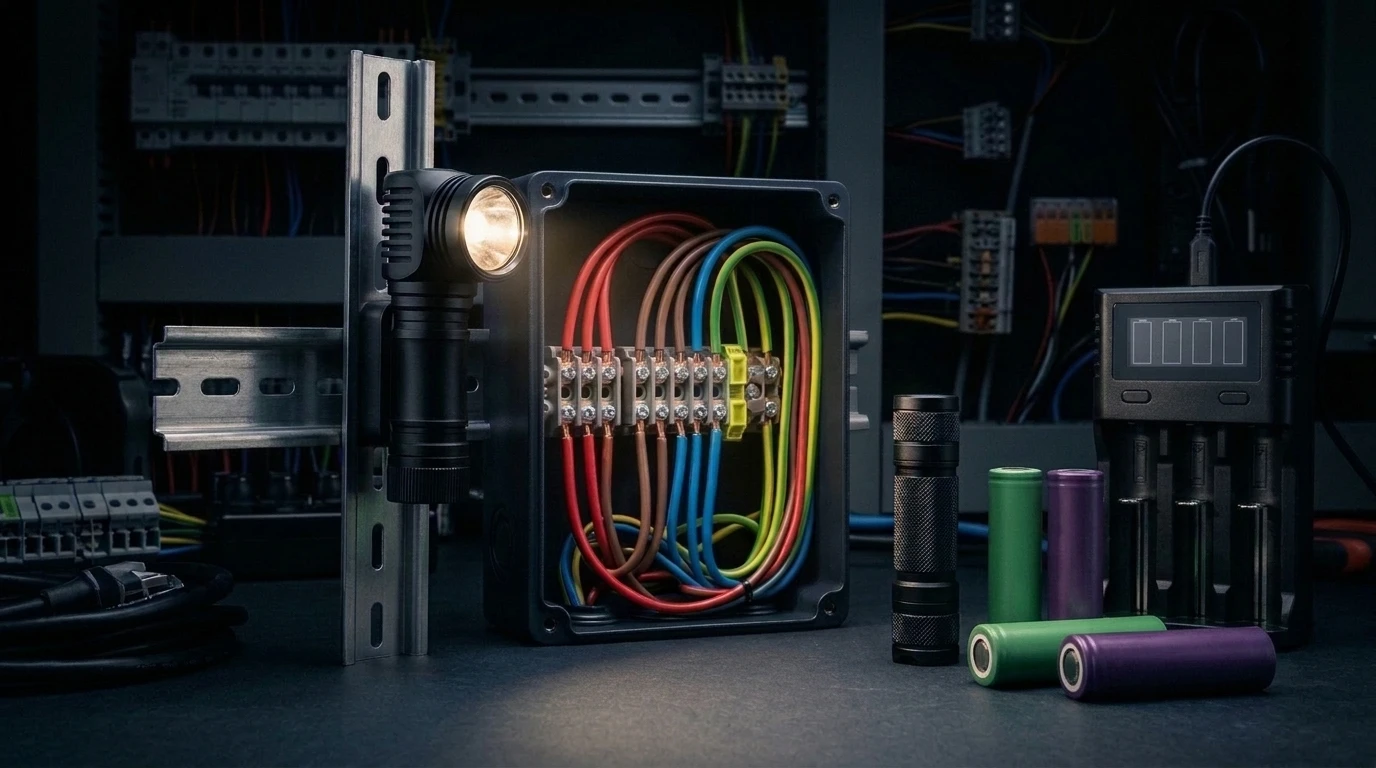
Verified High-CRI Flashlights, Magnetic Headlamps, Lanterns & Smart Chargers
Field-proven hardware using replaceable 18650, 21700, and Eneloop Pro AA/AAA cells—no fake zoom optics, no glued throwaway battery packs.
1. Exposing the "100,000-Lumen" Zoom Torch Scam & Why High CRI 90+ Matters
Search any online marketplace for an inspection torch and you will immediately see chunky black zoom flashlights advertising "100,000 Lumens" or even "990,000 Lumens". Physically, that claim is pure fiction: producing a genuine 100,000 lumens requires stadium-grade water-cooled arrays or briefcase-sized multi-cell floodlights drawing hundreds of watts. Most sliding-lens zoom tubes put out roughly 400 to 900 real lumens at turn-on before heat forces them down.
Worse than the fake lumen sticker is the light quality itself. Cheap zoom torches use overdriven, icy-blue 6500K–7500K emitters with a terrible Color Rendering Index (CRI 65–70). That harsh blue spike tricks the eye for three seconds indoors, yet strips out the deep red wavelength (R9) your eyes depend on to tell subtle colors apart. Inside a dusty distribution board, server rack, or engine bay, low-CRI blue light turns critical diagnostic clues into nearly identical shades of muddy grey-brown:
- Electrical Phase Wires: Distinguishing brown live conductors from faded red, orange, or dark grey insulation inside a tight junction box becomes guesswork under
7000Kblue glare. - PCB Trace Oxidation & Resistor Bands: Fine copper trace corrosion, heat-browned FR-4 fiberglass, burnt SMD flux, and red/orange/violet resistor color stripes pop cleanly under neutral-warm
Nichia 519A 4000K–4500K(CRI 90+) emitters—almost like stepping outside into midday sun. - Automotive & HVAC Fluid Leaks: Pink coolant drips, amber engine oil film, reddish transmission fluid, and green AC dye stand out immediately under High-CRI neutral light, whereas cool-blue LEDs flatten them into wet dark streaks.
❌ Cheap 7000K Zoom Torch (CRI ~68)
Blue-heavy spectrum crushes red contrast; dark brown and faded red wires blur together in cramped enclosures.
✅ Nichia 519A 4500K (CRI 90+)
Full-spectrum neutral-warm light separates wire jackets, heat-scorched PCB pads, and fluid colors effortlessly.
2. Driver Physics Without Jargon: Why Buck / Boost Beats Unregulated FET Drivers
Two flashlights using the exact same LED and the exact same 18650 battery can behave like night and day after five minutes on a workbench. The difference sits on the tiny round circuit board behind the LED—the driver:
- Unregulated Direct-Drive (
FET) Drivers: Think of a tap opened straight onto a water tank. When the Li-ion battery is fresh off the charger at4.2 V, a cheap FET driver blasts maximum current into the LED, making the body blazing hot within 45 seconds. Then two things hit at once: the torch throttles down to avoid melting, and as the battery drains toward3.5 Vand3.2 V, brightness sinks steadily hour after hour. - Regulated Constant-Current (
Buck / Boost) Drivers: Think of a precision voltage-and-current regulator. A Buck driver steps excess battery voltage down efficiently (~90%) into steady current; a Boost driver steps lower cell voltage up cleanly to drive high-efficiency emitters. Your250-lumenrack mode or600-lumeninspection mode stays completely flat—delivering the exact same usable beam at hour three as it did in minute one, right until the low-voltage warning blinks.
Lumens vs. Candela (The Garden Hose Rule): Do not shop by lumens alone. Lumens measure total light pouring out of the lens—like water volume flowing from a hose. Candela (cd) measures how tightly focused the center hotspot is—like twisting the nozzle into a jet. A wide flood headlamp might put out 600 lumens with only 2,500 cd for broad, glare-free desk and rack work, while a search torch with the same 600 lumens and 45,000 cd reaches across a dark yard.
Just watch out for the ANSI FL1 throw trap: laboratory throw numbers count down to 0.25 lux—about the brightness of a full moon on a clear night. At that faint limit you can barely tell a shadow from a fence post. In practical work, divide any advertised ANSI FL1 throw distance in half to get your true usable inspection range.
3. Right-Angle Magnetic Headlamps, EDC Torches & Blackout Lanterns
Holding a cylindrical torch between your teeth while crimping RJ45 plugs or routing diagnostic probes inside a server chassis gets old fast. An engineering kit needs three specialized form factors working together:
| Category & Model | Emitter & Driver | Cell & Charging | Best Workshop / Emergency Role |
|---|---|---|---|
Wurkkos FC11C(Updated Buck EDC) |
Nichia 519A (CRI 90+, 4000K/5000K) + Regulated Buck Driver |
Replaceable 1× 18650 + onboard USB-C + tail magnet |
#1 Bench & Pocket EDC: true wire colors, flat brightness curve, compact magnetic tail for quick panel checks |
Wurkkos HD15 / HD20(Dual-Optic Right-Angle) |
Dual spot + High-CRI flood emitters (LH351D/SST20 options) |
18650 (HD15) or 21700 (HD20) + USB-C powerbank out |
Steel Rack & Under-Hood Workhorse: wear on headband or stick magnetically onto 19" rack rails and car bonnets |
Sofirn HS42 / HS20(Dual-Beam Headlamp) |
Dedicated throw + wide flood + red night-vision channel (HS42) |
1× 18650 replaceable + sealed USB-C port |
Hands-free electrical fault finding, attic cable pulls, and preserving night vision without blinding coworkers |
Fenix HM65R(Rugged Industrial Dual) |
Regulated constant-current spot + High-CRI flood (IP68 magnesium body) |
1× 18650 (runs cold down to sub-zero) + USB-C |
Heavy-Duty Rain & Impact Pick: drop-tested magnesium alloy for outdoor telecom, roof PV, and wet roadside repairs |
Sofirn SC33(High-Output 21700) |
Cree XHP70.3 HI + High-Efficiency Boost Driver |
1× 21700 (5000 mAh) + USB-C |
Yard, Roof & Perimeter Inspection: long-running regulated mid-high output when reach matters more than pocket size |
Sofirn BLF LT1(Multi-Cell Blackout Lantern) |
Warm-to-neutral stepless tint ramping (2700K–5000K, CRI 90+) |
4× 18650 parallel + bidirectional USB-C powerbank |
Whole-Room Blackout Pillar: lights a kitchen or study for days on low and tops up phones alongside your LiFePO4 station |
Wurkkos FC11C (Nichia 519A)
Note the "C" revision—it replaces the older FET circuit with a regulated Buck driver while keeping the color-true Nichia 519A emitter and magnetic tail cap.
Wurkkos HD15 / HD20 & Sofirn HS42
Right-angle L-shaped bodies unclip from the headband in two seconds to stick horizontally onto steel distribution cabinets, UPS racks, and automotive engine bays.
Sofirn BLF LT1 (4× 18650)
Save your heavy LiFePO4 blackout power station for routers, gas boilers, and fridges—let a dedicated 4× 18650 lantern handle whole-room illumination for pennies of watt-hours.
4. Replaceable 18650 / 21700 Cells, Eneloop Pro & Smart Resistance Testing
18650 cells claiming impossible capacities like 9,900 mAh (the genuine physics ceiling for an 18650 is roughly 3,500–3,600 mAh, and for a 21700 roughly 5,000–5,800 mAh). Fake cells often contain tiny salvaged batteries packed in sand or plaster.
Standardizing your workshop and emergency drawer around removable cylindrical cells eliminates dead-tool surprises and dovetails cleanly with our SpecInfo Battery Lab methodology:
18650 (3500 mAh / ~12.6 Wh): The universal standard for compact EDC lights, magnetic headlamps, and the 4-cellSofirn BLF LT1lantern. Keep spares in hard polycarbonate 2-cell or 4-cell cases—never loose in a pocket with keys or coins.21700 (5000 mAh / ~18.0 Wh): Slightly thicker and longer than18650, packing roughly 43% more energy per cell for high-output inspection lights like theSofirn SC33orWurkkos HD20.Panasonic Eneloop Pro Ni-MH (AA 2500 mAh / AAA): Zero-leak, low-self-discharge workhorses for multimeters, Sub-GHz weather sensors, emergency radios, and compact AA penlights. Unlike alkaline cells, Eneloop Ni-MH batteries never spew corrosive potassium crust across your circuit boards after six months in storage.- 4-Bay Analyzing Chargers (
XTAR VC4SL/Vapcell S4 Plus): Onboard USB-C ports inside flashlights are convenient for daily top-ups, but they are completely blind to cell health. A proper 4-bay analyzer runs a Grad / Cap Test (charging to4.20 V, discharging down safely while counting realmAh, and recharging—or putting cells into3.7 VStorage Mode) plus measures DC Internal Resistance (mΩ). Healthy Li-ion cells stay crisp in low double-digit milliohms; when a cell climbs steeply in resistance, it heats up and collapses under load—retire and recycle it before an emergency strikes.
🔦 Interactive Flashlight Runtime, Usable Throw & Blackout Calculator (100% In-RAM)
Select your battery architecture, driver regulation topology, lumen level, and beam candela to model real sustained runtime, wattage draw, usable inspection distance (half of ANSI FL1), and 24-hour blackout spare cell count.
5. Recommended Engineering Picks: Torches, Magnetic Headlamps & Cell Analyzers
Wurkkos FC11C (Nichia 519A + Regulated Buck Driver)
The workshop benchmark for accurate wire and PCB color recognition. The "C" revision upgrades to a constant-current Buck driver for steady brightness without rapid voltage sag.
View on Amazon ↗Wurkkos HD15 / HD20 & Sofirn HS42 Dual-Beam
Snaps hands-free onto steel server cabinets, breaker doors, or vehicle bonnets. Choose HD15/HS42 for lighter headband wear or HD20 for longer 21700 shifts and reverse phone charging.
Fenix HM65R Headlamp & Sofirn SC33 Boost Torch
Pick the magnesium-bodied Fenix HM65R when rain, drops, and freezing weather demand IP68 durability, or step up to the Sofirn SC33 / HS42 for long-range outdoor plant and roof checks.
Sofirn BLF LT1 + XTAR VC4SL / Vapcell S4 Plus
Pair a multi-day BLF LT1 room lantern with a 4-bay smart analyzer to verify true cell capacity, store Li-ion spares safely at 3.7 V, and retire weak batteries before outages.
🧰 Complete High-CRI Workshop & Blackout Readiness Bundle
Replace disposable plastic torches forever with one standardized, field-testable lighting and cell-maintenance kit:
6. Frequently Asked Questions (FAQ)
Why do cheap "100,000-lumen" zoom flashlights fail electrical and PCB work?
Beyond fake lumen advertising (most generic zoom tubes deliver well under 1,000 real lumens and overheat quickly), they rely on cool-blue 6500K–7500K low-CRI emitters. Missing red spectrum energy flattens brown, red, and orange phase wires, scorched PCB pads, and resistor color bands into muddy grey.
Is 4000K or 4500K Nichia 519A better for a technical workbench?
Both deliver CRI 90+ color accuracy. Choose 4500K if you want crisp neutral-daylight separation on white PCBs and wiring looms, or 4000K for gentler reflections off shiny brushed aluminium racks and copper busbars with less eye strain late at night.
Can I charge 18650 and 21700 cells inside the flashlight instead of buying an analyzer?
Built-in USB-C ports are great for quick top-ups on the road, but they cannot measure genuine discharge capacity (mAh), check DC internal resistance (mΩ), or set spares to 3.7 V storage voltage. An XTAR VC4SL or Vapcell S4 Plus also handles your Eneloop Pro AA/AAA cells in the same bays.
How should I store spare Li-ion cells for blackout preparedness?
Store spares in rigid plastic battery cases in a cool closet—never loose near metal tools—and use your analyzer's storage function (around 3.7 V) for cells that sit untouched for months, keeping one or two active rotation cells topped up in your EDC light and BLF LT1 lantern.
7. Related SpecInfo Power, Diagnostic & Blackout Guides
- 1-Hour Home Blackout Backup & Plug-In Solar Guide: Portable LiFePO4 Stations, XT60i & Balcony Kits
- SpecInfo Battery Lab: Laptop & Cell Health Diagnostics, Wear Level & Impedance Guide
- ITAD Hardware Diagnostic Workbench Tools: Thermal Cameras, USB-C PD Testers & BIOS Programmers
- OBD2 Scanners, 12V AGM Battery Load Testers & Automotive Thermal Leak Diagnostics
- GaN 240W Desktop Chargers & Airline-Safe 99Wh USB-C PD Powerbanks Guide