1-Hour Home Blackout Backup & Plug-In Solar Guide: Portable LiFePO4 Stations, XT60i & Balcony Kits
When winter storms cut the grid or you rent a flat with zero roof access, you do not need scaffolding or a noisy petrol generator in the hallway. Here is the engineering blueprint comparing grab-and-go LiFePO4 power stations against 1-hour modular 5.12 kWh hand-truck builds, plus how to dodge the hidden inverter, XT60, and gas-boiler traps.
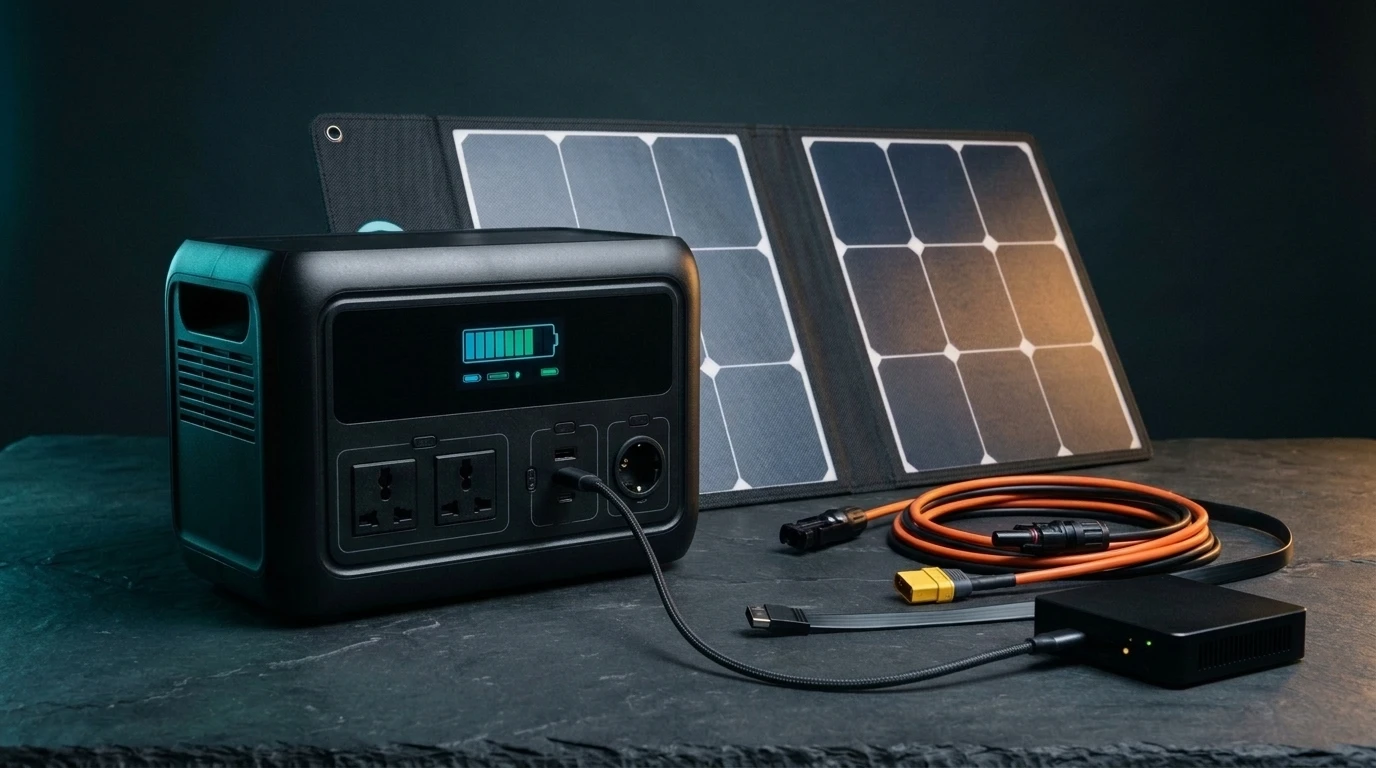
Almost everyone realizes they need blackout backup power at the worst possible time: when the fridge stops humming, the fiber broadband router dies mid-workday, and the hallway turns freezing cold. Between sealed all-in-one LiFePO4 boxes from EcoFlow, Anker SOLIX, and Bluetti, balcony plug-in solar kits, and 1-hour modular hand-truck rigs using standard 51.2V rack batteries, choosing the right build keeps you silent, fume-free, and online without rewiring your house.
Preparing Ahead of Winter Storms? Jump Directly to Verified Components
Pair one core power architecture below with true XT60i or flat-window solar leads and a pre-storm smart wattmeter. Tailor the exact watt-hour size to your loads in Section 5.
- Never Build or Plug In a Male-to-Male “Suicide Cord”: Feeding power backward into a house wall socket energizes exposed plug prongs and can backfeed street transformers, risking lethal shock to family members and line engineers. Either plug appliances directly into the power station/distribution box, or hire a licensed electrician to install a certified manual transfer switch.
- Never Disconnect Live
MC4Solar Plugs in Bright Sunlight: Unlike household AC wall power that alternates cleanly to zero, high-voltage DC solar current draws a sustained hot plasma arc that melts plastics and burns fingers. Switch off theDC PV Isolatoror drape an opaque blanket over the solar panel before unclipping leads. - Always Keep a +15% Freezing-Weather
VocVoltage Buffer: Solar panels produce noticeably higher open-circuit voltage on bright, frosty winter mornings than rated on their warm-lab sticker. Never exceed your station's maximum PV voltage limit (commonly60V–150Von portable units vs450Von modular all-in-one inverters). - Test Gas Boilers Before Blackout Day: Many modern gas condensing boilers verify flame ionization against a bonded Neutral-Earth reference; floating AC output from an unplugged battery station can trip an ignition lockout unless verified beforehand.
1. Three Emergency Power & Balcony Solar Archetypes
Matching your battery architecture to your home footprint stops you from buying an oversized heavy crate for a flat, or paying steep proprietary expansion markups when you really need multi-day appliance autonomy:
Grab-and-Go 1 kWh Station + Flat Solar Lead
Fits neatly beside a hallway router or desk, acting as a whisper-quiet <10 ms EPS backup for work laptops, ONT broadband, and medical/lighting gear, with optional window-routed folding panels.
- Target capacity:
768 Wh – 1,024 Wh LiFePO4plus direct100W USB-C PDports so AC inverter stay-awake draw stays off overnight.
All-in-One 2 kWh Box or Balcony Solar Buffer
Carries a modern A-rated fridge-freezer, fiber Wi-Fi, laptops, and short coffee-kettle bursts through a full 24-hour storm blackout while charging back to 80% from grid power in ~45 minutes before severe weather hits.
- Sweet spot: Sealed
2,048 Wh LiFePO4chassis with high800W–1,200WMPPT input and zero tool assembly required.
1-Hour Modular 51.2V 100Ah Hand-Truck Rig
Combines one generic 51.2V 100Ah server-rack battery strapped onto a steel hand truck with an all-in-one high-voltage inverter: delivers over five kilowatt-hours of storage plus up to 450V solar string charging.
- Future proof: Never locks you into single-brand expansion cables; the battery rolls straight onto a permanent wall system later.
2. Portable LiFePO4 Stations vs 1-Hour Modular Hand-Truck Systems
Both approaches store energy inside long-life Lithium Iron Phosphate (LiFePO4) cells rated for 3,000 to 6,000+ cycles without the thermal runaway danger of older NCM power packs. Choosing between a polished branded chassis and a one-hour modular hand-truck kit hinges on where proprietary lock-in hurts versus where grab-and-go simplicity shines:
- Where Branded Portable Stations Win Easily: Inside flats, townhouses, home offices, and camper setups, sealed all-in-one units (EcoFlow DELTA 3 Plus, Anker SOLIX C1000 / F2000, Bluetti AC180 / AC200L) require zero wiring, include built-in
100W–140W USB-C PDports, run ultra-quiet sub-30 dB cooling at low loads, trigger emergency switchover in under10–20 ms, and survive rain/balcony storage cleanly in a carryable silhouette. - The Proprietary Expansion Battery & Low-Voltage Trap: Once you try scaling a portable station from
2 kWhup to6 kWh+, branded expansion cables and snap-on battery bricks become remarkably expensive per kilowatt-hour while keeping you capped at low60V–150Vsolar limits — forcing parallel panel splitters on the ground instead of clean single-pair series strings. - Where the 1-Hour 51.2V Hand-Truck Build Wins: Mounting a standard
51.2V 100Ah(5,120 Wh)LiFePO4battery and a single3–5 kWall-in-one hybrid inverter onto a heavy steel sack truck takes roughly one hour using pre-crimped2 AWG (35mm²)leads, insulated ferrules, aDC PVisolator, and an AC socket distribution box. You gain massive5.12 kWh+runtime, full200V–450Vstring acceptance for affordable rigid glass solar panels, and standard open-market battery expansion without single-vendor handcuffs. Need permanent wall wiring? Compare full fixed-home architectures in our Hybrid Solar Inverter & Cold-Weather Voc Engineering Guide.
3. Five Hidden Blackout Traps That Drain or Cripple Backup Kits
Real-world storm outages expose five subtle hardware mismatches that almost never appear in glossy marketing banners:
- AC Inverter Self-Consumption (The Quiet Overnight Vampire): Keeping the
230V ACoutlet toggle enabled on a power station keeps a heavy transformer stage powered continuously, burning roughly25W to 45Won top of your connected load. Running just a15Wfiber ONT and router through AC mains means the inverter eats more battery than the router itself — shutting AC off completely and using native12V DCbarrel leads orUSB-C PDtriggers stretches outage life dramatically. - The 8A
XT60vs 15AXT60iSolar Cable Trap: Standard two-pinXT60solar adapters lack the grounded sense signal on the center third pin used by EcoFlow stations. Plugging one in convinces the BMS you attached a weak car cigarette-lighter socket, silently capping solar input at8Ainstead of unlocking the full15Asolar ceiling. Always specify a genuine 3-pinXT60i10AWG/12AWG cable. - Fridge Compressor Startup Surge vs Average Load: A modern fridge averages around
60W–120Wover a day because the compressor rests more than half the time, yet its brief startup pulse and periodic defrost heater spike past800W–1,200W. Small300W–600Wmini stations trip overload protection right when the compressor kicks in. - Gas Combi Boiler Floating-Neutral Lockout: When your station runs unplugged from the wall, neither AC prong is tied to ground. Boiler flame sensors see zero microamp return path and lock out with ignition fault codes. Always test your heating boiler during daylight before relying on any battery bank in winter. For dedicated server and network rack UPS selection, review our Pure Sine Wave UPS & NUT Configuration Guide.
- Drilling Walls vs Flat
MC4Window Cables: Renters who want zero holes through masonry or balcony doors can route rigid or foldable panel lines cleanly through sealed uPVC frames using ultra-flat braidedMC4window pass-through ribbons — just avoid pinching the ribbon onto sharp metal lock strikers.
4. Plug-In Balcony Solar Without Roof Scaffolding (EU vs UK Reality Check)
Connecting two solar panels directly to a balcony railing and dropping power inside has become one of Europe's fastest-growing DIY energy upgrades, but electrical legality differs sharply depending on where you live:
- Continental Europe, Germany & Poland (Plug-In Grid-Tie Microinverters): Under unified
800Wbalcony rules, certified microinverter and battery buffer kits (such as EcoFlow PowerStream, Anker SOLIX Solarbank, or Zendure SolarFlow) plug directly into an outdoor/indoor wall socket, using smart energy plugs (Tapo P110M/Shelly Plus Plug) to offset base house standby load automatically while charging aLiFePO4battery from surplus sun. - United Kingdom (
BS 7671Socket Rule vs Legal Off-Grid Balcony Storage): Current UK wiring regulations (BS 7671) do not permit backfeeding solar microinverters straight into a standard13Aring-main wall socket due to ring-circuit fault-current limits unless wired back to the consumer unit on a dedicated circuit by a registered electrician. However, UK flat dwellers and homeowners achieve a 100% legal, zero-notification workaround by running two balcony panels via a flatMC4window pass-through cable straight into theMPPT DCinput of a portableLiFePO4station — keeping all solar electricity off-grid while running desks, chargers, routers, and appliances straight from the battery! Explore multi-battery automation in our LiFePO4 Battery Banks & Dynamic Tariff Arbitrage Guide.
5. Interactive Home Blackout & Plug-In Solar Sizing Planner
Select your home type, critical appliances, desired storm autonomy, and solar charging setup below. The planner calculates realistic watt-hour sizing after AC idle drain, enforces XT60i / winter Voc cable limits, updates matching Amazon UK/US/PL links, and builds a pre-storm deployment checklist.
⚡ Home Blackout Backup & Plug-In Solar Architect
Balance battery capacity against AC inverter standby draw, XT60i current ceilings, and safe solar recharge rules.
6. The 1-Hour Hand-Truck Modular Build Checklist (For 5 kWh+ Capacity)
If your outage math pushes past three kilowatt-hours, building a portable cart from open-standard parts beats buying four stacked proprietary bricks every time:
- Mechanical Anchoring: Mount the heavy
51.2V 100Ahlithium rack battery at the very bottom axle shelf of a wide-base steel hand truck with heavy ratchet straps so the center of gravity never tips on thresholds, and bolt the all-in-one inverter vertically above the battery pack with breathing space around intake fans. - Clean Wire Terminations (Zero Loose Strands): Connect battery to inverter using heavy
2 AWG (35mm²)copper leads via a properly rated150A–200A DC Breaker. ForAC In,PV In, andAC Outscrew clamps, strip cleanly and crimp insulated bootlace ferrules — then perform a firm physical pull test on every terminal wire before snapping the cover shut. - Safe AC Distribution Box Output: Wire the inverter's AC output to an enclosed DIN-rail AC socket distribution box featuring a built-in digital wattmeter and dedicated MCB breakers so appliances plug into grounded household sockets without touching bare wiring. For full whole-house backup integration later, see our 7-Piece Smart Energy Master Blueprint.
7. Portable LiFePO4 Stations, Balcony Solar & Cable Kit Comparator
Filter between core battery architectures, solar panel kits, and must-have cables/meters to avoid charging bottlenecks:
🔋 Blackout Power Stations, Modular 51.2V Rigs, Balcony Solar & XT60i Matrix
| Hardware / Component Class | Core Electrical & Cell Spec | Best Blackout / Solar Role | SpecInfo Lab Note | Check Store |
|---|---|---|---|---|
| EcoFlow DELTA 3 Plus / DELTA 2 Max 1,024–2,048 Wh Portable LiFePO4 |
LFP Cells • Dual 500W MPPT (1,000W Total) • <10 ms UPS | Fastest grid storm top-up, home office EPS & dual-aspect balcony panels | Must pair solar leads with 3-pin XT60i connector to unlock 15A charging speed. | View on Amazon ↗ |
| Anker SOLIX C1000 / F2000 PowerHouse 1,056–2,048 Wh Heavy-Surge LiFePO4 |
InfiniPower LFP • UltraFast AC Charge • High Peak Surge | Fridge-freezers, microwave bursts & durable flat/house emergency backup | Noticeably low AC standby loss among 1–2 kWh class units; strong chassis build. | View on Amazon ↗ |
| Bluetti AC180 / AC200L / Elite 200 V2 1,152–2,048 Wh High-PV LiFePO4 |
LiFePO4 • Up to 1,200W Solar (12–145V Voc on AC200L) • 20 ms UPS | Clean high-voltage solar input from rigid balcony or garden panels without parallel splitters | AC200L 145V PV window easily takes 2–3 rigid 400W glass panels in simple series. | View on Amazon ↗ |
| EcoFlow RIVER 3 Plus / Compact Mini Station 286–858 Wh Whisper-Quiet Router UPS |
GaN Inverter (<30 dB) • <10 ms HID UPS • Direct USB-C 100W | Dedicated ONT, Wi-Fi 7 router, Mini PC & NAS silent desk backup without loud fans | GaN electronics trim low-load AC inverter losses sharply during routine outages. | View on Amazon ↗ |
| 51.2V 100Ah Server Rack LiFePO4 + Inverter Rig 5,120 Wh Modular Hand-Truck Architecture |
16S LiFePO4 + Internal 100A BMS • Pairs with 450V MPPT Inverter | Whole-zone multi-day outage resilience & cheap full-size rigid solar strings | Far higher Wh capacity without brand-locked cables; add a rated DC breaker on bus leads. | View on Amazon ↗ |
| 220W–400W Foldable ETFE IP68 Solar Panel EcoFlow / Renogy / Bluetti Monocrystalline |
ETFE Weather Coat • IP68 Rating • Integrated Kickstand | Zero-mount daylight charging on balconies, patios, gardens & campsites | Check Open-Circuit Voltage (Voc) before wiring two panels in series under cold sun. | View on Amazon ↗ |
| Balcony Plug-In Microinverter & Buffer Kit EcoFlow PowerStream / Anker Solarbank / Zendure |
Dual MPPT Balcony Input • Dynamic Smart-Plug Offset | Legal EU/PL zero-scaffolding base-load offset; use DC battery input off-grid in UK | UK readers: comply with BS 7671 by charging a portable battery station off-grid rather than feeding 13A sockets. | View on Amazon ↗ |
| 10AWG MC4-to-XT60i Cable + Flat Window Pass-Through 3-Pin Sense Plug & Zero-Drill uPVC Ribbon |
Thick Copper Strands • Genuine 3rd Sense Pin • Sealed MC4 Tips | Routing balcony/garden solar indoors cleanly while maintaining full 15A charge current | Double-check polarity with a multimeter before initial plug-in; keep clear of window latch teeth. | View on Amazon ↗ |
| Smart Energy Meter Plug + DC PV Isolator + USB-C 12V Lead Tapo P110M / DC Disconnect / PD Trigger |
Pre-Storm Appliance Profiling • Arc-Safe DC Cut • 12V Router Bypass | Measuring true fridge Wh, safe solar unplugging & cutting AC inverter standby drain | Small low-cost accessories that literally double usable blackout battery hours. | View on Amazon ↗ |
8. Four Zero-Regret Upgrades That Multiply Battery Runtime
Run Routers & Mini PCs via USB-C PD / 12V DC
Switching off the main AC inverter button overnight stops 25W–45W of transformer waste while cheap USB-C PD to 12V 5521 trigger cables keep broadband running effortlessly.
Inspect 3-Pin XT60i vs Plain 2-Pin XT60
Skipping generic two-pin cables ensures EcoFlow and fast-MPPT units recognize a genuine solar array rather than throttling speed down to car-socket amps.
Zero-Drill Flat Window MC4 Ribbons
Lets flats run panels out on a sunny railing while storing the sensitive LiFePO4 battery indoors at cozy room temperature where lithium cells charge happily.
Profile Your Fridge & Desk with a Smart Plug Today
Logging twenty-four hours of real fridge cycles on a Tapo P110M or Shelly plug replaces wild battery assumptions with an exact number before clouds roll in.
🧰 Complete 1-Hour Blackout Backup & Balcony Solar 6-Part Bundle
Combine one safe LiFePO4 power architecture with genuine XT60i / flat window solar leads and pre-storm metering — ready before the lights flicker:
9. Frequently Asked Questions (FAQ)
Why does a 1 kWh power station run flat overnight when only powering a 20W router?
Leaving the AC wall outlets switched on keeps the internal high-voltage inverter awake continuously, consuming roughly 25W to 45W by itself just to generate 230V AC — often more than the router uses. Turning the AC button off and powering routers, ONT fiber boxes, and laptops through direct USB-C PD or 12V DC sockets can triple runtime.
What is the difference between a standard XT60 cable and an XT60i solar cable?
A two-pin XT60 connector leaves the third sense pin open or miswired, causing EcoFlow and similar stations to assume you plugged into a car cigarette lighter socket and throttle solar charging down to 8A. A dedicated three-pin XT60i cable signals the station to unlock full 15A solar current.
Is plug-in balcony solar legal in both the EU/Poland and the UK?
In Germany, Poland, and across most of continental Europe, certified 800W plug-in balcony microinverter kits can feed directly into a household circuit under simplified notification rules. In the UK, BS 7671 wiring regulations forbid plugging solar grid-tie generation into standard 13A sockets without dedicated circuit wiring, so UK renters and homeowners achieve the same zero-drill result off-grid by routing balcony panels directly through a flat window MC4 cable into a portable LiFePO4 power station.
Why won't my gas combi boiler ignite when plugged into a portable power station?
Many modern condensing gas boilers inspect voltage between Neutral and Protective Earth (N-PE) to detect a valid flame-ionization current. Portable battery stations output a floating AC waveform when unplugged from the wall, triggering an immediate ignition lockout error unless using an approved pass-through UPS mode or a compliant neutral-ground bonding method.
When does a 1-hour modular 51.2V LiFePO4 hand-truck build beat branded expansion batteries?
Branded expansion batteries lock you into proprietary cables and low 60V–150V solar inputs. Once you need 5 kWh or more of energy, pairing a standard 51.2V 100Ah LiFePO4 server-rack battery on a steel hand truck with an all-in-one high-voltage MPPT inverter unlocks standard glass solar panels in series up to 450V, multi-day appliance resilience, and future migration into a permanent home backup wall.