Hybrid Solar Inverter vs On-Grid Guide: Zero-Export CT Clamps, Cold-Weather Voc String Sizing & Multi-MPPT Engineering
Why installing a pure On-Grid solar inverter today is an economic and technical trap—forcing you to dump midday solar power into the grid for pennies (or negative spot prices), trip offline whenever street voltage hits >253V AC, and sit in the dark during blackouts. Here is the complete electrical engineering playbook for Hybrid Inverters (Deye, Victron MultiPlus-II, Sofar HYD, GoodWe ET), Zero-Export to CT / SDM630 configuration, cold-weather Voc (-20°C) string math that saves your MPPT from burning out in winter, and multi-MPPT East/West/South sizing from home roofs to 50 kW industrial warehouses.
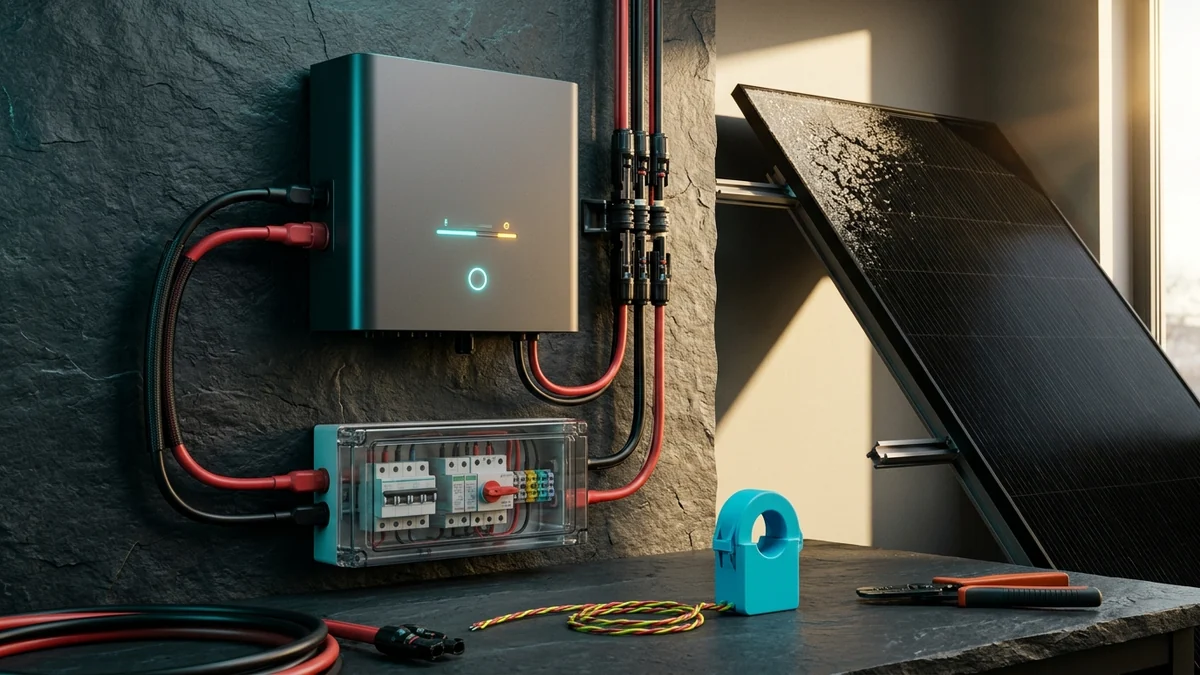
Between 2016 and 2021, residential solar installation followed a brain-dead formula: bolt 15 panels onto a south-facing roof, wire them into the cheapest pure On-Grid string inverter, and use the public electricity grid as a giant, free virtual battery (Net-Metering / Opusty). You exported excess power at 12:00 PM when nobody was home, and drew 80% to 100% of it back for free on winter evenings.
Today, that era is dead and buried. Across Poland (Net-Billing hourly RCE), the United Kingdom (low baseline SEG export rates vs full retail peak import), Germany, and across Europe, utility grids are drowning in unbuffered midday solar power. Installing a legacy pure On-Grid inverter today means paying thousands of pounds or zlotys to become a charity donor to your utility company at noon—while still paying 100% full retail plus distribution tariffs for every kilowatt-hour you consume after sunset.
Pure On-Grid String Inverter
Exports midday energy for a tiny fraction (10%–20% of retail rate, or ≤0.00 on sunny Sundays), trips completely offline whenever street voltage hits >253V AC, and goes 100% dead during a power cut despite blazing sun on your roof.
Hybrid Inverter + CT / Modbus
Uses split-core CT Clamps or an Eastron SDM630 meter to enforce Zero-Export to CT: routes 100% of PV power into home circuits, 51.2V LiFePO4 batteries, and DHW water heaters, immune to 253V grid curtailment, with <10ms blackout backup.
Cold-Weather Voc (-20°C) Math
Never size strings by dividing inverter V_max by panel Voc (STC +25°C)! At -20°C, silicon voltage rises by +12.5% to +13.5%. A string that looks safe on paper in July will avalanche and short your MPPT input MOSFETs on the first frosty January morning.
1. Why Pure On-Grid Inverters Are an Economic & Technical Trap today
Before you buy a single solar panel or sign an installer contract, you need to understand the three physical and economic mechanisms that make a traditional pure On-Grid (grid-tied only) inverter obsolete in:
📉 Trap #1: The Midday Wholesale Export Collapse (Net-Billing RCE in Poland & Low Basic SEG in the UK)
A pure On-Grid inverter has no battery bus and no internal energy storage buffer. It converts DC photons from your roof into 230V / 400V AC in real time: whatever your house does not consume in that exact millisecond is immediately pushed out through your bidirectional utility meter into the public grid. Look at the brutal math of midday export vs evening import in:
- The Midday Duck Curve Crash (10:30 AM – 03:30 PM): When your south-facing array hits peak production at 12:30 PM on a sunny spring or summer day, every other solar roof and commercial PV farm in the country is generating at 100% simultaneously. Under hourly wholesale Net-Billing (
RCE — Rynkowa Cena Energiiin Poland) or basic UK Smart Export Guarantee (SEG) tariffs, midday export credits routinely collapse to just10% to 20%of the retail import price—and on sunny, windy weekends, wholesale spot prices drop to0.00or go negative! - The Evening Retail + Distribution Ambush (05:00 PM – 10:00 PM): When you return home from work at 17:30, cook dinner on an induction hob, run the washing machine, boil the kettle, and power your homelab servers, the sun is setting. You must buy electricity back from the grid at
100%full retail energy + distribution + capacity market fees (enter your own exactkWhbuy and sell rates in the interactive calculator below to see your real annual spread). - The 6-to-1 to 10-to-1 Asymmetric Exchange Ratio: With a pure On-Grid inverter, you have to give the utility company 6 to 10 kWh of your midday solar energy just to pay for 1 kWh of electricity in the evening! Worse still, the tiny deposit credits earned from midday export in Poland cannot even be used to pay fixed distribution and network charges—and any unused deposit expires after 12 months.
⚡ Trap #2: Grid Overvoltage Tripping (>253V AC EN 50549 / G98/G99 Shutdowns)
Have you ever walked past a neighbour's Pure On-Grid inverter at 1:00 PM on a cloudless June Saturday and noticed the red fault LED blinking with error code Grid Overvoltage / Uac High / Error 102? Here is the Ohm's Law physics behind why On-Grid inverters shut down when the sun shines brightest:
- To push current (
I) out of your house and into the street's low-voltage distribution cable (which has a resistance and reactanceZ_grid), your inverter must raise its output voltage higher than the street voltage:V_inverter = V_transformer + (I_export × Z_grid). - When 15 houses on the same suburban transformer feeder all try to export
5 kW to 10 kWat noon, the line voltage climbs past248V,251V, and breaches the statutory EuropeanEN 50549-1/ PolishOSD/ UKBS EN 50160upper limit of253.0V AC(230V + 10%). - The moment the 10-minute rolling average reaches
253V AC(or instantaneous voltage hits258V–262V), safety regulations force a pure On-Grid inverter to open its AC relay and shut down completely to0 Watts! Even if you are running a2,500Wair conditioner or pool heat pump inside your own house, a pure On-Grid inverter cannot feed your own appliances without pushing against the253Vgrid—so you end up buying expensive grid electricity at 1:00 PM while your solar panels bake idly on the roof.
🔌 Trap #3: Complete Blackout Helplessness (Anti-Islanding Lockout)
Many homeowners are shocked the first time a winter storm or substation fault cuts street power at 11:00 AM on a bright, sunny day—and their roof-mounted On-Grid solar system immediately goes dead. Why? Because pure On-Grid inverters have no internal voltage-source oscillator or battery buffer and must obey strict Anti-Islanding protection (IEC 62116) to prevent electrocuting utility linemen repairing downed cables. Without anexternal AC grid reference wave (50 Hz) and without an isolated EPS / Backup Load output port, a pure On-Grid inverter cannot even power your fridge, gas/heat-pump circulation pumps, or Proxmox homelab server during a blackout.
2. How a Hybrid Inverter + Zero-Export to CT / SDM630 Solves Everything
Replacing a dumb On-Grid inverter with a true Low-Voltage (48V / 51.2V) or High-Voltage Hybrid Inverter—such as the industry-workhorse Deye SUN-5K/8K/12K-SG04LP3, Victron MultiPlus-II 48/5000, Sofar HYD 5K–20K, or GoodWe ET Plus—completely rewires the power flow architecture of your home or business:
How Zero-Export to CT (and Eastron SDM630 Modbus) Keeps 100% of Energy On-Site
Every genuine hybrid inverter ships with (or supports) external current-sensing hardware installed inside your main consumer unit / distribution board right at the point where the utility company's tails enter the building:
- Split-Core
CT Clamps(Current Transformers, e.g.,100A:50mA): Hinged ferrite cores that clip around your incoming Live phase wire(s) (L1on 1-phase UK/PL installations, orL1, L2, L3on 3-phase installations) without disconnecting main cables. Note: always point the physical arrow embossed on the CT clamp toward the inverter/loads (or toward the grid per your manual's diagram) and keep CT sensor twisted-pair wires away from high-voltage AC power cables. - Bidirectional RS485 Smart Meter (
Eastron SDM630-Modbus V2for 3-Phase /SDM120for 1-Phase): When your hybrid inverter is mounted in a garage, boiler room, or outbuilding15m to 80maway from the main utility meter cabinet, analogue CT clamp milliamps suffer signal attenuation. Instead, install a 4-DIN-moduleEastron SDM630-Modbus V2in the main board and run a single shieldedCAT6 / RS485 twisted pairto the inverter'sMeter-485port.
⚙️ The 3 Exact Settings on Deye / Victron / Sofar for Zero-Export Operation
Inside the inverter's system work mode menu (e.g., Deye System Work Mode or Victron ESS — Energy Storage System), configuring local energy sovereignty takes 60 seconds:
- Enable
Zero-Export to CT(UncheckSolar Sell): By selectingZero-Export to CTand leavingSolar Sell = OFF, the inverter powers both critical loads on theBackup/Loadport AND heavy non-critical appliances (induction hob, oven, heat pump, EV charger, washing machine) wired on the main house consumer unit between the inverter and the CT clamp! - Set
Zero-Export Power(Grid Trickle Setpoint) to20W – 40W: Why set20W(drawing a tiny 20 Watts from the grid) instead of0W? Because when a2,200Wkettle clicks off, the inverter's DSP control loop takes20ms to 100msto ramp down AC injection. Setting a20Wpositive import cushion guarantees that transient load drops never spill a single watt-hour backward across the utility meter—allowing you to run in 100% self-consumption mode without feeding the street. - Enable
Asymmetric Phase Feeding(on 3-Phase Hybrids in Poland / EU): Standard cheap 3-phase inverters split power equally acrossL1, L2, L3(e.g.,1,000W + 1,000W + 1,000W). If your dishwasher onL1draws2,100WwhileL2andL3draw only100W, a symmetric inverter would import1,100WonL1while exporting900WonL2/L3! Low-voltage 3-phase hybrids like theDeye SUN-8K/10K/12K-SG04LP3support true per-phase asymmetric output (pushing up to 50% of rated inverter power onto a single loaded phase) plus inter-phase vector balancing.
Solving the >253V AC Grid Overvoltage Curse Forever
Why does a Hybrid Inverter running in Zero-Export to CT mode never trip off at 253V AC on sunny afternoons? Because when your inverter is not pushing export current (I_export = 0 A) out into the street impedance (Z_grid), it creates zero local voltage rise at your meter terminals! Even if your neighbours' pure On-Grid inverters saturate the street transformer up to 252V AC, your hybrid inverter calmly continues harvesting 5,000W+ from your solar panels on the internal DC bus—routing that energy directly into your 51.2V LiFePO4 battery bank, air conditioning, and domestic hot water (DHW) tank while your neighbours' inverters sit dead with red fault lights.
3. How to Size Solar Panels to Your Inverter Without Burning the MPPT in Winter (Voc vs Vmp & Winter Frost Safety Margin)
This is the single most expensive—and most frequently misunderstood—engineering calculation in photovoltaics. Every winter in Poland, the UK, and Northern Europe, thousands of DIYers and careless installers wake up on a crisp, cloudless January morning at -15°C to -20°C to the smell of burnt electronics and a dead inverter displaying F07 / DC Bus Overvoltage. And when they file a warranty claim, the manufacturer downloads the inverter's non-volatile black-box EEPROM log, sees Peak PV Input Voltage = 524V DC (on a 500V Max unit), and immediately voids the warranty.
🥶 The Cold-Weather Voc Multiplier Trap: Why Silicon Voltage Explodes in Freezing Weather
Look at the silver specification sticker on the back of any modern solar panel (for example, a popular 450W–500W N-Type TOPCon or Mono PERC module). You will see two critical voltage ratings:
Vmp(Maximum Power Voltage, e.g.,34.8Vor41.5V): The working voltage when the inverter's MPPT tracker is actively drawing current under load.Voc(Open-Circuit Voltage, e.g.,42.0Vor49.8V): The resting voltage across the panel terminals when zero current is flowing—which occurs every morning at dawn right before the inverter wakes up, or whenever the AC breaker trips!
Here is the trap: Both Voc and Vmp on the sticker are measured under Standard Test Conditions (STC) at a laboratory cell temperature of +25°C. However, a crystalline silicon p-n junction is a semiconductor diode whose bandgap widens as temperature decreases. Every solar datasheet lists a Temperature Coefficient of Open-Circuit Voltage (wzrost napięcia na mrozie)—typically -0.25%/°C to -0.29%/°C.
Because współczynnik temperaturowy is negative and temperature in winter drops below +25°C, two negatives multiply to create a massive positive voltage surge!
The Opposite Problem: Too Few Panels to Wake the Inverter Up & Summer Roof Heat (+65°C)
Just as you must never exceed the maximum voltage limit in winter, you also need to check the minimum number of panels required to start the inverter—especially when installing a small array (e.g., 3, 4, or 5 panels on a garage, balcony, or garden pergola):
- Inverter Start-Up Voltage (
V_start): Large 3-phase hybrid inverters typically need around160V–200Vjust to wake up and begin producing power. If you only mount 4 panels (producing roughly140Vtotal) on a garden shed, the voltage will be too low and a 3-phase inverter will never start! - Summer Roof Heat Drops Panel Voltage by ~14%: Heat works in the exact opposite direction to winter frost: when a dark roof heats up to
+65°Con a hot July afternoon, solar panel voltage drops by roughly14%. A 5-panel string that barely started at175Vin spring will drop to around150Vin July heat and may shut down at noon! - Easy Fix for Small Arrays (2 to 5 Panels): If you only have space for 2, 3, or 4 panels on a pergola or shed, don't wire them into a high-voltage 3-phase inverter. Instead, connect them to a compact external
Victron SmartSolar MPPTcharge controller wired directly to your51.2V LiFePO4battery bank! It wakes up at just~57V, so even 2 panels in series will charge your battery all day long.
4. Understanding Built-In MPPT Trackers: True 2x / 3x / 4x MPPT vs The Internal 2+1 Parallel Busbar Trap
An MPPT (Maximum Power Point Tracker) is a high-frequency DC-DC buck/boost converter inside your inverter that continuously sweeps the voltage-current (I-V) curve of a solar string every few milliseconds to lock onto the exact point where Power = Voltage × Current is maximized. However, inverter marketing brochures routinely mislead buyers about how many independent MPPT trackers are actually inside the chassis.
🔍 The Datasheet Trap: Why "3 PV Inputs" Often Means Only 2 Independent MPPT Trackers (2+1 Topology)
Look underneath a Deye SUN-10K/12K-SG04LP3 or similar 3-phase hybrid inverter and you will see three pairs of positive/negative MC4 connectors labeled PV1+ / PV1-, PV2+ / PV2-, and PV3+ / PV3-. Uninformed installers assume this means three independent MPPT trackers. Wrong!
- On a
2 MPPT (2+1 Strings)inverter,PV1andPV2are hard-wired in parallel onto a single internal copper busbar feedingMPPT 1(rated at e.g.26A–34Atotal input current), whilePV3feedsMPPT 2(rated at13A–17Afor a single string). - The Golden Rule of Parallel MPPT Inputs (
PV1 + PV2): Because parallel circuits share the exact same voltage node, if you plug two strings into a shared2-in-1MPPT tracker, both strings MUST contain the exact same number of identical panels! Never connect a 10-panel string onPV1and a 7-panel string onPV2on the same MPPT tracker—the 7-panel string will drag the common bus voltage down, or back-feed current into the shorter string. - When You Need Physically Independent MPPTs: Whenever two strings have different panel counts (e.g., 12 panels on the main house roof + 6 panels on the garage), different tilt angles (
35°roof vs90°vertical south facade for winter sun), or different panel wattages/models, they must be wired to separate, independent MPPT trackers (MPPT 1vsMPPT 2, or by adding an externalVictron SmartSolar MPPTon the51.2VDC bus).
Flattening the Generation Curve: Multi-MPPT East + West + Vertical South Architecture
In the old Net-Metering era, everyone pointed 100% of their panels due South at a 35° tilt to maximize a sharp midday peak at 12:30 PM. Under self-consumption and Zero-Export rules, a sharp 12:30 PM spike is the worst possible profile because your house cannot absorb 10 kW at noon while your battery is already 100% full by 11:30 AM. Instead, use independent MPPTs to build a wide, flat "tabletop" generation curve from 06:00 AM to 08:30 PM:
MPPT 1— East Roof String (Azimuth90°): Catches dawn photons from 05:45 AM to 12:30 PM, immediately powering morning showers, coffee machines, breakfast cooking, and recharging the 51.2V LiFePO4 battery bank after overnight homelab/HVAC draw.MPPT 2— West Roof String (Azimuth270°): Takes over from 12:30 PM until 08:30 PM, directly feeding afternoon heat-pump cycles, dinner cooking, and evening EV/domestic loads during the most expensive retail tariff window (16:00–21:00) without touching battery cycles!MPPT 3(or External SmartSolar MPPT) — Steep / Vertical South Facade or Fence (Tilt65°–90°): In December and January in Poland and the UK, the midday sun sits at just14° to 18°above the horizon. While roof panels at30°are covered in snow or hit at a shallow grazing angle, a vertical south-facing wall or solar fence string catches winter sun almost perpendicularly (plus snow never sticks to a90°wall, and ground snow reflection adds a+15%bifacial/albedo boost!).
🛠️ Do You Actually Need Panel Optimizers (Tigo TS4-A-O) or Are Bypass Diodes Enough?
Sales reps love adding DC Power Optimizers (such as Tigo TS4-A-O) to every single panel on a quote, adding substantial unnecessary hardware cost to your invoice. Here is the honest engineering truth:
- Every Modern Half-Cut Solar Panel Already Has 3 Internal Schottky Bypass Diodes: If a chimney or dormer shadow covers the bottom half of one half-cut panel, the inverter's global MPPT shadow scan activates that panel's internal bypass diode—dropping only
~17V–35Vwhile the rest of the string continues producing at 100% current. - Where
Tigo TS4-A-OOptimizers ARE Worth It (Selective Deployment): Never put Tigo optimizers on unshaded panels (they add extra MC4 connection points on the roof and consume a few watts of quiescent power). Instead, use selective deployment: clip aTigo TS4-A-OONLY onto the 1, 2, or 3 specific panels that get swept by a chimney, soil vent pipe, or tree shadow, or when you are forced to mix two slightly different tilt angles inside a single series string.
Scaling from Home Roofs (5–12 kW) to Industrial Warehouses & Factories (30–50 kW)
The exact same Zero-Export and multi-MPPT physics scales from a family house to a manufacturing plant, cold-storage warehouse, woodworking shop, or server colocation facility:
- Residential & Homelab Scale (
5 kW – 12 kW,48V/51.2V LVBattery Bus): Single-phase UK homes (G98up to3.68 kWorG995–8 kW) and three-phase Polish/EU homes (10–12 kW) pair a2 MPPThybrid inverter with10 kWh – 30 kWhof safe51.2V LiFePO4rack modules. - Commercial & Industrial Roof Scale (
30 kW – 50 kW+, e.g.,Deye SUN-50K-SG01HP3-EU-BM4): Factories, carpenter workshops, bakeries, and logistics hubs consume massive 3-phase power between07:00 and 17:00during daytime shifts, but often face strict DNO grid connection refusals (Odmowa warunków przyłączenia OSD or zero export allowance). By installing a50 kWHigh-Voltage Hybrid Inverter with4 Independent MPPT Trackers(up to8 strings / 65 kWpof panels) configured inZero-Export to CTmode with current-transformer coils on the main250A–630Abusbars, a business can slash daytime factory electricity bills by 60%–80% immediately—even before receiving a commercial export permit!
🧮 Interactive Solar String Voc (-20°C) Verifier, MPPT Sizer & Zero-Export Calculator
IEC 62548 VOC MATH • MPPT WINDOW • RCE/SEG ZERO-EXPORT ROI
Enter your solar panel datasheet values, winter minimum temperature, string length, and inverter voltage ceiling below to verify whether your string is 100% Safe in Winter Frost, risks Burning the MPPT (OVER-VOLTAGE DANGER), or fails to wake up on hot/cloudy days (UNDER-START FAIL)—plus calculate annual savings from keeping energy on-site via Zero-Export:
🌤️ Chimney Shading, Pergola Expansions & Stopping >253V AC Trips: Hoymiles Microinverters vs Selective Tigo TS4-A-O vs SmartSolar MPPT
Two questions come up in almost every residential solar audit: "How do I stop my inverter from shutting down at 253V AC on sunny days?" and "What is the smartest way to handle chimney shading or add 2–4 extra panels on a shed/pergola?"
- How a Hybrid Inverter Physically Stops
>253V ACGrid Overvoltage Trips: An inverter only pushes local phase voltage above253V ACwhen it tries to force export current through high-impedance street cables back to the utility transformer. When you switch to a Hybrid Inverter withZero-Export to CT, midday solar peaks never push against the street grid—instead, the inverter routes 100% of that power internally into your51.2V LiFePO4battery bank and automatically triggers high-power local loads (such as aTuya 63A DINhot water cylinder contactor or air-to-air heat pump AC). Your phase voltage drops back below246Vand you keep 100% of your solar harvest legally! - Selective Optimizers (
Tigo TS4-A-O 700W) — Only Under Shaded Panels: If 1 or 2 panels on a 10-panel string are shaded by a chimney, dormer, or vent pipe for a few hours a day, you do not need to buy optimizers for all 10 panels. Clip aTigo TS4-A-Oonly under the 1 or 2 shaded modules so their impedance matches the unshaded string current. - 2-in-1 & 4-in-1 Microinverters (
Hoymiles HMS-800W-2T / HMS-1600-4T / HMS-2000-4T) on the DeyeGENPort: What if you want to mount 2 to 4 panels on a garden shed, gazebo, balcony, or multi-angle dormer where 2–4 panels only produce70V–140V DC(too low to wake up a main string inverter)? Use aHoymiles HMSmicroinverter (which has an independent MPPT for every single panel starting at just22V DC!) and wire its230V ACcable straight into your hybrid inverter'sGEN / Micro-Inverter Inputport—allowing those extra panels to power your home and charge your51.2V LiFePO4battery even during a grid blackout!
5. Hybrid Inverter, MPPT, Zero-Export Meter & DC Protection Matrix (Amazon UK)
Use our interactive hardware matrix below to filter between Hybrid Inverters, Microinverters & Multi-MPPT Charge Controllers, Zero-Export Modbus Meters & CT Clamps, 1000V DC Combiner Boxes (Type 2 SPD + gPV Fuses), and MC4 / 1000V DC Diagnostic Tools:
📊 Hybrid Solar Inverter, MPPT & Zero-Export Engineering Hardware Matrix
| Component & Model Class | Voltage / Current Spec | Zero-Export & Protection | Key Engineering Advantage | Target Deployment | Check Availability |
|---|---|---|---|---|---|
| Victron MultiPlus-II 48/5000/70-50 & 48/3000 Hybrid Inverter/Charger Modular Low-Frequency Toroidal Transformer Hybrid (1-Ph & 3-Ph Parallel) |
48V / 51.2V DC Bus50A Transfer Switch |
Zero-Export ESS via CT or RS485 Energy Meter + <20ms UPS |
Indestructible toroidal transformer surges to 9,000W; native CAN-Bus BMS via Cerbo GX |
Residential, Off-Grid, Homelab UPS & 3-Phase Clusters | View on Amazon ↗ |
| Victron SmartSolar MPPT 150/45, 150/70 & 250/100-Tr VE.Can Ultra-Fast External MPPT Solar Charge Controllers for 48V/51.2V Banks |
150V or 250V DC Max35A to 100A Charge Out |
Starts at V_bat + 5V (~57V)Synchronized VE.Can / Bluetooth |
Solves short strings (2–5 panels on pergolas/sheds) & adds extra independent MPPTs to any hybrid | Adding East/West/Vertical Strings to 51.2V LiFePO4 Banks | View on Amazon ↗ |
| Eastron SDM630-Modbus V2 (3-Phase) & SDM120-Modbus (1-Phase) Bidirectional DIN-Rail RS485 Modbus Smart Meter for Zero-Export |
3×230V/400V Direct 100A(or CT-operated up to 600A) |
RS485 Modbus RTU 50ms Per-Phase Power Vector |
Plug-and-play Zero-Export meter for Deye, Sofar, Solis, Growatt & Home Assistant over 80m CAT6 | Main Consumer Unit / Distribution Board Zero-Export Sensing | View on Amazon ↗ |
| 2-String / 3-String 1000V DC Solar Combiner & Isolator Box (IP65) Pre-Wired DC MCB Breaker + Type 2 DC Surge Arrester (SPD) + gPV Fuses |
1000V DC Rated16A–32A DC MCB + 40kA SPD |
Arc-Chute Non-Polarized DC MCB + Replaceable 10×38mm gPV Fuses |
Protects inverter MPPT MOSFETs from lightning induced surges & provides safe mechanical DC isolation | Mandatory Between Roof PV Strings & Hybrid Inverter MPPTs | View on Amazon ↗ |
| Tigo TS4-A-O Module-Level PV Optimizer (700W / 15A) Selective Partial-Shading & Multi-Tilt Impedance Matching Optimizer |
Up to 700W / 80V / 15AWorks with Any String Inverter |
Selective Deployment (No Hub Required for Pure Optimization) |
Prevents 1 or 2 chimney-shaded panels from dragging down string current without wiring a new MPPT | Chimney/Dormer Shaded Panels or Mixed-Angle Roof Strings | View on Amazon ↗ |
| Hoymiles HMS-800W-2T / HMS-1600-4T / HMS-2000-4T Microinverter 2-in-1 & 4-in-1 Module-Level MPPT Microinverter (AC-Couples to Hybrid GEN Port) |
22V Start / 60V–65V Max 2 or 4 Independent MPPTs |
Safe Low-Voltage DC + AC-Coupling via Hybrid GEN Port |
Each panel has its own MPPT; ideal for 2–4 panels on sheds, pergolas, balconies & shaded dormers | Pergolas, Garden Sheds, Balconies & Hybrid GEN-Port Expansion | View on Amazon ↗ |
| 6mm² TUV H1Z2Z2-K Double-Insulated Solar DC Cable & Genuine MC4 Kit Tinned Copper 1500V DC UV/Ozone-Resistant PV Wire + Ratchet Crimper |
6.0mm² Tinned Copper1500V DC EN 50618 / H1Z2Z2-K |
IP68 UV-Stabilized MC4Precision 2.5/4/6mm² Die Crimp |
Eliminates #1 cause of rooftop DC arc fires (mismatched cheap MC4 plugs & un-crimped pliers joints) | All Roof-to-Inverter PV String Runs (Red + / Black -) | View on Amazon ↗ |
| 1000V DC True-RMS Digital Clamp Meter (AC/DC Amps & Inrush) CAT III 1000V / CAT IV 600V Hall-Effect DC Current & High-Voltage Tester |
0–1000V DC / AC0–600A DC Hall-Effect Clamp |
Non-Contact DC String Current + VFD / Inrush Current Capture |
Ordinary multimeters explode above 600V DC or cannot clamp DC amps; essential for cold Voc audits | Verifying String Polarity, Cold Voc & MPPT Current Draw | View on Amazon ↗ |
| 3-Phase 63A/100A Manual Changeover Switch (I-0-II) & RCBO Protection 4-Pole DIN-Rail Bypass Switch (Grid <-> Inverter EPS Backup Output) |
4-Pole 63A / 100A 400V ACCenter-Off ( I - 0 - II) Interlock |
Full Hardware Maintenance Bypass + Type A / Type B 30mA RCD |
Lets you switch house critical loads back to direct Grid power in 2 seconds during inverter firmware/maintenance | Main Distribution Board Next to Hybrid Inverter Backup Port | View on Amazon ↗ |
6. In-Depth Engineering Spotlights: The 6 Mandatory Components for a Bulletproof Hybrid & Zero-Export Build
Victron Energy MultiPlus-II 48/5000/70-50 & 48/3000/35-32 (G98/G99 & EN 50549 Certified)
While all-in-one high-frequency hybrid inverters (like the Deye SUN-5K/8K/12K-SG04LP3) pack MPPTs and inverter bridges onto a single PCB, Victron's MultiPlus-II 48V represents the modular, industrial-grade pinnacle of hybrid power electronics. Built around a massive copper low-frequency toroidal transformer, a single MultiPlus-II 48/5000 easily swallows brutal 9,000W inductive motor inrush spikes from borehole water pumps, air-source heat pumps, and workshop compressors that trip lesser transformerless inverters. Even better, because your solar strings connect via separate Victron SmartSolar MPPT controllers onto the common 51.2V DC busbar, if a lightning surge ever damages a solar controller in 10 years, you swap a single modular box in 15 minutes without losing your house inverter or 51.2V LiFePO4 battery bank. Three units can be synchronized in parallel for full 3-Phase 15 kVA asymmetric Zero-Export operation.
Victron SmartSolar MPPT 150/45, 150/70 & 250/100-Tr VE.Can (12V/24V/48V Auto-Select)
What do you do when both MPPT trackers on your existing Deye, Sofar, or Victron hybrid system are already occupied by your East and West roof strings, and you want to add 3, 4, or 6 extra panels on a garden pergola, garage roof, or vertical south fence? A standard 3-phase inverter with V_start = 180V won't even wake up on 3 or 4 panels! The cleanest engineering solution is to wire that short string into a Victron SmartSolar MPPT 150/45 or 250/100 connected directly across your main 51.2V LiFePO4 battery busbar (via a mega-fuse). Because the SmartSolar is a buck converter that wakes up as soon as PV voltage reaches V_batt + 5V (just ~57V DC!), even two 450W panels in series (Vmp = 70V) will harvest power from dawn till dusk and pump it straight into your 51.2V battery bank for your main hybrid inverter to convert into AC!
Eastron SDM630-Modbus V2 (3-Phase 100A) & SDM120-Modbus (1-Phase) DIN-Rail Smart Meter
Standard clip-on CT clamps come with short 3-to-5-meter analog leads. If you extend raw analog CT wires over 20 meters through conduits next to 230V/400V mains cables, induced electromagnetic noise corrupts the milliamp phase angle—causing your hybrid inverter to misread import vs export. Whenever your inverter sits more than 10 meters from the main distribution board, install the industry-standard Eastron SDM630-Modbus V2 (4 DIN modules wide) right behind your main incoming isolator switch. It measures true active power (W), reactive power (VAr), power factor, and per-phase voltage on L1, L2, L3 with Class 1 accuracy and transmits noise-immune digital RS485 Modbus RTU packets over a single twisted pair (Pin A / Pin B) to your hybrid inverter's Meter_CON port.
2-String / 3-String 1000V DC Solar Combiner & Isolator Box (Type 2 DC SPD + gPV Fuses + DC MCB)
Warning: Never use a standard household 230V AC circuit breaker on a high-voltage DC solar string! Alternating current crosses 0 Volts 100 times per second (at 50 Hz), which naturally extinguishes electrical arcs. Direct current from a 450V–850V DC solar string never crosses zero—if you flip an AC breaker under DC load, it draws a continuous 3,000°C plasma arc that melts the breaker into flames within 4 seconds! Between your roof strings and your hybrid inverter's MPPT inputs, always install a dedicated 1000V DC Solar Combiner Box containing: (1) cylinder 10×38mm gPV string fuses (15A or 20A) on both positive and negative poles, (2) a magnetic-blowout 1000V DC MCB isolator, and (3) a Type 2 (or Type 1+2) 1000V DC Surge Protection Device (SPD) bonded via minimum 16mm² green/yellow copper earth wire to your main earthing terminal to shunt induced lightning spikes away from your inverter's MPPT MOSFETs.
6.0mm² TUV H1Z2Z2-K (EN 50618) Tinned Copper Solar Cable & Precision MC4 Ratchet Crimping Kit
Over 70% of rooftop photovoltaic thermal faults traced by thermal imaging cameras occur inside poorly crimped or cross-mated MC4 connectors. Never squeeze an MC4 pin with flat nose pliers or solder it (solder wicks up the strands and cracks under roof thermal cycling from -20°C to +75°C), and never use 4.0mm² wire on long 14A high-current strings where 6.0mm² H1Z2Z2-K double-insulated tinned copper cable cuts line heating by 33%. Always crimp open-barrel MC4 contacts using a dedicated ratcheting 2.5/4/6mm² solar crimping tool that folds the brass wings into a gas-tight cold weld before clicking the pin into the insulator housing.
1000V DC True-RMS Digital Clamp Multimeter with Hall-Effect DC Current & Inrush Capture
Before plugging a newly wired roof string into your hybrid inverter's MPPT terminals, you must verify two things with a meter: (1) that the polarity is not reversed (Red = Positive, Black = Negative—reversing a 500V DC string into an MPPT input can instantly blow the anti-parallel protection diode), and (2) that the actual measured Voc is safely below the inverter's ceiling. Ordinary basic DIY multimeters top out at 600V DC and only measure AC amps via their clamp jaw. A true 1000V DC Hall-Effect Clamp Meter lets you measure open-circuit string voltage up to 1,000V DC and clamp directly around either the 6mm² solar string cable or your 50mm² 51.2V LiFePO4 battery cable to read live DC charging/discharging current without ever breaking a live circuit.
Hoymiles HMS-800W-2T / HMS-1600-4T / HMS-2000-4T Microinverters & Tigo TS4-A-O (700W) Optimizers
If you want to add 2 to 4 solar panels on a garden shed, carport, pergola, or south wall—or if heavy chimney shadows sweep across a small dormer—a Hoymiles HMS 2-in-1 or 4-in-1 Microinverter gives every single solar panel its own independent MPPT tracker starting at a safe 22V DC. Better yet, instead of losing that power during a grid outage, you can wire the microinverter's 230V AC output straight into the GEN / Micro-Inverter port of a hybrid inverter so it charges your 51.2V LiFePO4 battery bank automatically! And for main roof strings where only 1 or 2 modules catch chimney shade, clip a Tigo TS4-A-O (700W) optimizer selectively onto just those shaded panels.
🛒 Quick-Shop: Complete Hybrid Inverter, MPPT & Zero-Export Engineering Stack (Amazon UK)
Equip your hybrid solar installation with verified Zero-Export telemetry, cold-weather MPPT expansion, and 1000V DC surge protection:
7. Frequently Asked Questions (FAQ)
❓ Can I run a Hybrid Inverter with Zero-Export to CT right now and add the 51.2V LiFePO4 battery bank a few months later?
Yes—most modern 48V/51.2V and HV hybrid inverters (including the Deye SUN-SG04LP3, Sofar HYD, and GoodWe ET series) can operate in batteryless Zero-Export to CT mode on day one. Using the split-core CT clamps or Eastron SDM630 meter, the inverter dynamically throttles its MPPT trackers to match your exact instantaneous house consumption (keeping grid export at 0W) and prevents >253V AC grid trips. Then, whenever your budget is ready, you simply bolt a 51.2V LiFePO4 battery rack onto the DC terminals and plug in the RJ45 CAN-Bus BMS cable to unlock overnight storage and <10ms blackout backup!
❓ What happens during a power cut if my hybrid inverter's EPS / Backup port is active: why is Neutral-Earth (N-PE) bonding critical?
When the street grid fails, a hybrid inverter immediately opens its internal Grid Relay (isolating your house from dead street cables) and powers your critical circuits via the Backup / EPS Load port. In the UK (TN-C-S / PME) and Poland (TN-S / TN-C-S), disconnecting the incoming neutral pole would leave your backup circuits with a "floating neutral" unless the inverter engages its internal N-PE (Neutral-to-Protective-Earth) Islanding Relay (e.g., checking Signal Island Mode on Deye or the built-in grounding relay inside a Victron MultiPlus-II). Without proper N-PE bonding in island mode, downstream 30mA RCD / RCBO residual current breakers will not trip during an earth fault, and gas boilers (which use flame-ionization rectification to Neutral/Earth) will show a flame error. Always verify your inverter's automatic islanding ground relay configuration during commissioning.
❓ Can I keep my existing old On-Grid inverter and AC-couple it into a new Hybrid Inverter instead of throwing it away?
Absolutely! Both the Deye SUN-SG04LP3 (via its programmable GEN / Micro-Inverter port) and the Victron MultiPlus-II (via AC-out-1 with the 1:1 Rule and Frequency-Shift Power Control) allow you to connect an existing pure On-Grid string inverter or microinverter array onto the hybrid inverter's isolated island bus. Even during a grid blackout, the hybrid inverter creates a stable 50.0 Hz reference grid that tricks your old On-Grid inverter into waking up and charging your 51.2V LiFePO4 battery bank—and when the battery reaches 100% SoC, the hybrid inverter automatically shifts AC frequency up to 51.5 Hz – 52.0 Hz to smoothly throttle or shut down the On-Grid inverter!