3D Printing for Homelab & Workshop: 10"/19" Rack Mounts, PETG vs ASA, Enclosed CoreXY, Filament Dryers & Brass Heat-Set Inserts
Printing a 10-inch switch bracket in PLA feels fine on day one—until warm rack exhaust and constant gravity turn it into sagging rubber. Here is the practical fabrication guide to polymer heat limits (PETG vs ASA vs TPU), active filament drying, enclosed CoreXY fume filtration, shear-safe rack ear slicing, and Ruthex brass heat-set inserts.
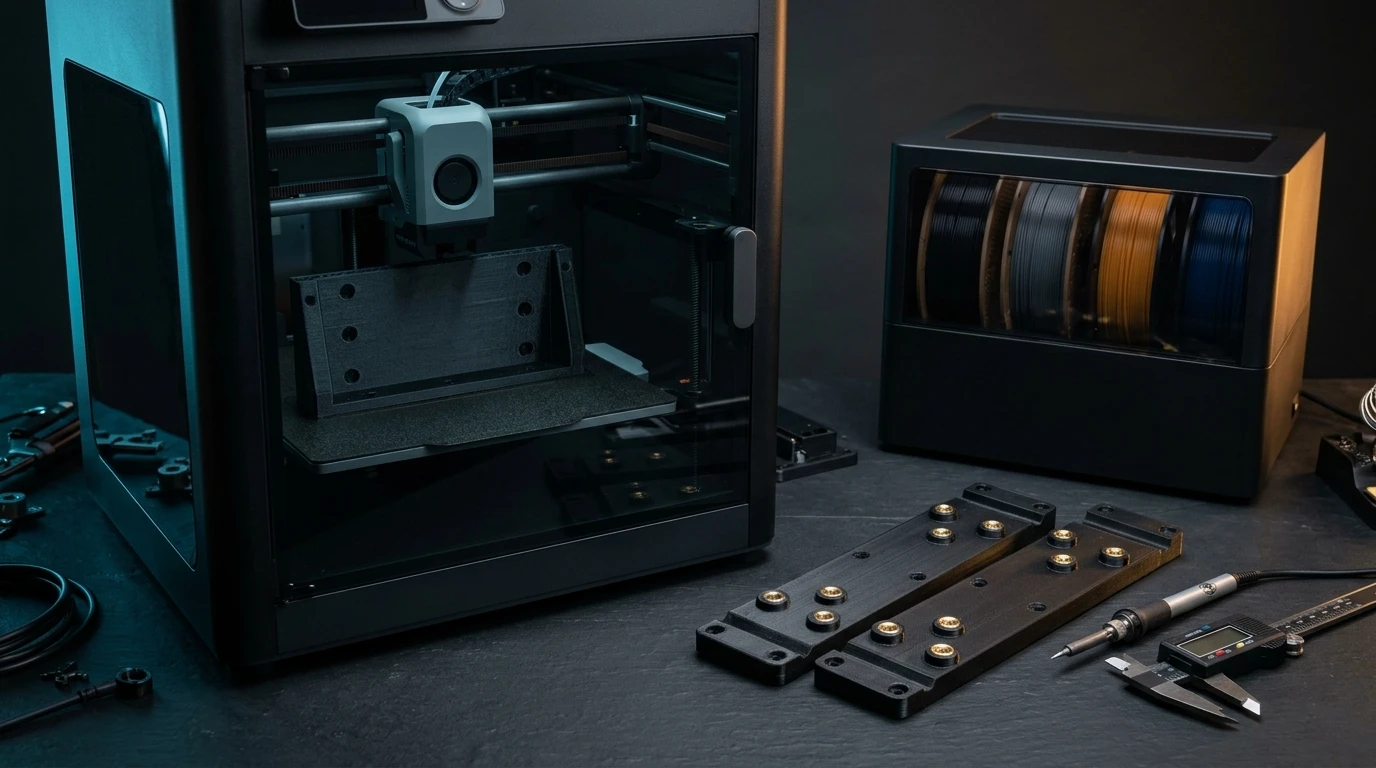
Core Fabrication Stack for Homelab Rack Mounts & Outdoor Brackets
Everything needed to print warped-free PETG and ASA parts, keep hygroscopic spools bone-dry, and tap repeatable machine threads into printed brackets.
1. Why PLA Fails in Server Racks & Cars: PETG vs ASA vs ABS vs TPU
Standard PLA is phenomenal for quick fit-check prototypes and desk trays, yet it is a ticking time bomb for functional infrastructure. Its glass transition temperature sits near 55°C—and under continuous static weight (known as polymer creep), a cantilevered shelf holding a Mini PC or switch starts drooping at just 40–45°C. Inside a compact 10-inch Mini Rack or enclosed 19-inch cabinet, a fanless 10G SFP+ or PoE+ switch and adjacent GaN/brick power supplies easily bathe nearby plastic ears in 45–60°C air. Leave a PLA phone or dashcam mount on a car dashboard in July sun and it turns into soft taffy inside an hour.
Choosing the right engineering filament solves creep permanently without jumping straight to exotic industrial resins:
PETG(Workhorse Indoor Rack & Bracket Standard,~75–80°CTg): Offers enough thermal headroom for ventilated 10"/19" switch ears, Mini PC trays, keystone patch frames, and indoor sensor clips. It resists brittle snapping better than PLA, prints with low odor on open or enclosed printers, and shows virtually zero warping on a textured PEI sheet.ASA(Outdoor UV & High-Heat Champion,~95–100°CTg): Chemically similar to ABS in stiffness and heat tolerance, but engineered to shrug off ultraviolet sunlight, rain, and frost without turning chalky or brittle. UseASAfor outdoor Ecowitt weather station mast brackets, PoE camera junction boxes, solar conduit clips, and hot engine-bay or windshield mounts.ABS(Tough Enclosed Mechanical Chassis,~100–105°CTg): Slightly less UV-stable outdoors than ASA, yet remains a classic choice for high-temp internal printer parts, enclosed fan ducts, and acetone-smoothed mechanical housings inside a heated chamber.TPU 95A / 85A(Anti-Vibration & Strain Relief): Flexible elastomer that absorbs hard-drive hum and high-RPM blower resonance. Printing customTPUisolation feet for a 4-bay NAS, shock-absorbing fan gaskets, or split rack cable grommets cuts chassis buzz noticeably compared to rigid plastic.
| Polymer | Safe Service Temp (Tg) |
UV & Outdoor Weather | Enclosure & Drying Needs | Best Homelab / Workshop Role |
|---|---|---|---|---|
PLA / PLA+ |
~50–55°C (creeps early) |
Poor (warps in sun, brittle) | Open printer fine; low moisture sensitivity | Room-temp desk organizers, cable combs, rapid dimensional test prints |
PETG |
~75–80°C |
Moderate (shaded outdoor OK) | Open or enclosed; must dry (60–65°C) to prevent stringing |
10"/19" rack ears, Mini PC sleds, PSU cradles, keystone panels, Pi cases |
ASA |
~95–100°C |
Excellent (UV-stabilized) | Enclosed CoreXY + HEPA/Carbon + dry spool (75–80°C) |
Outdoor weather/camera enclosures, hot car mounts, fanless switch shrouds |
ABS |
~100–105°C |
Fair (yellows in direct UV) | Enclosed CoreXY + HEPA/Carbon + dry spool (75–80°C) |
Internal printer shrouds, high-heat ducts, vapor-smoothed housings |
TPU 95A |
~75–80°C (elastomer) |
Good (resists flex fatigue) | Direct-drive extruder; dry thoroughly (50–55°C) |
Anti-vibration NAS/fan feet, rack drive isolators, split cable grommets |
PETG Structural
Handles warm 10"/19" rack airflow around switches and Mini PCs without styrene fumes—just keep the spool dry and add extra wall loops.
ASA Weatherproof
Built for direct UV radiation, roof poles, and summer windshields where PLA turns soft and PETG slowly fades or relaxes.
TPU 95A Isolators
Turns noisy rack shelves and spinning HDD cages into quiet mounts by decoupling vibration from metal rails.
2. Hygroscopic Moisture Physics: Why Active Filament Dryers Matter
Every engineering polymer—especially PETG, TPU, and PA (Nylon)—acts like a microscopic sponge for room humidity. That moisture sits trapped inside the solid plastic filament until it enters a 230–270°C nozzle, where liquid water flashes instantly into pressurized steam.
You can spot wet filament in seconds: faint popping or crackling sounds at the nozzle, tiny wisps of vapor, heavy spiderweb stringing between rack screw holes, and rough matte blisters along outer walls. Worse, those microscopic steam pockets fracture inter-layer adhesion so a PETG rack ear looks passable on the outside yet snaps clean along a layer line the moment you tighten an M6 cage nut.
- Active Heated Dryers (
SUNLU FilaDryer S4/S2,Creality Space Pi): A dedicated circulating heater holds steady convection airflow (50–70°C) to drive trapped water out of the spool without annealing or fusing wraps together—unlike risky kitchen ovens with wild thermostat swings. Four-bay dryers like theSUNLU S4let you dry and feed directly into the extruder via PTFE Bowden tubes while keeping backup spools ready. - Sealed Dryboxes & Silica Gel Desiccant: An active dryer removes moisture; an airtight tote or cereal container loaded with rechargeable orange-to-green silica gel beads and a digital hygrometer keeps relative humidity under
15–20% RHbetween prints so you are not re-baking the same spool every weekend.
3. Enclosed CoreXY Speed & VOC Fume Safety (Adventurer 5M Pro vs Creality K1C)
Open-frame bedslinger printers handle PLA and small PETG parts fine, yet they fight physics the second you load ASA or ABS. Cool room drafts across an open bed cause bottom corners of wide 10-inch rack faceplates to curl upward off the PEI sheet and split mid-print. Moving to an enclosed CoreXY platform fixes both geometry and workshop safety at once:
ASA / ABS): Melting ASA and ABS releases styrene-family volatile organic compounds (VOCs) and ultrafine particles (UFPs). Never run long ASA/ABS jobs beside your desk in an unventilated bedroom. Use an enclosed printer equipped with internal HEPA + activated carbon circulation, wait 10–15 minutes after the bed cools before opening the door so internal scrubbers cycle the chamber air, and place the printer in a ventilated workshop or garage exhaust zone.
| Workshop Machine | Kinematics & Build Volume | Enclosure & Air Filtration | Dryer / Material Match |
|---|---|---|---|
Flashforge Adventurer 5M Pro |
CoreXY • 220 × 220 × 220 mm • Quick-swap nozzles |
Full factory enclosure with dual-mode internal + exhaust HEPA 13 & activated carbon | Fits most 10-inch half-width brackets diagonally; clean out-of-the-box PETG and ASA workflow |
Creality K1C / K1 Max |
CoreXY • 220³ mm (K1C) / 300³ mm (K1 Max) • Hardened nozzle |
Enclosed chamber with rear carbon filter + active chamber fan; K1 Max spans full 10-inch (254 mm) faceplates flat |
Ideal for wide rack faceplates, carbon-filled PETG-CF / PA-CF upgrades, and multi-hour ASA enclosures |
SUNLU FilaDryer S4 / S2 |
4-spool (S4) or 1-spool (S2) active dryer |
Circulating PTC heater up to 70°C with live RH% readout & PTFE feed ports |
Keeps PETG, TPU, and PA bone-dry right up to the extruder inlet |
Creality Space Pi |
Single or dual-bay compact active dryer | 360° hot-air circulation, 45–70°C presets, touchscreen timer |
Compact bench companion beside a single CoreXY printer |
4. Designing 10"/19" Rack Ears That Hold Weight: Orientation, Walls & Heat-Set Inserts
Ninety percent of broken 3D-printed rack mounts fail because of slicer orientation—not weak filament. An FDM print is strongest along continuous extruded XY perimeters and weakest between stacked Z layers:
- Print Orientation (Layer Lines Perpendicular to Shear): Never stand a 1U rack ear vertically on its edge to save bed space. If layer lines run parallel to the front faceplate flange, the downward weight of an 8-port PoE switch pulls directly against weak Z-layer seams and shears the ear clean off. Lay the front faceplate or main L-bracket flat on the build plate so continuous perimeter loops wrap around both the rack cage-nut slot and the switch mounting arm. For tall side-wings, print modular interlocking ears flat and bolt them together with
M4orM5hardware. - Wall Loops Beat 100% Infill: Printing solid
100%infill wastes hours and invites warping without adding proportional bending stiffness. Instead, set4 to 6wall perimeters (about2.0–2.4 mmsolid outer skin on a0.4 mmnozzle),5–6top/bottom shell layers, and25–40%Gyroid infill for balanced three-dimensional rigidity. - Brass Heat-Set Inserts (
Ruthex M3 / M4 / M5) vs Captive Hex Nuts: Driving self-tapping wood screws directly into plastic strips threads after two maintenance pulls. Pressing knurled brass inserts into tapered or straight-bore bosses gives steel-bolt durability. Use a temperature-controlled USB-C PD soldering iron from our Pinecil / FNIRSI C245 soldering guide fitted with a dedicated brass heat-set tip—set slightly above printing temp (around220–240°Cfor PETG,260–280°Cfor ASA)—and let gentle gravity sink the insert flush without forcing molten plastic into the internal threads. Always measure hole shrinkage on a test coupon using digital stainless calipers first.
Wall Loops / Perimeters : 4–6 walls (minimum 2.0 mm solid wall shell)
Infill Pattern & Density: Gyroid @ 25%–40% (avoids linear shear planes)
M3 Brass Insert Boss    : 4.0 mm pilot hole | min 8.0 mm outer boss diameter
M4 Brass Insert Boss    : 5.6 mm pilot hole | min 10.5 mm outer boss diameter
M5 Brass Insert Boss    : 6.4 mm pilot hole | min 12.5 mm outer boss diameter
🧪 Interactive Filament, Drying & Brass Insert Engineering Selector (100% In-RAM)
Choose your target hardware environment, part filament weight, estimated print duration, and brass heat-set insert size to calculate polymer thermal match, dryer schedule, insert boss geometry, print energy in kWh, and a copyable slicer checklist.
5. Recommended Workshop Hardware: Enclosed CoreXY Printers, Dryers & Inserts
Flashforge Adventurer 5M Pro 3D Printer
Built-in air circulation scrubbers, auto-leveling, and tool-free quick-swap nozzles make this a dependable bench machine for moving cleanly from PETG rack brackets into warp-free ASA enclosures.
Creality K1C / K1 Max Enclosed CoreXY
Choose the compact K1C with hardened extruder internals for carbon-reinforced filaments, or step up to the 300 mm K1 Max build plate to print one-piece 10-inch (254 mm) rack faceplates flat on the bed.
SUNLU FilaDryer S4 / S2 Filament Dryer
Dries up to four 1 kg spools simultaneously in the S4 (or single-spool S2), stopping PETG popping and TPU stringing before moisture ever reaches the hotend melt zone.
Creality Space Pi Filament Dryer
Sleek benchtop dryer with one-touch polymer temperature curves for PETG, ASA, ABS, TPU, and PA, keeping hygroscopic spools bone-dry throughout multi-hour rack builds.
🛒 Complete SpecInfo Workshop Filament, Brass Insert & Metrology Bundle
Pair your enclosed CoreXY printer and active dryer with consistent dimensional spools, knurled Ruthex heat-set inserts, and stainless calipers before slicing your next rack shelf:
6. Related SpecInfo Homelab & Workshop Engineering Guides
- Proxmox Mini PC Cluster & 10-Inch Mini Rack: QDevice Quorum, Ceph vs ZFS & Rack Fabrication
- USB-C PD Soldering Irons (Pinecil V2 / FNIRSI HS-02), JBC C245 Tips & Brass Heat-Set Control
- Cloud-Free Local Home Weather Station (Ecowitt 868 MHz): Outdoor ASA Pole & Sensor Mounting
- Best 2.5GbE & 10G SFP+ Switches: Thermal Exhaust & Rack-Mount Sizing Guide