Cloud-Free Local Home Weather Station (Ecowitt 868 MHz): Ultrasonic Wind (Wittboy WS90), Soil Moisture (WH51), Solar PV & Garden Automation
Relying on cloud airport forecasts 30 km away leaves facade Venetian blinds exposed to backyard wind gusts and triggers lawn sprinklers in pouring drizzle. Here is the complete Sub-GHz hardware, zero-cloud Home Assistant setup, and automation blueprint using the Ecowitt Wittboy WS90, GW2000 Ethernet gateway, and WH51 soil probes.
Verified Ecowitt Ultrasonic Arrays, LAN Gateways & Sub-GHz Probes
Core modular hardware for building a zero-subscription local weather station. Always verify your regional Sub-GHz band (868 MHz in Europe/UK, 915 MHz in US/AU) on every sensor and gateway before checkout.
1. Why Cloud Airport Forecasts Fail Smart Home Automation
Most smart home platforms pull weather data from a free internet API tied to an official airport METAR station 20 to 40 km away. That works well enough for checking tomorrow's coat choice, yet it fails badly whenever physical hardware around your house depends on real-time conditions:
- Microclimate Wind Gusts on Facade Blinds: Open farmland or an airport runway measures smooth wind, while two neighbouring houses or a valley ridge channel violent sudden gusts right across your south-facing external facade Venetian blinds. By the time an hourly cloud forecast updates, bent aluminum slats are already knocking against the window frame.
- Patchy Rain Showers & Wasted Irrigation: Summer rain cells regularly soak one postcode while leaving a nearby town dry. A cloud forecast guessing a "40% chance of rain" either leaves your garden parched or lets automated valves soak an already saturated lawn.
- Roof Solar Irradiance (
W/m²) vs Ambient Lux: A generic "partly cloudy" icon tells you nothing about whether your hybrid solar inverter should pre-heat hot water or hold battery reserve. A local roof pyranometer outputs actual sunlight power inW/m²every 16 seconds, letting your hybrid solar inverter and blind rules react to real cloud edges. - Offline Resilience: If your fiber line drops during a severe storm—precisely when wind retraction and lightning alerts matter most—cloud weather integrations freeze at stale values, whereas local
868 MHzradio telemetry keeps flowing uninterrupted inside your home LAN.
2. Solid-State (Ecowitt Wittboy WS90) vs Mechanical Cups & Tipping Buckets (WS69 / WS80 + WH40)
Traditional consumer weather stations rely on spinning three-cup anemometers, pivoting wind vanes, and mechanical seesaw tipping-bucket rain gauges. Outdoors on a roof or garden pole, those moving parts face three constant enemies: autumn leaves wedged in the funnel, bird droppings, and spiders spinning webs across the tiny tipping spoon.
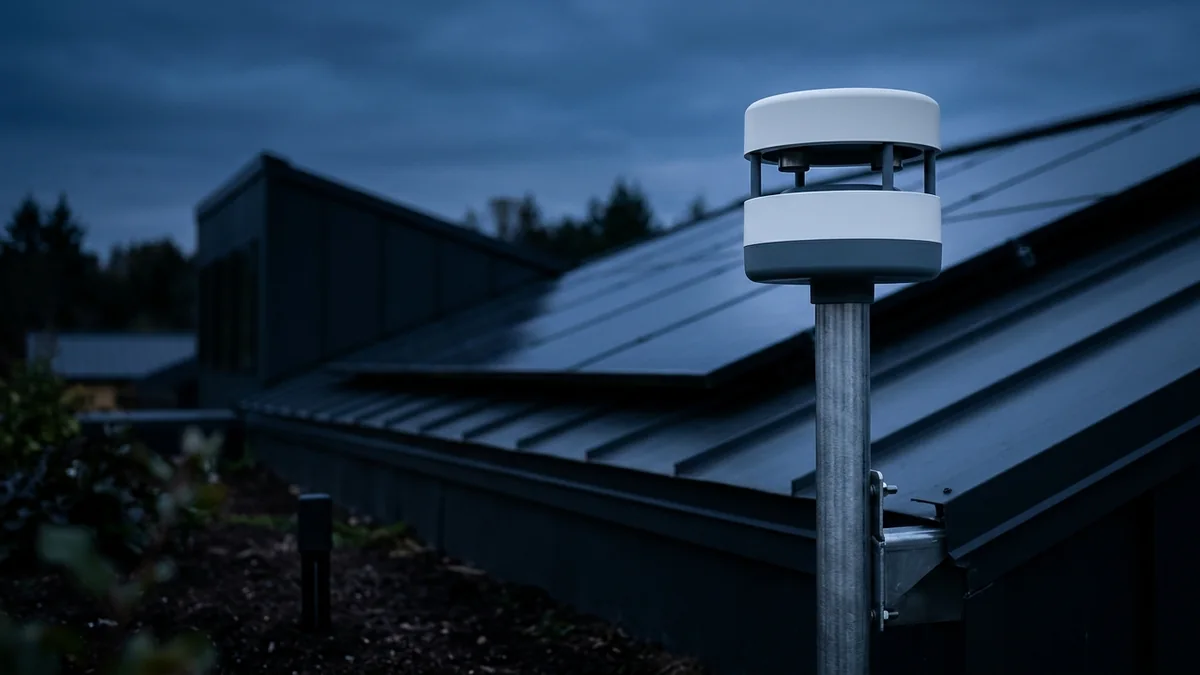
The Ecowitt Wittboy WS90 replaces every exposed moving part with solid-state engineering. Four recessed ultrasonic transducers bounce sound pulses across an open gap to measure wind speed and direction thousands of times per second with zero bearings to wear out or freeze stiff. On top of the cap, a haptic piezoelectric rain sensor detects the kinetic impact of individual raindrops—firing an instant "rain started" trigger in under 2 seconds, long before a traditional tipping bucket would even collect enough water for its first mechanical tip. Adding an optional 12V DC power cord activates an internal plate heater so winter sleet and snow melt cleanly instead of blocking readings.
There is one honest physical trade-off to know: piezoelectric caps excel at instant rain detection and heavy downpours, but very fine coastal mist or dense fog can slightly under- or over-estimate exact millimetre totals compared to a physical funnel. If you want both instant <2 s rain alerts and textbook millimetre rainfall logging, pair the WS90 with a separate ground-accessible WH40 self-emptying tipping bucket in your garden where cleaning out a leaf takes five seconds.
| Outdoor Array | Wind & Rain Mechanism | Maintenance & Speed | Best Engineering Fit |
|---|---|---|---|
Ecowitt Wittboy WS90(Solid-State 7-in-1) |
4-transducer ultrasonic wind + piezoelectric haptic rain + W/m² solar + UV + T/RH/pressure |
Zero moving parts; no stuck bearings or spider-jammed spoons; rain trigger in <2 s; optional 12V winter heater |
Top roof-mount choice for blind wind protection, instant awning/skylight rain close, and low-maintenance smart homes |
WS80 + WH40 Hybrid(Ultrasonic + Mechanical Rain) |
WS80 ultrasonic wind (high mast) + separate WH40 tipping-bucket rain funnel (low post) |
WS80 sits maintenance-free up high; WH40 sits at waist height for effortless funnel cleaning & mist precision |
Weather enthusiasts and gardeners demanding both rapid gust sensing and exact calibrated mm rainfall totals |
WS69 Traditional Array(Mechanical 7-in-1) |
Spinning wind cups + directional vane + built-in mechanical tipping-bucket rain spoon | Requires periodic ladder/pole cleaning of funnel mesh and spiders; bucket misses initial light drizzle until tip fills | Accessible pole mounts in open gardens where regular cleaning is easy and mechanical simplicity is preferred |
Wittboy WS90
Built for roofs and tall masts you never want to climb twice a year. Instant <2 s haptic rain response and lag-free ultrasonic gust sampling make it unmatched for facade blind & awning safety.
WS90 / WS80 + WH40
Keep the ultrasonic head high in clean airflow and mount the standalone WH40 tipping gauge on a reachable garden fence post for razor-sharp drizzle and 24-hour rainfall totals.
WS69 Mechanical
Classic cups and tipping spoon deliver reliable baseline telemetry when mounted low enough to rinse out autumn debris once a season.
3. Sub-GHz RF Frequency Lock (868 MHz vs 915 MHz) & Local LAN Architecture
868 MHz vs 915 MHz): Ecowitt hardware uses fixed-frequency Sub-GHz radio chips tuned at the factory for each region: 868 MHz for Europe and the UK, and 915 MHz for North America and Australia (with 433 MHz on legacy variants). You cannot change frequency in software. Buying an 868 MHz WS90 or WH51 probe for a 915 MHz gateway—or ordering an imported 915 MHz probe for a European 868 MHz gateway—results in 100% radio silence. Always match the exact MHz label across every box before clicking Buy.
Unlike Wi-Fi outdoor sensors that struggle through insulated brick walls and chew through batteries every few weeks, Ecowitt sensors transmit short Sub-GHz bursts up to roughly 100 m in open air—so AA cells easily run for a year or longer. Inside your home, a compact indoor gateway receives those Sub-GHz packets and bridges them onto your home network:
| Ecowitt Gateway | Network & Power | Local Integrations | Best Deployment Role |
|---|---|---|---|
GW2000 Hub |
Wired RJ45 Ethernet + PoE (802.3af) + Wi-Fi backup + USB-C |
Local HTTP POST Customized Upload + Local WebUI + native Home Assistant Ecowitt |
Homelab gold standard: plug straight into your PoE switch or Proxmox VE rack with zero Wi-Fi drops |
GW1100 Dongle |
2.4 GHz Wi-Fi + USB-A 5V power (includes wired indoor T/RH/pressure probe) |
Local HTTP POST Customized Upload + Local WebUI + native Home Assistant Ecowitt |
Compact plug-in bridge for apartments or placing near a window facing the garden without Ethernet drops |
HP2560 Console |
Wall/desk 7-inch TFT display + Wi-Fi + MicroSD historical CSV slot | Local Customized Upload to Home Assistant + at-a-glance family display without phones |
Kitchen or hallway wall dashboard giving instant wind, soil, and lightning readouts alongside HA logging |
How Zero-Cloud Customized Upload Works (16-Second LAN Telemetry)
Out of the box, the Ecowitt app offers cloud uploads to ecowitt.net. You can skip the cloud completely in two minutes: first add the official Ecowitt integration inside Home Assistant, which immediately gives you a unique local webhook path and port. Then open your GW2000 or GW1100 local web page (or Ecowitt app under Weather Services → Customized) and point the gateway straight at your Home Assistant LAN IP:
Customized Upload Profile (100% Offline):
Protocol Type   : Ecowitt (NOT Wunderground)
Server IP/Host  : 192.168.1.50              # Static LAN IP of your Home Assistant host
Path            : /api/webhook/ecowitt_xxxx # Exact webhook path generated by HA Ecowitt integration
Port            : 8123                      # Default Home Assistant HTTP port
Upload Interval : 16 seconds                # Fast local gust & rain detection on LAN
4. Modular Sensor Expansion (Sub-GHz ~100 m Open Range)
Once a single GW2000 or GW1100 gateway sits on your network, you do not need extra hubs for extra measurements. You can pair dozens of specialized Sub-GHz probes into the exact same receiver:
WH51Capacitive Soil Moisture Sensors (Up to 8 Channels): Unlike cheap resistive metal forks that corrode via electrolysis in wet dirt within one summer, theWH51uses an epoxy-sealed capacitive blade powered by a single1.5Valkaline AA battery. You can run up to 8 separate channels across lawn zones, raised vegetable beds, and greenhouse pots, then run a quick two-point dry-air / water-cup calibration in the gateway UI for clean0–100%moisture percentages.WH57Lightning Strike Detector: Listens for radio-frequency electromagnetic pulses from cloud-to-ground and cloud-to-cloud discharges, estimating storm-front distance in kilometres and counting recent strikes. Mount it under an open wooden porch eave or sheltered north wall away from switching power supplies and plasma TVs to avoid false electrical noise.WN34Stainless Steel Waterproof Probe Thermometer: Features a slender food-grade stainless sensor on a durable cable wired back to a compact battery transmitter. Drop the probe inside a garage deep chest freezer (instant alert if temperatures climb above-14°Cduring a breaker trip), a garden pond, hot tub, or root-zone soil depth.WH45/WH46Indoor Air Quality Station: Adds true photoacoustic/NDIR CO2ppm tracking alongsidePM2.5andPM10particulate dust counters on the same gateway, letting Home Assistant boost mechanical ventilation or close outdoor air dampers during winter wood-smoke inversion episodes.
5. Four High-ROI Local Automations Connecting Your Smart Home Ecosystem
Telemetry sitting in a pretty graph is passive entertainment; tying those 16-second readings into actuators turns weather data into real property protection and energy savings:
- Wind Storm Retraction (Facade Venetian Blinds & Patio Awnings): Connect your
WS90gust entity to the cover controllers from our Smart Roller Shutters & Facade Blinds guide. The moment wind gusts exceed45 km/h(or 1-minute sustained wind stays above35 km/h), force exterior blinds and fabric awnings to100% Open / Retracted—and enforce a 30-minute calm cooldown hysteresis before allowing automatic lowering again so gusty lulls do not yo-yo slats back down into danger. - True Soil-Moisture Irrigation (Zero Watering in Rain or Wet Turf): Replace blind sprinkler timers with a three-part condition tied to your smart Zigbee garden water valve: trigger morning irrigation only when your lawn
WH51probe reads below32%, liveWS90rain rate equals0 mm/h, and trailing 24-hour rainfall totals stay below5 mm. - Roof Solar Irradiance (
W/m²) PV Diagnostics & Summer Shading: Compare yourWS90solar irradiance sensor (W/m²) side-by-side against live DC string power from your hybrid solar & LiFePO4 battery system. If the roof pyranometer reports blazing800 W/m²midday sun while PV output sits near zero, Home Assistant alerts you immediately to a tripped DC isolator, inverter fault, or heavy snow/pollen blanket. Simultaneously, whenever afternoon irradiance crosses>550 W/m²in summer, tilt south and west facade blinds before indoor temperatures climb. - Lightning Storm Guard (
WH57Inside 15 km): When theWH57registers lightning discharges closer than15 km, broadcast a chime to wall tablets and mobile phones, remind family to pull outdoor cushions or close motorized roof skylights, and run a proactive check on your Proxmox VE & Home Assistant UPS status.
🌦️ Interactive Local Weather Station & Automation Planner (100% In-RAM)
Select your RF region band, LAN gateway, outdoor wind/rain array, lawn size, soil probes, and automation modules to generate a frequency-safe BOM, seasonal water savings estimate, Customized Upload profile, and copy-ready Home Assistant YAML.
6. Recommended Hardware Picks: Cloud-Free Ecowitt Station & Sub-GHz Probes
Ecowitt Wittboy WS90 7-in-1 Ultrasonic Station + GW2000 Ethernet Gateway (868 MHz)
Maintenance-free solid-state outdoor sensor cap paired with a rock-solid wired Ethernet/PoE receiver. Fires instant rain alerts in under 2 seconds and streams local 16-second telemetry straight into Home Assistant.
View on Amazon ↗Ecowitt GW1100 Wi-Fi Gateway / HP2560 Console (868 MHz)
Choose the compact USB GW1100 dongle for effortless window-ledge Wi-Fi placement or step up to the HP2560 color console for wall-mounted readouts and MicroSD historical logging alongside Home Assistant.
Ecowitt WH51 Capacitive Soil Moisture Sensor (868 MHz)
Corrosion-proof capacitive probe that measures real root-zone moisture percentage instead of guessing from cloud forecasts. Supports up to 8 independent channels on one gateway for lawns, beds, and greenhouses.
View on Amazon ↗Ecowitt WH57 Lightning Detector & WN34 Freezer/Pool Probe (868 MHz)
Monitor approaching storm fronts within 15 km via WH57 strike telemetry and protect chest freezers, hot tubs, or garden ponds from silent power trips using the wired WN34 stainless probe.
7. Related SpecInfo Smart Home & Energy Engineering Guides
- Smart Roller Shutters, Facade Blinds & Motorized Curtains: Tuya Zigbee vs Wi-Fi vs Shelly 2PM vs SwitchBot
- Smart Home Essentials: Zigbee Scene Buttons, Appliance Plugs, IR/RF, Garden Water Valves, MVHR & Safety
- Hybrid Solar Inverter vs On-Grid String Inverter: MPPT Sizing, String Voc & Zero-Export Blueprint
- Smart Energy System Blueprint: Combining Hybrid Solar, LiFePO4 Batteries & Home Automation
- Home Assistant + Zigbee2MQTT on Proxmox: SONOFF ZBDongle-E EmberZNet Flash & Local Mesh Guide