Dual-Lens & 180° Articulating Endoscope Inspection Cameras + Wall Cable Detectors: Safe Conduit Pulling, Drywall & Engine Cylinders
Blind drilling into a live 230V ring main, kinking armored fiber inside a tight 20 mm conduit, or peering at a blurred cylinder wall through a cheap USB phone snake costs far more than proper field optics. Here is the engineering playbook for 3.9–8 mm Dual-Lens and 180° articulating borescopes, tri-sensor wall scanners with static grounding, NCV confirmation, and 40% fill-safe cable pulling.
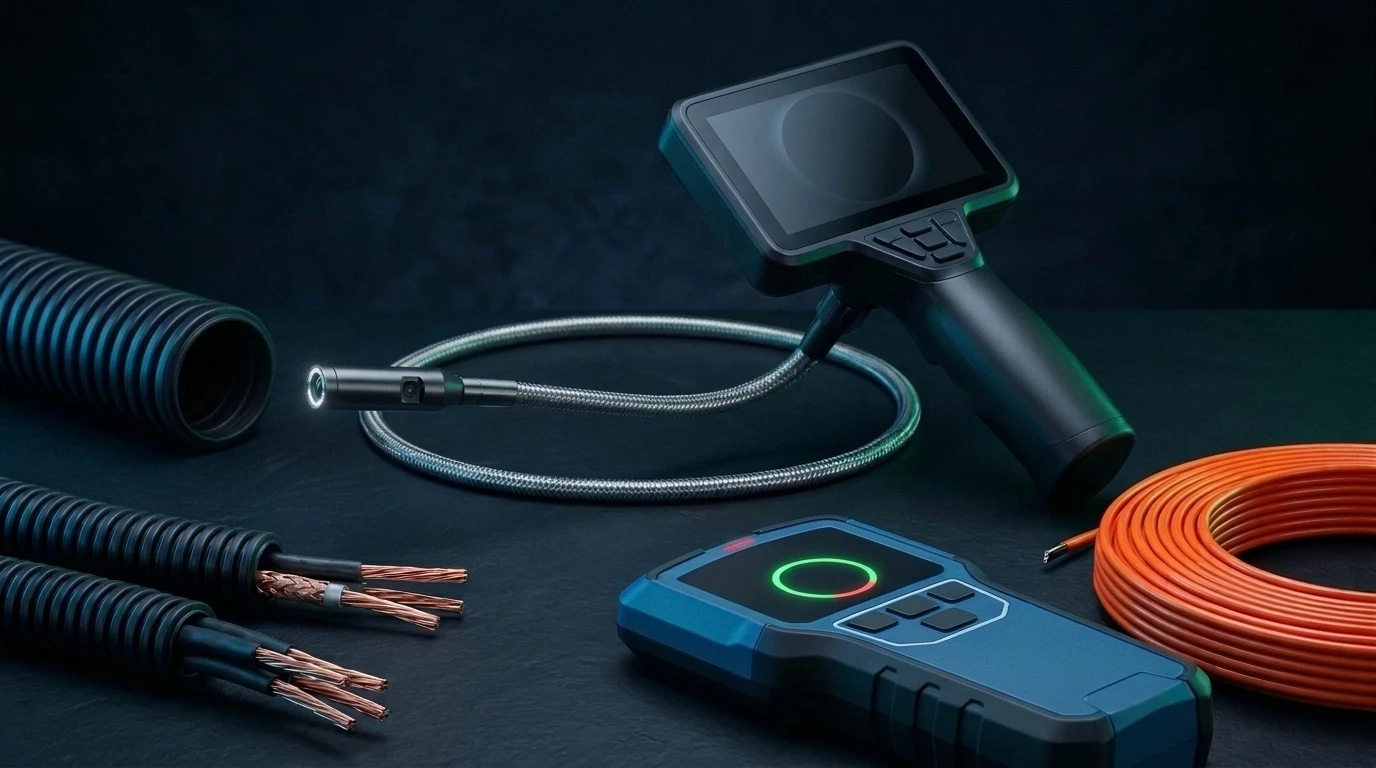
Field-Ready Dual-Lens Endoscopes, Wall Scanners, NCV Testers & Fish Tapes
Core diagnostic hardware for routing network drops, auditing HVAC coils, scanning masonry before drilling, and inspecting spark-plug bores without guessing.
1. Why Cheap USB Phone Endoscopes Fail Inside Conduits, Drywall & Cylinders
Every technician eventually tries a bargain USB-C snake camera plugged into a smartphone—and almost every one abandons it after the first real job. Inside a narrow 20 mm corrugated duct, a dusty wall cavity, or a car spark-plug well, three physical flaws turn cheap phone probes into an opaque smudge:
- Fixed Long Focal Length & Macro Blur: Typical bargain modules focus sharply at
5–10 cmor farther, yet the inside wall of a20 mmconduit or copper pipe sits only0.5–1.5 cmfrom the glass. Modern Dual-Lens probes use one wide forward lens (3–8 cmsweet spot) paired with a side-facing macro lens tuned for2–10 cm(and usable down to ~1.5 cmalong pipe walls), keeping solder joints and cable snags razor sharp. - Harsh Uncontrolled Glare vs Matte Contrast: Honed steel cylinder liners, wet PVC bends, and aluminum HVAC fins reflect raw white LEDs straight back into cheap CMOS sensors, blowing out every detail into a white blob. Quality standalone IPS scopes (like Depstech DS520 or Teslong TD500) add multi-step dimmed LED rings and wide-dynamic-range sensors that preserve piston-crown carbon texture and pipe crack edges.
- Clip-On Mirrors Fall Off & Phone OTG Drops Out: Bargain probes ship with a tiny screw-on
45°mirror cap that routinely vibrates loose inside a combustion chamber or snagging conduit—creating a costly retrieval headache. Meanwhile, Android OTG permissions and third-party USB apps nag for network access or crash just as your hands are covered in oil and drywall dust. A dedicated battery-powered IPS screen boots in three seconds and works reliably with gloved hands.
Dual-Lens (Front + 90° Side) vs 180° Two-Way Articulating Probes
Before buying, match the tip geometry to the space you inspect most often:
| Probe Architecture | Typical Tip OD & Optics | Cable & Control | Where It Excels (and Fails) |
|---|---|---|---|
| Dual-Lens IPS Scope ( Depstech DS300 / DS520) |
5.5 mm to 8.0 mm sealed head with front + 90° side camera; 2–10 cm focus |
Semi-rigid gooseneck cable (holds shape through wall voids & ducts); 1-button split/switch | Best for conduit obstructions, drywall cavities, P-traps & HVAC drains. Zero falling mirror caps. Cannot bend backward inside a wide chamber. |
| 180° Two-Way Articulating ( Teslong TD450S / TD500) |
3.9 mm, 6.0 mm or 8.5 mm micro head; 2–10 cm macro focus + high-temp warning |
Thumb-wheel / joystick steering bends neck 180° each way; tungsten-braided shaft |
Gold standard for automotive cylinders, intake valves, ceiling joists & AC evaporator coils where you must look back toward the entry hole. |
| Cheap USB-C Phone Snake (Generic Fixed Lens) |
Bulky 8.5 mm rigid head; fixed single lens; clip-on mirror risk |
Limp PVC cable coils inside ducts; relies on flaky phone OTG apps | Acceptable only for checking under a fridge or behind a desk—unreliable inside 20 mm corrugated bends or engine bores. |
Teslong TD450S / TD500 (180°)
Two-way joystick steering lets a 6 mm or slender 3.9 mm tip drop down a spark-plug well or ceiling cutout and U-turn 180° to inspect intake valves, cylinder cross-hatching, or joist notches—pairing naturally with diagnostics from our OBD2 & automotive diagnostic guide.
Depstech DS300 / DS520 (Dual-Lens)
Semi-rigid cable pushes cleanly down 20 mm and 25 mm conduits or across insulated stud bays while switching instantly from forward travel view to 90° wall-seam inspection.
Respect Tip Thermal Limits
CMOS camera tips are rated around 60°C–80°C (some articulating units trigger an auto-shutdown alarm above 75°C). Always let an engine block or exhaust manifold cool below hand-warm before inserting any borescope.
1.1 Drainage Engineer & Sewer Push-Rod Cameras (30–50 m Fiberglass Reels, 512 Hz Sonde & Self-Leveling)
If your goal is inspecting blocked foul drains, inspection chambers, rainwater gullies, or under-slab sewer runs (40–150 mm pipes) rather than electrical conduits or engine cylinders, a handheld 1–5 m borescope will hit a wall almost immediately. After roughly 1.5–2 m inside a wide drain, a thin 8 mm borescope cable simply coils up instead of pushing forward—and as the cable twists through elbows, you quickly lose track of whether a crack or fatberg is on the ceiling or floor of the pipe.
This is where drainage engineer CCTV push-rod systems take over: heavy-duty reels carrying 30 m to 50 m+ of stiff semi-rigid fiberglass push rod feeding a sealed 23 mm stainless-steel IP68 camera head:
| Drainage Engineer Feature | Real-World Field Function | Why It Beats Handheld Borescopes |
|---|---|---|
Fiberglass Push-Rod Reel (30–50 m, 5–7 mm) |
Rigid enough to push across 30+ meters of lateral clay or PVC pipe while flexing smoothly past 90° swept bends via a stainless spring neck. |
Thin handheld borescope leads buckle after ~1.5 m in wide 50–110 mm drains. |
Gravity Self-Leveling Head (23 mm Sapphire Glass + Skids) |
An internal weighted bearing keeps the video horizon upright automatically; snap-on centering skids keep the lens above standing sludge. | Prevents disorientation when documenting leaks for builders or property insurers. |
Built-In 512 Hz Sonde Transmitter + Surface Locator |
Emits a 512 Hz underground radio beacon detected from above ground with a matching handheld wand to mark the exact dig spot and depth. |
Eliminates trenching across an entire driveway when clay joints collapse or tree roots intrude. Note: ensure you bundle or own a 512 Hz receiver wand—the camera head only transmits. |
| Digital Meter Counter & Sun-Visor DVR | Overlays real-time distance (m / ft) onto recorded 1080p SD-card video on a shaded 9"–10" IPS field monitor. |
Produces audit-grade homebuyer and drainage survey footage with exact defect footage markers. |
2. Wall & Cable Scanning: Tri-Sensor Detectors & Free-Hand Static Grounding
Drilling a single 8 mm anchor hole blindly into drywall or masonry can pierce a live 230V AC ring main, nick a pressurized copper heating pipe, or rupture a PEX-Al-PEX manifold loop. Basic magnetic-only stud finders catch drywall screws and timber frames, yet completely ignore plastic-sheathed cables or non-magnetic copper pipework.
True 3-mode tri-sensor wall scanners combine three distinct physics engines inside one puck:
- Inductive Ferrous Metal Sensor: Detects magnetic rebar, steel conduit, cast-iron stacks, and drywall nails deep inside masonry or plaster.
- Non-Ferrous Eddy-Current Sensor: Flags non-magnetic copper water pipes, brass manifolds, aluminum foil backing, and PEX-Al-PEX multilayer tubing.
- Passive 50/60 Hz Live AC Electric-Field Sensor + Dielectric Stud Mode: Senses alternating electric fields around energized
230V/120Vconductors alongside density shifts behind gypsum board to mark timber or metal stud edges.
| Wall Detector | Detection Modes | Depth & Interface | Best Field Role |
|---|---|---|---|
Bosch Professional GMS 120-27 |
Magnetic metal, non-magnetic copper, live 50/60 Hz wire, timber studs (with object-type icon) |
Deep masonry/drywall scan (up to ~100–120 mm ferrous, ~50 mm live AC) + center-finder crosshairs + drill-mark slot |
Top choice for installers & frequent renovators: clearly separates copper pipe vs rebar vs live wire with center precision. |
Bosch Truvo |
Auto-combining ferrous/non-ferrous metal & live AC wire detection (no manual mode switching) |
Simple 3-color traffic-light LED ring (Green / Amber / Red) + single-button auto-calibration | Fastest DIY safety check before hanging TV brackets, shelves, or curtain tracks when you just need a clear Go / No-Go drill signal. |
Why it fails : Dry plasterboard, painted drywall, and OSB hold static surface charges.
              Moving a capacitive AC scanner across ungrounded wallboard triggers constant
              false "LIVE WIRE EVERYWHERE" red alerts even with zero cables nearby.

The fix     : 1. Hold the scanner in your scanning hand, turn it ON in the air away from pipes.
              2. Place the bare palm of your OTHER (free) hand flat against the wall ~15 cm
                 beside the scanner and keep it sliding/grounded while you scan slowly.
              3. Your body safely bleeds static charge off the gypsum surface—false alarms
                 vanish instantly while genuine 50/60 Hz energized cables remain razor-sharp.
              4. ALWAYS double-check any suspect zone with a dual-range NCV pen at open boxes.
12–1000V and 90–1000V): test on a known live socket, verify zero signal on the isolated conductor, then re-test the known live socket to prove your tester's batteries didn't die mid-job. Note that metal-armored SWA cables, foil-backed insulation, or damp fresh plaster can shield AC electric fields from both wall scanners and NCV pens.
3. Conduit Pulling Without Kinking Fiber or Tearing Cat6A Jackets
Once the wall scan clears your drill path and your endoscope confirms the conduit bend isn't full of dried mortar or a trapped pull string, the mechanical pull itself determines whether your 10GbE Ethernet or OS2 fiber link works on the first test:
- Nylon vs Fiberglass Fish Tape (Klein Tools / Super Rod): Flat spring-steel fish tapes scratch corrugated PVC ridges, conduct electricity dangerously if they stray into an energized panel, and take permanent kinks. Nylon/PET fish tapes glide around tight sweeps with low friction and zero conductivity, while modular fiberglass glow-rods (like Super Rod kits) bridge long suspended ceiling voids and straight wall drops without buckling.
- Why Tight
90°Elbows Bind: Pulling force multiplies around every sharp bend—two tight90°elbows in sequence can lock cables solid mid-run. Always inspect unknown ducts with your borescope first, swap tight plumbing-style elbows for sweeping long-radius bends or pull boxes, and tape cable ends into a smooth tapered bullet head (never a blunt lump of electrical tape). - The
40%Conduit Fill Rule: Industry cabling standards cap total cable cross-section at 40% of the conduit's internal area when pulling three or more cables. That60%breathing room stops jackets from friction-welding around curves, prevents tight compression that causes macro-bending light loss in fiber, and keeps PoE++ Ethernet bundles cool. - Verify Copper Integrity After the Pull: Pulling too hard over sharp drywall screws or exceeding the
40%fill stretches twisted pairs and spikes crosstalk. After terminating, verify conductor continuity and check length/faults using the practices in our Pure Copper Cat6A vs Fake CCA & TDR Tester guide—and confirm optical fiber patch standards via our SFP+ Fiber Optic & SC/LC Connector guide.
📏 Interactive Conduit Fill, Endoscope Clearance & Pull Safety Calculator (100% In-RAM)
Enter your Cat6/Cat6A Pure Copper runs, armored OS2/OM4 fiber links, 3×2.5 mm² mains cables, conduit size, and bend count to verify compliance against the 40% safe fill limit, required endoscope tip diameter, and fish tape strategy.
4. Recommended Field Hardware Picks (Optics, Wall Scanners, NCV & Fish Tapes)
Teslong TD450S / TD500 Articulating Borescope
Steers cleanly back toward intake valves, weld seams, and ceiling joists with one thumb—leaving phone OTG crashes and falling clip-on mirrors behind.
View on Amazon ↗Depstech DS300 / DS520 Dual-Lens IPS Endoscope
Dedicated IPS inspection screen with instant electronic switching between forward travel view and 90° side inspection inside 20–32 mm ducts and drywall bays.
View on Amazon ↗Bosch Professional GMS 120-27 Wall Scanner
Separates magnetic rebar, non-magnetic copper heating pipes, timber studs, and energized AC conductors with illuminated object-type icons and center markings.
View on Amazon ↗Bosch Truvo Digital Wall & Cable Detector
Zero-menu wall detector built for fast pre-drill checks on plasterboard and brick before mounting racks, access points, or wall brackets.
View on Amazon ↗Klein Tools / Super Rod Fiberglass & Nylon Fish Tape
Pulls Cat6A and armored OS2/OM4 optical fiber across suspended ceilings and conduit bends safely without kinking steel tape or risking panel shorts.
View on Amazon ↗Fluke 1AC II / Klein NCVT-3P Non-Contact Voltage Tester
Pocket-sized non-contact voltage pen for confirming breakers truly killed power inside wall boxes and trunking before stripping jackets or cutting conductors.
View on Amazon ↗Self-Leveling 512 Hz Sewer & Drain Push-Rod Camera (30m–50m)
Full-reel fiberglass push-rod camera system (Sanyipace / Anysun / VEVOR 512Hz Pro) with sun-visor DVR and centering skids for deep blocked drains, root ingress, and pre-purchase CCTV pipe surveys.
View on Amazon ↗512 Hz Sonde Pipe Locator Receiver Wand (Far / Near Mode)
Essential surface companion wand paired with 512 Hz drain camera heads to trace sewer pipe paths and mark collapsed joints or blockages from ground level before digging.
🛒 Complete Blind-Wall, Conduit, Drain & Cylinder Inspection Stack (Amazon OneLink)
Everything needed to scan walls accurately, inspect tight 20 mm ducts, trace 50 m sewer drains with a 512 Hz sonde, verify zero voltage, and pull Ethernet or fiber cleanly:
5. Frequently Asked Questions (FAQ)
❓ Why are cheap USB phone endoscopes blurry inside 20 mm pipes and engine cylinders?
Budget USB snakes rely on fixed-focus lenses aimed around 5–10 cm, un-diffused LEDs that wash out reflective steel or white PVC, and floppy 8.5 mm heads without side optics. Dedicated IPS Dual-Lens and 180° articulating probes use tight 2–10 cm macro optics, stepped LED brightness, and semi-rigid or steerable shafts built for narrow spaces.
❓ Should I buy a Dual-Lens endoscope or a 180° articulating borescope?
Choose a Dual-Lens probe (Depstech DS300 / DS520) for straight or gently curved ducts, drain traps, and wall voids where instant switching between forward and 90° side lenses beats screw-on mirrors. Choose a 180° articulating probe (Teslong TD450S / TD500) for automotive cylinders, intake valves, and ceiling joists where you need to steer backward toward the entry opening.
❓ How does free-hand static grounding fix wall scanner false alarms?
Dry plasterboard and OSB panels hold electrostatic surface charge that fools capacitive live-wire sensors. Resting your free bare palm flat against the wall ~15 cm from the Bosch GMS 120-27 or Truvo bleeds static through your body, silencing phantom beeps so genuine 50/60 Hz cables stand out accurately.
❓ Why is the 40% conduit fill limit critical for Cat6A and optical fiber?
Exceeding 40% cross-sectional area traps cables inside bends, causing pulling friction that tears outer jackets, kinks delicate fiber cores, and blocks cooling around PoE+ bundles. And never share a conduit between unshielded Ethernet and 230V AC mains.
❓ Can a 5 m wall endoscope inspect blocked sewer drains, or what does a drainage engineer use?
A 1–5 m handheld borescope coils up after ~1.5 m inside wide 50–110 mm foul or stormwater drains and cannot keep the horizon upright. Drainage engineers use a dedicated 30–50 m fiberglass push-rod reel with a 23 mm self-leveling IP68 camera head, centering skids, digital meter counter, and built-in 512 Hz sonde transmitter paired with a handheld 512 Hz surface locator wand.
6. Related SpecInfo Diagnostics, Cabling & Automotive Guides
- Pure Copper Cat6A vs Fake CCA Ethernet: TDR Testers, PoE Drop & Safe Termination
- OBD2 Scanners (vLinker vs ELM327), 12V AGM Battery Testers & Automotive Thermal Inspection
- SFP+ Fiber Optic Connectors (SC vs LC, APC vs UPC), OS2 vs OM4 & Switch Sizing
- ITAD & Repair Workbench Tools: Thermal Cameras, USB-C Power Meters & BIOS Programmers