Pure Copper Cat6A (AWG23) vs Fake Aluminum CCA “Cat 8” Cables, TDR Testers & PoE+ Beyond 100m
Installing Reolink PoE cameras or ceiling Wi-Fi 7 access points only to watch them drop to 100 Mbps—or mysteriously reboot every single night at dusk? Nine times out of ten, the switch is fine and the hidden culprit inside your wall is fake Copper-Clad Aluminum (CCA) cable sold under flashy “Cat 8” labels. Here is how to spot counterfeit aluminum reels in 3 seconds, locate nail-pierced drywall runs to the exact metre with a TDR cable tester, and push rock-solid PoE+ out to 200–300 metres.
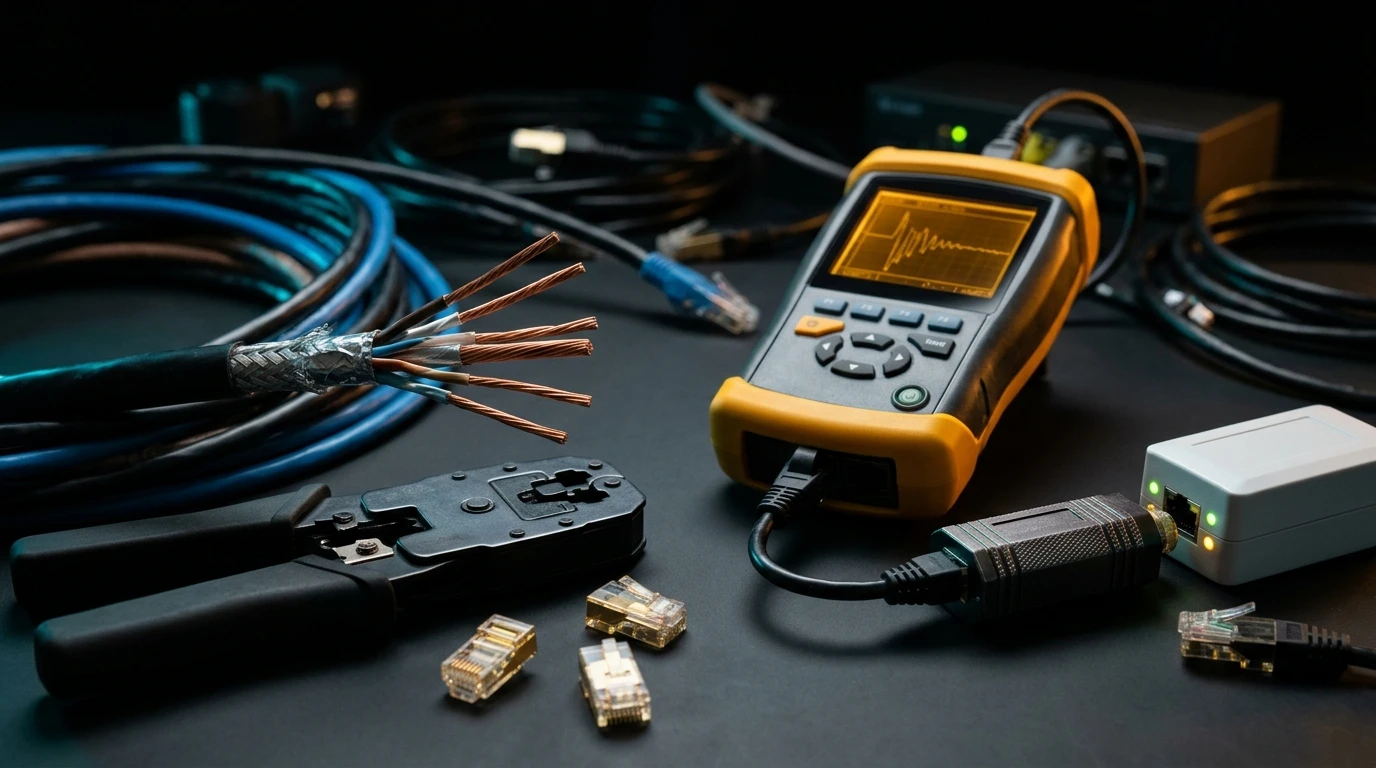
🚨 WHY CHEAP “CAT 8” CCA CABLES REBOOT CAMERAS & FAIL SAFETY CODES
Copper-Clad Aluminum (CCA) is banned by UL 444 & TIA-568 structural cabling standards. Because aluminum conducts roughly half as well as copper, long runs suffer massive PoE voltage drop: a camera runs fine in daylight, then snaps offline every night when its infrared LEDs ignite. Worse, running PoE+ (30W) or PoE++ (60W) over bundled CCA heats jackets inside wall cavities, and solid CCA conductors snap inside punch-down jacks within months.
1. The “Cat 8” & CCA Aluminum Scam: Why Cameras Reboot Every Night
Search any online marketplace for “Cat 8 Ethernet cable” and you will find suspiciously lightweight, dirt-cheap flat patch cords and reels promising 40 Gbps speeds. Put one in the wall for a Reolink PoE security camera or a ceiling Wi-Fi 7 access point, and a bizarre pattern starts:
- Daytime deception: In bright daylight the camera sips a modest amount of power, stays online, and shows a steady link light.
- The dusk IR crash: The moment darkness falls, internal infrared LEDs or spotlights flip on and power demand doubles or triples. Over high-resistance Copper-Clad Aluminum (
CCA) or razor-thin AWG28 flat wire, voltage drops like a rock between your switch and the camera—causing the camera to brown out, cut its IR LEDs, reboot, turn IR back on, and loop until morning. - Snap-off brittle cores: Pure copper bends and holds neatly inside punch-down keystones. Aluminum work-hardens quickly—give a CCA core three sharp bends during wall-box installation and it snaps right at the jacket.
Aluminum CCA & Flat “Cat 8”
Roughly 55% higher electrical resistance than pure copper. Causes nighttime PoE camera drops, heats up inside conduits, and cracks at sharp 90° wall corners.
100% Solid Bare Copper AWG23 Cat6A
Low DC resistance handles 60W–90W PoE++ effortlessly, runs clean 10 Gbps up to 100 metres, and bites securely into wall keystones and patch panels for decades.
Blade Scrape + Magnet Test
Scrape a stripped strand with a sharp blade: orange all the way through = pure copper. Silver core = CCA aluminum. If a strong magnet pulls it = cheap Copper-Clad Steel (CCS)!
🧮 Interactive PoE Voltage Drop & Cable Auditer (Pure Cu vs Fake CCA)
Check if your camera, Wi-Fi 7 AP, or gate intercom will survive nighttime PoE+ loads before pulling cable through walls—100% local in RAM.
# Generated SpecInfo Switch / NIC Link Integrity Audit
2. Why Cheap Blinkers Lie: TDR Cable Testers & Pass-Through RJ45 Termination
Every toolbox starts with an eight-LED wire-map blinker, and every builder eventually learns its blind spot: it only confirms DC continuity from pin 1 to pin 1. It happily lights up 1-through-8 green on three faults that cripple real networks:
- Split pairs (crossed untwisted pairs): Swapping two wires correctly on both ends gives 1-2-3-4-5-6-7-8 sequential LEDs, yet destroys noise cancellation and caps gigabit ports down to 100 Mbps or constant packet drops.
- Hidden mid-wall nail & rodent bites: If a drywall screw grazes Pair 2 (pins 3 & 6) thirty-four metres above a suspended ceiling, a dumb LED box only tells you “pin 3 is open”—leaving you guessing which room to cut open.
- Live switch PoE verification: Confirming whether an outdoor drop is receiving passive 24V (which fries modern devices) or negotiated
IEEE 802.3at/btbefore plugging in an expensive camera or 2.5GbE PoE+ switch port.
Noyafa NF-8209S / Klein Tools VDV501-851 (Scout Pro 3)
Instead of guessing behind plasterboard, a TDR (Time-Domain Reflectometer) fires a harmless test pulse down all 8 wires and measures the reflection timing—printing on screen that Pair B breaks cleanly at, say, 18.4 metres (exact ceiling bend or wall junction). Digital anti-interference wire tracers isolate unlabeled bundles inside noisy racks without AC hum.
100% Bare Copper AWG23 Reel + Klein / VCELINK Pass-Through Crimper
Pass-through RJ45 plugs + flush-trim crimpers let all 8 color-coded wires poke cleanly out the front of the connector so you can visually verify the exact T568B sequence (White-Orange, Orange, White-Green, Blue, White-Blue, Green, White-Brown, Brown) before squeezing once to crimp and trim flush. Note: flush blades must leave zero protruding copper whisker on metal shielded plugs so end pins never short-circuit a grounded hood.
3. Reaching Gates & Garages Beyond 100m + Storm Surge Armor
Standard IEEE Ethernet signals and PoE power are strictly designed for a maximum run of 100 metres (90m solid wall cable + up to 10m combined patch leads). What happens when a driveway gate, barn, or detached workshop sits 160m to 260m away with zero mains power midpoint?
- Inline Passive
IP67 PoE+ Extenders(100m → 200m / 300m): Waterproof inline repeaters splice directly mid-span inside a buried conduit or fence post with zero wall outlet needed. Powered purely by your core switch's PoE++ (802.3bt) or strong PoE+ supply, each repeater regenerates clean Ethernet timing and passes remaining DC wattage down the next 100 metres. - When to Switch to Fiber Instead: If two separate buildings have their own independent electrical earthing rods—or if you want 10 Gbps with zero lightning induction path across open soil—skip long outdoor copper entirely and bury pre-terminated Single-Mode OS2 optical fiber paired with compact SFP+ switches.
- Mandatory Outdoor Surge Arrestors (
Ubiquiti ETH-SP-G2): Any outdoor Ethernet run feeding an exposed pole-mounted camera or rooftop wireless bridge acts like a giant antenna during nearby lightning strikes. Mounting a grounded Ethernet surge protector just before the cable enters your house shunts destructive spikes straight to earth instead of blowing out your switch and NVR motherboard.
Waterproof IP67 PoE+ Extender + Ubiquiti ETH-SP-G2 Surge Protector
Tighten IP67 waterproof glands onto smooth UV-rated outer PE cable jackets and mount a grounded Ubiquiti ETH-SP-G2 surge arrestor right at the exterior wall entry point. Keep PoE links isolated cleanly behind an OPNsense No-WAN Camera VLAN so an exterior wall RJ45 jack never gives an intruder access to your indoor LAN.
4. Verified Cabling, TDR Testers & PoE Extension Matrix
Filter by pure copper cable stock, TDR diagnostic meters, or outdoor PoE repeaters & surge defense. Zero fixed retail prices—check live Amazon UK / Global stock directly:
| Hardware Model / Type | Core Engineering Spec | Standard & Speed | Killer Field Advantage | Best Application | Check Availability |
|---|---|---|---|---|---|
| Cat6A 100% Bare Copper Bulk Reel (AWG23) | Solid Pure Copper (Zero CCA) | 10GbE / PoE++ 60–90W | Lowest voltage drop & lifetime reliability | Permanent walls, attic, PoE APs & cameras | View on Amazon ↗ |
| Outdoor UV Direct-Burial Pure Copper Cat6 | PE UV / Water-Blocked Solid Cu | 2.5G–10G / PoE+ | Sunlight & frost-proof PE outer jacket | Exterior walls, roof eaves & driveway trenches | View on Amazon ↗ |
| Noyafa NF-8209S / NF-8601S | TDR Distance + PoE + Digital Tone | Cat5e / Cat6 / Cat6A | Pinpoints drywall breaks to the exact metre | IT installers, CCTV & network fault finding | View on Amazon ↗ |
| Klein Tools Scout Pro 3 (VDV501-851) | Rugged Pro Wiremap + Length + Port ID | RJ45 / RJ11 / Coax | Rock-solid rugged meter with remote IDs | Heavy site builds & patch panel mapping | View on Amazon ↗ |
| Pass-Through RJ45 Crimper + Shielded Plugs | Single-Squeeze Crimp + Flush Trim | Cat6 / Cat6A Pass-Through | See wire color order clearly before crimping | Fast reliable field terminations on cameras | View on Amazon ↗ |
| IP67 Waterproof PoE+ / PoE++ Extender | Passive Inline Repeater (+100m Hop) | 802.3af / at / bt | Reaches 200m–300m with zero local mains AC | Long driveways, gates, barns & remote poles | View on Amazon ↗ |
| Ubiquiti ETH-SP-G2 Surge Protector | Dual-Stage ESD & Surge Clamp | Gigabit / Passive & 802.3 PoE | Sacrificial earth shield before house entry | Any outdoor PoE camera or rooftop radio | View on Amazon ↗ |
🛠️ Complete Pro Cabling, TDR & Outdoor PoE+ Installer Kit
Pull cable once and make it last twenty years—pair pure bare copper Cat6A with TDR verification and storm surge protection:
5. Frequently Asked Questions (FAQ)
Why does my PoE security camera work all day and reboot every night when IR turns on?
When night infrared LEDs or floodlights engage at dusk, power consumption jumps sharply. On high-resistance fake CCA (Copper-Clad Aluminum) or thin flat cables, that extra current spikes voltage drop until it dips below the camera's operating cutoff—forcing an endless night reboot loop.
Are cheap “Cat 8” flat cables on online marketplaces actually better than Cat6?
No. Many unbranded bargain “Cat 8” flat ribbons and lightweight reels use tiny AWG26/28 CCA wire with sloppy twisting and fail basic gigabit/PoE stability. Genuine 100% solid bare copper AWG23 Cat6 or Cat6A effortlessly outperforms counterfeit Cat 8 labels.
Why isn't an inexpensive 8-LED cable blinker enough?
Simple continuity blinkers only check pin-to-pin DC connection—they fail to catch split pairs that cap links to 100 Mbps, cannot inspect PoE wattage/voltage, and cannot show the exact metre distance to a drywall screw damage inside a wall like a TDR tester does.
How can I run a PoE camera to a gate 180 or 250 metres away without running AC power?
Pull 100% pure copper outdoor PE Cat6/Cat6A and insert a waterproof IP67 inline PoE+ repeater extender around the 90m–100m mark. Alternatively, across long open ground or detached electrical panels, switch to pre-terminated Single-Mode OS2 fiber for zero lightning induction.