Compressor vs Desiccant Dehumidifiers & True NDIR CO2 Sensors: Stopping Damp, Drying Laundry & Protecting Garage Servers
Why damp air feels colder and breeds black mould, how the simple 15°C rule decides between a low-wattage Compressor dehumidifier (MeacoDry Arete) and a sub-zero Desiccant unit (Meaco DD8L), how to dry laundry indoors for a fraction of tumble-dryer energy, and why you must avoid fake eCO2 / TVOC sensors in favour of real optical NDIR CO2 chambers.
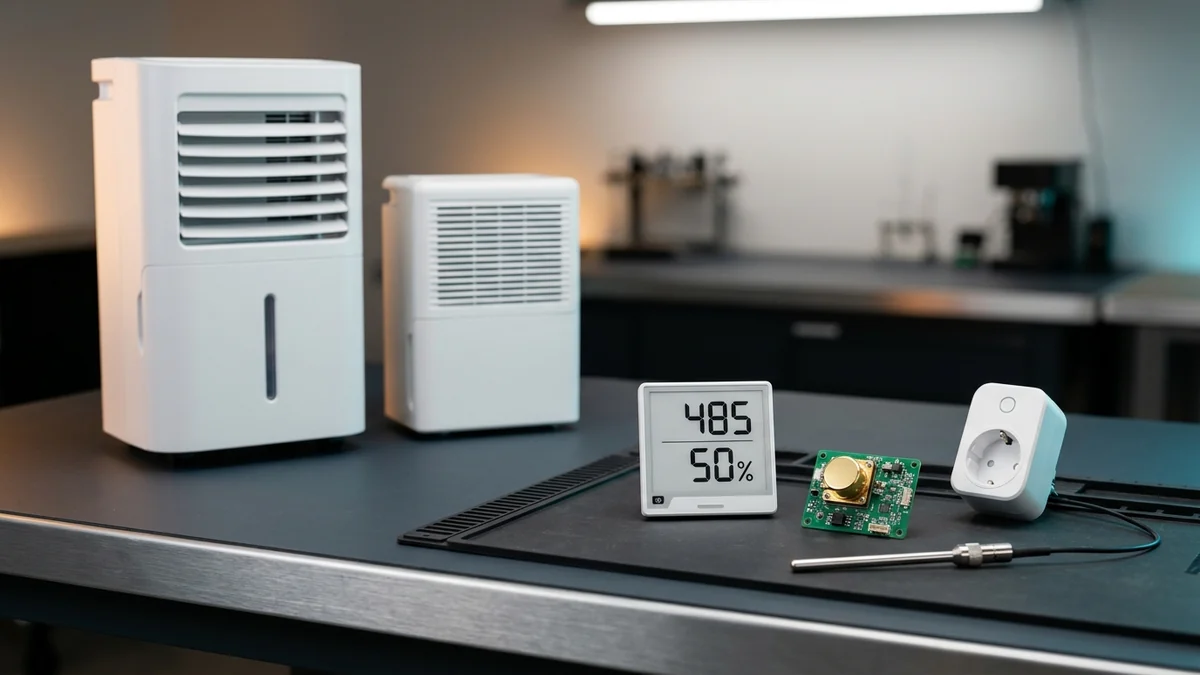
1. Why Damp Air Costs More to Heat & Where 10 Litres of Water Come From Every Day
Many homeowners assume that wet windows and black mould in bedroom corners mean the house has a leaking roof or rising damp. In 9 out of 10 cases, the water comes from normal daily life trapped inside a well-sealed building:
- Breathing and sleeping: Two adults sleeping for 8 hours exhale roughly
0.8 to 1.0 litreof water vapour into the bedroom air overnight. - Cooking and showering: Boiling pasta, making tea, and taking hot showers add another
2 to 3 litresof moisture per day. - Drying one load of washing indoors: A single load of wet laundry taken out of the washing machine holds
2.0 to 2.8 litresof water. If you hang it on a rack in the hallway or living room, all 2.5 litres evaporate straight into the air and condense on the coldest surfaces in the house — window glass, external wall corners behind wardrobes, and cold water pipes.
Just as importantly, damp air feels clammy and makes you turn the thermostat up. Controlling indoor relative humidity into the healthy 45% to 55% RH golden zone stops window condensation overnight, prevents mould spores from germinating, and makes a room at 20°C feel noticeably cosier (especially when paired with an Air-to-Air Heat Pump inverter AC or smart infrared floor heating).
🟢 Compressor Dehumidifier (150W–240W)
- Where it wins: Heated homes, flats, bedrooms, hallways, and indoor laundry rooms (
15°C to 28°C). - How it works: Draws damp air over cold fridge coils so water drops into the tank.
- Power draw: Only
150W to 240W— the cheapest way to dry a warm home and wet laundry.
🔵 Desiccant Dehumidifier (330W–650W)
- Where it wins: Cold garages, workshops, cellars, lofts, boats, and unheated storage (
1°C to 15°C). - How it works: Uses a moisture-absorbing wheel (
zeolite) regenerated by an internal heater. - Bonus effect: Never freezes up in winter, runs quieter (no compressor), and warms the room by
+2°C to +3°C.
🔴 Mini Peltier / Thermo-Electric (20W–40W)
- The Amazon trap: Tiny desk-sized boxes sold as "wardrobe/bedroom dehumidifiers".
- Real extraction: Barely
100 ml to 250 ml per day(a few tablespoons of water) — 50 times weaker than a real 12L/20L unit. - Verdict: Physically incapable of drying a bedroom or laundry load. Avoid completely.
2. The 15°C Rule: Compressor (Meaco Arete) vs Desiccant (Meaco DD8L)
The single biggest mistake buyers make is choosing a dehumidifier by tank size alone without checking the temperature of the room where it will run.
A. Heated Living Spaces Above 15°C → Always Buy a Compressor Unit
A compressor dehumidifier (such as the MeacoDry Arete One / Arete Two 12L, 20L, or 25L, Pro Breeze 20L, or EcoAir DC12/DC18) works like a compact refrigerator. A fan pulls moist room air across a cold metal evaporator coil; water vapour condenses into liquid drops and drips into the bucket.
- Why it wins indoors: At normal room temperatures (
18°C–22°C), a 12L or 20L compressor unit draws only150W to 240Wof electricity. It extracts the maximum amount of water per kilowatt-hour. - Why it fails in a cold garage: Below
15°C(and especially below10°C), the metal cooling coil inside a compressor dehumidifier drops below0°C. Moisture freezes into ice on the coil instead of dripping into the tank. The machine then spends half its time defrosting ice rather than drying the air, and extraction plunges by 70%–80%.
B. Cold Garages, Workshops & Unheated Rooms Below 15°C → Always Buy a Desiccant Unit
A desiccant dehumidifier (such as the Meaco DD8L / DD8L Zambezi or EcoAir DD1 Simple) has no compressor and no gas refrigerant. Instead, air passes through a slowly rotating wheel packed with zeolite — a porous mineral that acts like a molecular sponge and grabs water straight out of freezing air. An internal heater warms a small section of the wheel to release the water into the collection tank.
- Consistent winter extraction (
1°C to 15°C): Whether your garage or workshop is at4°Cor12°C, a desiccant unit extracts a steady7 to 8 litres per daywithout ever icing up. - Protects tools, cars, and server racks: An unheated UK or Polish garage in November easily hits
80%–90% RH, rusting brake discs, hand tools, and corroding PCB solder joints on homelab servers or stored ITAD stock. A desiccant unit with a continuous drain hose keeps the garage locked at a safe50%–55% RHall winter.
🧺 Practical Tip: Drying Laundry Indoors at 1/5th the Cost of a Tumble Dryer
A standard vented or condenser tumble dryer draws 2,000W to 2,500W per cycle and batters clothes with high heat. Instead, place your clothes horse in the smallest room (bathroom, utility room, or spare bedroom), close the door, and turn on a 150W–240W compressor dehumidifier (or a desiccant unit in a cool utility room) on its 6-hour Laundry Timer:
- Total electricity used: Only
0.8 to 1.3 kWhfor the entire dry load — roughly 75% to 85% less electricity than a traditional tumble dryer. - 2-in-1 HEPA Air Purification: Units like the MeacoDry Arete One / Two accept a medical-grade H13 HEPA filter, cleaning dust, pollen, and mould spores out of the air while drying your clothes.
3. Interactive Dehumidifier, Laundry & Air Quality Calculator (#humidity-co2-auditor)
Select your room type, average temperature, and laundry habits to calculate the right dehumidifier technology, percentage energy reduction vs a tumble dryer, and a ready-to-copy smart automation script:
💧 Dehumidifier Technology, Laundry Efficiency & CO2 Telemetry Calculator
100% RAM Client-Side • kWh & % Efficiency16°C–22°C), a 20L Low-Energy Compressor Dehumidifier (MeacoDry Arete One / Two 20L) is the most efficient choice. It draws roughly 205W, dries a full rack of wet clothes for a fraction of a tumble dryer's cost, and automatically sleeps once indoor humidity reaches 55% RH.
alias: "Smart Climate - 55% RH Dehumidifier & True NDIR CO2 Alert"
description: "Runs dehumidifier between 58% and 52% RH (preferring off-peak/solar) and alerts when NDIR CO2 exceeds 1000 ppm"
trigger:
  - platform: numeric_state
    entity_id: sensor.zigbee_room_humidity
    above: 58
    id: "damp_high"
  - platform: numeric_state
    entity_id: sensor.zigbee_room_humidity
    below: 52
    id: "damp_cleared"
  - platform: numeric_state
    entity_id: sensor.ndir_bedroom_co2_ppm
    above: 1000
    for: "00:15:00"
    id: "co2_stuffy"
action:
  - choose:
      - conditions:
          - condition: trigger
            id: "damp_high"
        sequence:
          - service: switch.turn_on
            target:
              entity_id: switch.tuya_16a_dehumidifier_plug
      - conditions:
          - condition: trigger
            id: "damp_cleared"
        sequence:
          - service: switch.turn_off
            target:
              entity_id: switch.tuya_16a_dehumidifier_plug
      - conditions:
          - condition: trigger
            id: "co2_stuffy"
        sequence:
          - service: notify.mobile_app
            data:
              title: "🌬️ High Bedroom CO2 (>1000 ppm NDIR)"
              message: "Open trickle vents or crack window for 5 minutes to clear exhaled CO2."
4. True Optical NDIR CO2 Sensors vs The Fake "eCO2 / TVOC" Sensor Trap
A dehumidifier keeps moisture in check with the windows closed, which brings us to the second invisible factor of indoor comfort: Carbon Dioxide (CO2).
Outdoor fresh air contains roughly 420 ppm (parts per million) of CO2. When you work in a closed home office or sleep in a bedroom with the door and windows shut, your exhaled breath pushes indoor CO2 past 1,200 ppm within two hours and often above 2,200 to 3,000 ppm by morning. Above 1,200 ppm, human cognitive decision-making drops measurably, sleep becomes shallow, and you wake up feeling groggy even after 8 hours in bed.
⚠️ How to Spot a Fake "eCO2" Sensor Before You Buy
Search Amazon for "CO2 monitor" and half the cheap multi-in-one displays do not contain a carbon dioxide sensor at all. Instead, they use a cheap metal-oxide smell sensor (TVOC — Total Volatile Organic Compounds) and run a software formula that guesses an eCO2 (equivalent CO2) number:
- False alarms from smells: Spray deodorant, peel an orange, use isopropyl alcohol on your workbench, or make toast, and a fake
eCO2meter immediately screams3,500 ppm DANGER— even with the window wide open! - Blind to real human breath: Conversely, if two people sit quietly in a sealed room without producing strong odours, a cheap
TVOC / eCO2chip often shows a green450 ppmwhile true carbon dioxide has climbed past2,000 ppm. - The Golden Rule: Only buy monitors that explicitly specify a True Optical NDIR (Non-Dispersive Infrared) sensor module — such as the Sensirion SCD40 / SCD41 or SenseAir S8 (used in the Aranet4 Home, SwitchBot Meter Pro CO2, and Qingping Air Monitor). An
NDIRchamber shines an infrared light beam tuned to the exact wavelength absorbed byCO2molecules (4.26 μm), giving laboratory-grade readings.
🌬️ How to Clear Bedroom CO2 Without Losing Winter Heat: Single-Room Ceramic Wall Recuperators (dMVHR) & HEPA+Carbon Purifiers
Even the best dehumidifier or air purifier only treats the air already inside your room — it cannot turn exhaled carbon dioxide (CO2) back into fresh oxygen. Yet in modern airtight homes with triple-glazed windows and sealed doors, opening a bedroom window at -5°C dumps your expensive heating straight outside. How do you get fresh outdoor oxygen 24/7 while keeping 90% of your heat indoors, without ripping down ceilings to install whole-house ductwork?
- Single-Room Decentralised Heat Recovery Ventilators (Ceramic Wall Recuperators —
Blauberg Vento/Vents TwinFresh): Installed through a single160 mmcore-drilled hole in an exterior bedroom or home-office wall, a push-pull ceramic wall recuperator contains a thick honeycomb ceramic heat accumulator and a whisper-quiet brushless EC fan (drawing just3W–6W). For 70 seconds it gently extracts stale, high-CO2room air, storing your room's warmth inside the ceramic honeycomb; then the fan automatically reverses for 70 seconds, drawing fresh outdoor oxygen through the warm ceramic core so the air entering your bedroom is already pre-warmed (recovering85% to 92%of indoor heat)! - Dedicated
H13 True HEPA + Activated CarbonAir Purifiers for PM2.5, Solder Fumes & 3D Printer VOCs: While a dehumidifier's rear HEPA filter is great in hallways, a bedroom or electronics/3D-printing workspace benefits enormously from a dedicated cylindrical360°purifier (such as the Levoit Core 300S / 400S or Winix Zero) combining a laserPM2.5dust sensor, anH13 True HEPApleat pack, and an activated carbon pellet filter that traps cooking odours, flux smoke, and resin/filament VOCs at a silent24 dBsleep level.
5. Dual-Scale Deployment: From Bedroom & Homelab to ITAD Warehouses
Just like our Tuya & Zigbee 3.0 Smart Automation architecture and Smart Energy LEGO Blueprint, moisture and air quality control scales from a single apartment to an industrial warehouse:
- Home & Bedroom Scale: Place a quiet
12Lor20LMeacoDry Arete in the hallway or utility room set to55% RH, and keep a battery-powered e-ink Aranet4 Home or SwitchBot NDIR CO2 Monitor on your desk and bedside table. - Garage Homelab, NAS & Workshop Scale: In an unheated garage housing a 24/7 Proxmox / TrueNAS server, 3D printer filament, and power tools, run a Meaco DD8L Desiccant Dehumidifier with a continuous drainage tube routed out through the wall. Plug it into a Tuya 13A/16A Energy Monitoring Smart Plug linked to a Zigbee Temperature & Humidity Sensor so you can track daily watt-hours and set hysteresis limits (turn on at
58% RH, turn off at50% RH). - ITAD Warehouse & Pallet Storage Scale: Pallets of refurbished laptops, motherboards, and enterprise SAS drives stored in cool warehouse bays suffer rapid oxidation on gold PCIe/RAM fingers and BGA pads whenever relative humidity exceeds
60% RHduring cold-to-warm weather swings. Combining high-airflow industrial desiccant/refrigerant extraction with multi-zone Zigbee hygrometers prevents dead-on-arrival RMA returns.
6. Engineering Comparison Matrix: Dehumidifiers & True NDIR CO2 Monitors
📊 Dehumidifiers (Compressor vs Desiccant), NDIR CO2 & Smart Humidity Hierarchy
| Model / Device Class | Core Technology | Optimal Temp Range | Power / Sensor Spec | Best Use Case | Check Availability |
|---|---|---|---|---|---|
| MeacoDry Arete One / Two (20L / 25L) | Low-Energy Compressor + H13 HEPA | 15°C – 32°C |
~205W–240W (40 dB) |
3–5 Bed Home, Fast Laundry Drying & HEPA Air Cleaning | View on Amazon ↗ |
| MeacoDry Arete One (10L / 12L) | Compact Compressor + H13 HEPA | 15°C – 32°C |
~150W (Ultra-Quiet 35 dB) |
Flats, 1–2 Bed Apartments, Bedrooms & Home Office | View on Amazon ↗ |
| Meaco DD8L / DD8L Zambezi (8L Desiccant) | Zeolite Desiccant Wheel (No Refrigerant) | 1°C – 15°C |
330W / 650W (+Warm Air Output) |
Cold Garages, Workshops, Unheated Conservatories & Server Racks | View on Amazon ↗ |
| Pro Breeze / EcoAir 20L Compressor | Digital Compressor + Continuous Drain | 15°C – 32°C |
~230W–260W + 24h Timer |
High-Value Utility Room & Whole-House Moisture Removal | View on Amazon ↗ |
| Aranet4 Home / SwitchBot NDIR CO2 Meter | True Optical NDIR Infrared Chamber |
0°C – 50°C |
Sensirion SCD41 / SenseAir E-Ink |
Bedrooms, Home Offices, Meeting Rooms & Ventilation Checks | View on Amazon ↗ |
| Tuya Zigbee Hygrometer + 16A Smart Plug | Zigbee 3.0 Telemetry + Power Relay | -10°C – 50°C |
±0.2°C / ±2% RH + kWh Meter |
Multi-Room Dew Point Tracking & Automated Dehumidifier Control | View on Amazon ↗ |
| Single-Room Ceramic Heat Recovery Unit (dMVHR) | Reversible Honeycomb Ceramic Core + EC Fan | -20°C – 40°C |
3W–7W | Up to 90% Heat Recovery |
Clearing Bedroom/Office CO2 Without Ducts or Losing Winter Heat | View on Amazon ↗ |
| Smart H13 HEPA + Activated Carbon Purifier | 3-Stage Cylindrical H13 HEPA + Carbon + PM2.5 | 5°C – 40°C |
~15W–38W (24 dB Sleep Mode) |
Removing PM2.5 Smog, Allergens, Solder Smoke & 3D Printer VOCs | View on Amazon ↗ |
7. Detailed Hardware Breakdown & Recommended Configurations
MeacoDry Arete One / Arete Two (12L / 20L / 25L Dual Dehumidifier & H13 HEPA Purifier)
Designed in the UK specifically for damp British and European housing stock, the MeacoDry Arete series solves the three biggest annoyances of older dehumidifiers: it can be pushed flat against a wall (air enters through side intakes), includes a dedicated one-button Smart Laundry Mode (runs for 6 hours and shuts off automatically to save power), and houses a huge medical-grade H13 HEPA filter. Choose the 10L/12L model for flats and 1–2 bedroom homes, or the 20L/25L model for 3–5 bedroom family houses and heavy laundry drying.
Meaco DD8L / DD8L Zambezi & EcoAir DD1 (8L Zeolite Desiccant Dehumidifier)
If you store tools, classic bikes, 3D printer spools, or a TrueNAS / Proxmox server rack in an unheated garage, loft, cellar, or conservatory, a compressor dehumidifier will ice up in winter. The Meaco DD8L and EcoAir DD1 use a thermal zeolite wheel that pulls out the same 8 litres of water at 5°C as it does at 20°C, gently warms the outgoing air by +2°C to +3°C, includes a continuous drain hose in the box, and automatically resumes its settings after a power cut (making it compatible with smart plugs).
Aranet4 Home, SwitchBot Meter Pro CO2 & Sensirion SCD41 NDIR Monitors
Stop guessing why you wake up tired or lose focus in your afternoon home-office session. Both the Aranet4 Home (multi-year AA battery life with e-ink screen) and the SwitchBot Meter Pro CO2 use genuine Non-Dispersive Infrared (NDIR) optical chambers rather than cheap smell sensors. You see the exact moment bedroom or office carbon dioxide crosses 1,000 ppm so you know when to crack a trickle vent for 5 minutes without throwing away all your house heat.
Tuya Zigbee LCD Thermo-Hygrometers (3-Pack) + 13A/16A Energy Monitoring Smart Plugs
A dehumidifier's internal humidity sensor only measures the air right next to its own exhaust grille. By placing compact Zigbee Temperature & Humidity Sensors in the coldest corners of your bedroom, bathroom, behind wardrobes, and inside your server cabinet, you see where moisture actually builds up and can trigger your dehumidifier or bathroom extractor fan automatically during cheap off-peak electricity hours or hybrid solar surplus windows.
Single-Room Decentralised Ceramic Heat Recovery Ventilator (Blauberg Vento / Vents TwinFresh Class)
If your true optical NDIR monitor shows bedroom carbon dioxide climbing past 1,800 ppm every night with the door closed, a Single-Room Decentralised Ceramic Heat Recovery Ventilator (dMVHR) is the cleanest retrofit available for finished homes and cabins. Requiring just one core hole through the outside wall and zero ceiling ducts, its reversible EC fan alternates 70-second extract and supply cycles through a high-mass ceramic honeycomb—expelling stale CO2 and excess moisture while keeping up to 90% of your indoor heat inside the room.
Smart H13 True HEPA + Activated Carbon Air Purifier with Laser PM2.5 Sensor (Levoit Core / Winix Class)
Pairing your dehumidifier and NDIR CO2 monitor with a dedicated 3-stage H13 True HEPA + Activated Carbon air purifier completes the indoor air stack. In bedrooms it captures 99.97% of winter chimney smoke particles (PM2.5), pollen, and dust mites at a barely audible 24 dB; in a home lab or workshop, its laser particulate sensor automatically ramps up fan speed the moment you tin a soldering iron or start a 3D print job.
🛒 Complete SpecInfo Damp-Proof & Clean Air Hardware Kit (Amazon OneLink)
Jump directly to verified Compressor & Desiccant dehumidifiers, replacement HEPA filters, true optical NDIR CO2 monitors, and multi-room smart hygrometers:
8. Frequently Asked Questions (FAQ)
Should I buy a 12L or 20L compressor dehumidifier?
For a 1–2 bedroom flat or small apartment without heavy daily laundry, a 10L or 12L compressor unit (~150W) is quiet and sufficient. For a 3–5 bedroom house, or if you regularly dry family laundry indoors on a clothes airer, step up to a 20L or 25L model (~205W–240W). A 20L unit extracts moisture almost twice as fast while running for fewer hours per day, so total electricity consumption per litre of water removed is actually lower.
Can I use a smart plug to switch any dehumidifier on and off?
Check whether the dehumidifier has Auto-Restart (Memory Function) after a power cut. Models with mechanical dials or Auto-Restart memory (including the MeacoDry Arete and Meaco DD8L series) resume running as soon as a smart plug switches power back on. However, if a unit has a modern smart humidistat (like Meaco's built-in 55% RH target mode), it is even better to leave the smart plug switched ON permanently as an energy meter (Watts / kWh) and let the dehumidifier's internal logic manage compressor cycles safely.